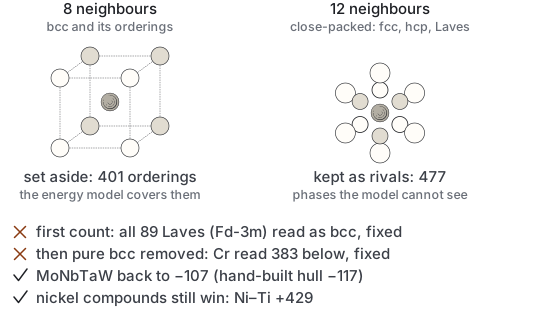
Can counting each atom's neighbours separate bcc-like structures from close-packed ones?
Yes. Bcc-like structures count 8 neighbours and close-packed ones 12; 401 bcc orderings were set aside once two faults in the filter were fixed.
In the log: Separating bcc-derived from close-packed by counting neighbours
confirmedDate not stated in the log; it was written between the commit of 2026-09-13 08:16 and the first commit that contains it, 2026-09-16 02:04rung 3 · kinetics0 predictions · 1 result paragraphEXPERIMENTS.md lines 4799–4869, lines 5578–5631
What E86 did and how it came out, drawn from this record and the files it names (book/assets/diagrams/exp/E86.svg).
Pre-registration
The pre-registration, as written
E86 removed bcc superstructures from the off-lattice hull, reasoning that the expansion
already describes them and the ordering temperature measures them. That is true of the
ladder as a whole and false of rung 0, which is the rung the generator learns from. Rung
0 evaluates the random configuration and compares it against elements and off-lattice
intermetallics only. With the on-lattice ground states removed, the margin it rewards is, to
leading order, the magnitude of the random alloy's mixing enthalpy - and a large negative
mixing enthalpy is strong unlike-pair affinity, which is precisely the driving force for
ordering.
So the screen has been paying the generator for the ordering hazard, which is the phase
change the requirement forbids. This is E56 a third time: a hull missing the phase that wins,
and a generator that finds it.
Verified two ways.
The candidates the generator chose already had their ordering temperatures measured in E82,
and three of four order inside the service window:
candidate
T_od
Mo0.62 Ta0.38
991 +/- 106
inside 90-1000 K
Mo0.50 Ta0.33 W0.15
914 +/- 104
inside
Ta0.39 Mo0.34 W0.18 Nb0.08
844 +/- 138
inside
Ta0.53 Mo0.47
1277 +/- 45
above
And putting the 401 excluded orderings back moves the hull by exactly the amount that
explains the margin:
composition
hull shift
loses to
Ta0.53 Mo0.47
-184 meV/atom
MoTa (B2)
Mo0.62 Ta0.38
-168
Mo2Ta, MoTa
MoNbTaW
-122
MoNb2, TaW2
Nb0.5 Ta0.5
-6
-
Mo0.62Ta0.38's whole margin was -144 meV/atom against a shift of -168: corrected, it is
positive. Nb-Ta, a near-ideal solid solution with no ordering tendency, shifts by six and
keeps its margin. That is the discriminator the screen should have had and did not.
Withdrawn: every composition ranking produced against the E86 hull, which includes the
E88 and E91 campaigns and the "Mo-Ta is the best composition in the space" claim that has
stood since E67. The compositions were found honestly; the score they were ranked on was
measuring ordering tendency wearing the name of stability.
Not withdrawn: the off-lattice hull work itself. Excluding bcc orderings is right for the
question "what non-bcc phase beats this", which is what E56 was about and what rung 2 asks.
The error is that rung 0 needs both questions and was only given one.
What E74 already said and I did not hear. It recorded that the four candidates were
"better than the reference on the hull, worse on ordering", that three were near coin tosses
at equilibrium, and that the service probability rested entirely on the kinetic discount. I
read that as a kinetics problem and went to build a cheap activation energy. It was evidence
that the screen was selecting for ordering, and the whole line of work since - E90 through
E95, the melting-point proxy, the survey, the memory fight - was treating a symptom.
Results
EXPERIMENTS.md · line 4833
Outcome. The filter works, after two faults of my own found by cross-checking rather than
by the result looking wrong.
The full record
This entry is written in 2 separate places in the log, shown here in log order.
EXPERIMENTS.md · lines 4799–4869
E86 — Separating bcc-derived from close-packed by counting neighbours
E85 left the twelve-element hull untrustworthy. The off-lattice hull may hold only phases the
expansion cannot represent, and the symmetry test used there - exact Im-3m with a one-atom
primitive cell - removed 241 structures but missed the tetragonally distorted bcc
superstructures, of which 58 refractory binaries survived as I4/mmm and kept MoNbTaW at +6
meV/atom instead of -57.
Coordination number is the discriminator that does not care about distortion. From the
ideal geometries: bcc has eight nearest neighbours and its second shell at 1.1547 times the
first; face-centred and hexagonal close packing have twelve, with nothing until 1.414. So a
cutoff between those two ratios separates them, and a tetragonal strain of a few per cent
moves the shells without merging them.
Calibrated before it is used. The 136 prototypes on file are of known type - 8 bcc, 8
hcp, 8 omega, 56 C15, 56 C14 - so the test is run on them first. If it cannot label
structures whose answers are already known, it has no business labelling the other 936.
Predicted:
The prototypes separate cleanly: bcc near 8, hcp near 12, the Laves phases near 12 to
16, with no overlap between the bcc group and the rest.
More than 241 of the 936 are bcc-derived - the symmetry test was strictly a subset of
what this should catch, and the 58 I4/mmm refractory binaries are the visible remainder.
MoNbTaW returns to within 10 meV/atom of -57, the value the prototype hull gives,
because the refractory phases that were beating it are bcc orderings the expansion already
accounts for.
The nickel result of E84 survives: Ni-Ti, Ni-Nb, Ni-Ta and Ni-V compositions stay
beaten by off-lattice compounds, which are close-packed and so are kept.
A failure of 3 means something is wrong beyond the filter and the twelve-element hull has
a second fault; a failure of 4 would mean the filter is now too aggressive and is discarding
the real intermetallics along with the orderings.
Outcome. The filter works, after two faults of my own found by cross-checking rather than
by the result looking wrong.
#
predicted
measured
1
prototypes separate cleanly
bcc/B2/strained-bcc 8, fcc/hcp 12
holds, on the second attempt
2
more than 241 bcc-derived
401
holds
3
MoNbTaW back near the prototype value
-107 against -117
holds
4
the nickel result survives
Ni-Ti +429, Ni-Nb +276, Cu-Zr +330
holds
Fault one: the first coordination measure destroyed the Laves phases. Counting
neighbours inside 1.10 times each atom's own nearest bond works only where bond lengths are
uniform. In a C15 Laves an atom's closest neighbours are its own sublattice, so the count
came back at six of twelve and all 89 Fd-3m structures were labelled bcc - the exact
phases the hull was built for (E56). Normalising by the cube root of volume per atom instead
fixes it: the scale is set by the structure, so a spread of bond lengths cannot shrink the
count. Measured afterwards, Im-3m reads 8.0 across the board, Fd-3m and P6_3/mmc read 12.0.
It was caught by cross-checking coordination against the spacegroup already on file, not by
the answer looking wrong. The histogram also carried the tell: counts of 2, 3 and 4, which no
metal has.
Fault two: the filter removed elemental bcc. Chromium then screened 383 meV/atom below
a hull that no longer contained bcc chromium. An elemental bcc structure is not an ordering,
it is the element's own ground state and the endpoint the expansion is referenced to, so the
rule applies only where more than one element is present. Caught by the pure-element test,
which is the one check that has now found three separate faults.
The twelve-element hull stands at 613 phases - 136 prototypes plus 477 database
structures, with 401 bcc orderings excluded because the expansion already describes them and
T_od measures whether they form.
One correction to the prediction itself. Prediction 3 was written as "returns to within
10 meV/atom of -57". -57 is the MACE-relaxed driving force the ladder reports, not the screen
value, which is -114 to -117; the two are different quantities and I compared the screen
against the ladder's number. The prediction holds on the quantity it should have named -
-107 against -117 - but it was stated against the wrong one.
EXPERIMENTS.md · lines 5578–5631
E86 removed bcc superstructures from the off-lattice hull, reasoning that the expansion
already describes them and the ordering temperature measures them. That is true of the
ladder as a whole and false of rung 0, which is the rung the generator learns from. Rung
0 evaluates the random configuration and compares it against elements and off-lattice
intermetallics only. With the on-lattice ground states removed, the margin it rewards is, to
leading order, the magnitude of the random alloy's mixing enthalpy - and a large negative
mixing enthalpy is strong unlike-pair affinity, which is precisely the driving force for
ordering.
So the screen has been paying the generator for the ordering hazard, which is the phase
change the requirement forbids. This is E56 a third time: a hull missing the phase that wins,
and a generator that finds it.
Verified two ways.
The candidates the generator chose already had their ordering temperatures measured in E82,
and three of four order inside the service window:
candidate
T_od
Mo0.62 Ta0.38
991 +/- 106
inside 90-1000 K
Mo0.50 Ta0.33 W0.15
914 +/- 104
inside
Ta0.39 Mo0.34 W0.18 Nb0.08
844 +/- 138
inside
Ta0.53 Mo0.47
1277 +/- 45
above
And putting the 401 excluded orderings back moves the hull by exactly the amount that
explains the margin:
composition
hull shift
loses to
Ta0.53 Mo0.47
-184 meV/atom
MoTa (B2)
Mo0.62 Ta0.38
-168
Mo2Ta, MoTa
MoNbTaW
-122
MoNb2, TaW2
Nb0.5 Ta0.5
-6
-
Mo0.62Ta0.38's whole margin was -144 meV/atom against a shift of -168: corrected, it is
positive. Nb-Ta, a near-ideal solid solution with no ordering tendency, shifts by six and
keeps its margin. That is the discriminator the screen should have had and did not.
Withdrawn: every composition ranking produced against the E86 hull, which includes the
E88 and E91 campaigns and the "Mo-Ta is the best composition in the space" claim that has
stood since E67. The compositions were found honestly; the score they were ranked on was
measuring ordering tendency wearing the name of stability.
Not withdrawn: the off-lattice hull work itself. Excluding bcc orderings is right for the
question "what non-bcc phase beats this", which is what E56 was about and what rung 2 asks.
The error is that rung 0 needs both questions and was only given one.
What E74 already said and I did not hear. It recorded that the four candidates were
"better than the reference on the hull, worse on ordering", that three were near coin tosses
at equilibrium, and that the service probability rested entirely on the kinetic discount. I
read that as a kinetics problem and went to build a cheap activation energy. It was evidence
that the screen was selecting for ordering, and the whole line of work since - E90 through
E95, the melting-point proxy, the survey, the memory fight - was treating a symptom.