No result paragraph for this entry was found in the log.
EXPERIMENTS.md · lines 2935–2998E56 — The survey inverts: every composition it rated highest is unstable off the lattice, and the one it rejected is not
E54 showed the expansion cannot represent the phase that beats it at HfV2 and ZrV2. E56
asks the question properly, for every composition the survey qualified, against a hull of
136 relaxed competitors - the eight elements as bcc, hcp and omega, and every binary pair
as a C15 and C14 Laves at both stoichiometries, all MACE-MPA-0.
The hull is checkable and it checks out. All seven Laves phases the literature reports as
stable in this system come out below the elements (HfMo2 -240, HfW2 -239, ZrW2 -182,
ZrMo2 -167, TaV2 -127, HfV2 -50, ZrV2 -4 meV/atom), and the inverted stoichiometries -
V1Zr2 where the real phase is Zr1V2 - come out strongly positive at +573 and +562. The
eight elemental bcc energies agree with references_equilibrium.npz, computed
independently, to 0.39 meV/atom.
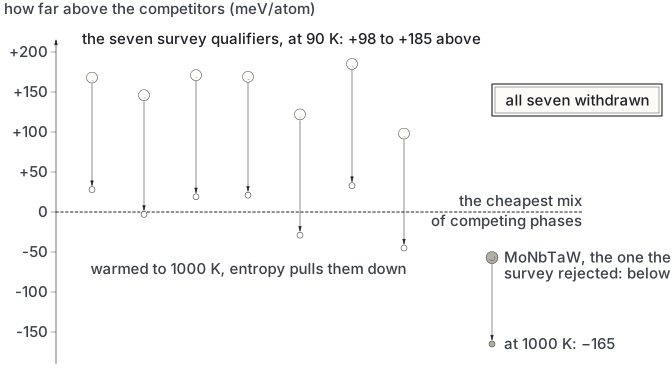
d below is how far the bcc solid solution sits above the cheapest mixture of
competitors. The solid solution is given its ideal configurational entropy; the competitors
are given none, so a decomposition into two solid solutions is scored worse than it really
is and d is a lower bound. T* is where it crosses zero.
Every one of the seven is above the hull at the cold end of the service window by 98 to 185
meV/atom, and every crossing temperature falls inside the window or just above it. Not one
of them is a solid solution at 90 K. All seven are withdrawn.
MoNbTaW, which the survey rejected, is below the hull across the whole window, and the only
mixture that competes with it is the pure bcc elements - in the entire 136-phase set there
is no off-lattice structure that beats it anywhere. The same holds for every composition
later found in that corner: each winning mixture is pure bcc elements and nothing else,
which is what the binary phase diagrams say, since Mo-Nb, Mo-Ta, Mo-W, Nb-Ta, Nb-W and
Ta-W are all continuous bcc solid solutions with no intermetallic between them.
So the hull is not missing a competitor there - there is not one to miss, and its work was
done elsewhere. Where the expansion was lying, in the V/Hf/Zr corner, it changed the answer
by 120 meV/atom; where the expansion was sound it reduces to the ordinary mixing energy and
agrees. That is what a rung is supposed to do. The ordering the expansion does see in
it, at 631 +/- 22 K (E53), is on its own lattice and is the one thing the expansion is
entitled to say.
Why the entropy term had to be there. At 1000 K four of the seven read as marginally
stable, by -3 to -45 meV/atom. Comparing zero-temperature energies would have called them
all unstable by about 180 meV/atom and been right for the wrong reason. The requirement
spans 90 to 1000 K, and it is the cold end that decides: an eight-component solid solution
earns roughly 180 meV/atom of mixing entropy at 1000 K and 16 meV/atom at 90 K.
A correlation is not claimed. Across the seven, the expansion's transition temperature
and the hull's driving force have r = +0.31, which on seven points is nothing. The result
here is categorical, not correlational: seven of seven fail, the control passes.
What this costs the generator. The reward the generator was to be trained on is
P(the transition sits outside the window), computed from the expansion. On this evidence
that reward is highest exactly where the expansion is answering a question about a
structure that does not form. A generator maximising it would learn to find Laves formers,
and would be doing its job perfectly. The lattice check is therefore not a filter to apply
afterwards - it belongs in the verdict, or the verifier rewards its own blind spot.