EXPERIMENTS.md · lines 4893–4957E88 — The fly on twelve elements: prediction
Everything the ladder needs for Cr, Co, Cu and Ni is now in place: a twelve-element expansion
at 9.09 meV/atom cross-validation with all twelve corners pinned (E85), and a 613-phase hull
whose competitors come from the databases with bcc orderings excluded (E86). This is the
first run of the generator over the widened space.
Predicted: the fly stays in the refractory corner. Two things push against the new
elements and both are measured, not assumed. They pay 505 to 1100 meV/atom simply to sit at
the shared lattice - cobalt more than twice what vanadium pays, which was the worst of the
original eight. And their binaries form the deep ordered compounds the hull now contains, so
a nickel- or cobalt-rich solid solution is beaten before the entropy term is counted.
- At least nine of the top ten compositions are drawn wholly from the refractory eight.
- The best conservative score lands between -80 and -120 meV/atom, near the -117 the
eight-element space gave, because the answer there is unchanged and the widening only adds
places to lose.
- Where Cr, Co, Cu or Ni appear at all in the top ten, they sit below 10 atomic per cent.
Falsified by the fly finding a stable composition rich in the new elements - and that
would be the interesting outcome, not the embarrassing one, provided it survives the ladder.
It is the outcome the operator's question was aimed at, so it gets checked rather than
explained away.
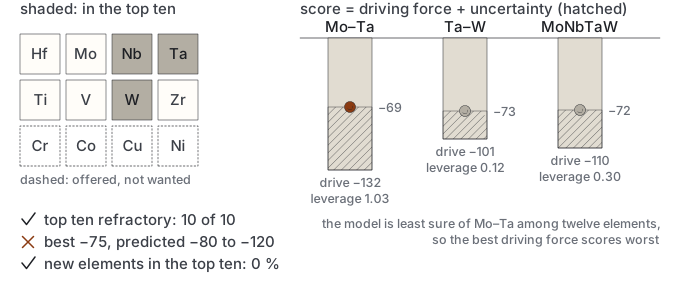
Outcome. The fly stays refractory, as predicted, and the reason it picks a different
refractory alloy than before is worth more than the prediction was.
Six seeds, 800 proposals each, 75 distinct compositions in 7 minutes. The top ten are
Ta-W and Ta-W-Nb without exception. Ten of the 75 contain more than 3 per cent of the new
elements at all, and the best of those - Cr0.64 Ni0.36 at -38 conservative - is nowhere near
the leaders. Chromium, cobalt, copper and nickel were available to the generator and it
did not want them, which is the answer the widening was run to get.
But the refractory alloy it picked is not the one the eight-element space picked, and
that is a finding about the objective rather than about the metals:
Mo-Ta has the best driving force of the three and the worst conservative score, because its
leverage against the twelve-element training set is 1.03 where Ta-W's is 0.12. Widening the
element set made the expansion less certain about the refractory binaries: the same 2961
structures now spread over a far larger space, so the Mo-Ta corner is relatively less
sampled than it was among eight elements, where the same composition sat at leverage 0.21.
The conservative objective is then doing exactly what E72 built it to do - preferring what
the model knows - and the cost is now visible. It biases the search towards well-sampled
regions, which is safe and is also conservative in the ordinary sense. The repair is not to
weaken the objective but to sample the training set where the search actually goes, which is
the same argument that produced the relaxation survey of E70.
A display fault of mine, found while reading the results. generate_campaign.py printed
compositions over range(8), so once the space was widened Ti, V, W and Zr were never shown:
the leading candidate printed as Ta0.43 when it is W0.57 Ta0.43, and every composition
appeared to sum to about half. The scores were never affected - only what was shown - but the
first reading of this run was wrong because of it.