No result paragraph for this entry was found in the log.
EXPERIMENTS.md · lines 4649–4695E84 — The competitor set comes from the databases, and it catches what guessing missed
The system is widened to twelve elements - the eight refractory metals plus Cr, Co, Cu and
Ni - and the off-lattice hull is rebuilt from what the materials databases actually hold
rather than from prototypes chosen by hand.
936 structures across all 78 elements and binary pairs, fetched over OPTIMADE from
Materials Cloud MC3D (434, built from ICSD, MPDS and COD, so a record of what has been
observed), Alexandria (392) and JARVIS (110). OQMD errored and Materials Project timed out;
neither was needed for coverage. Every structure relaxed with the same potential and the same
settings as the existing hull - cell and ions, fmax 0.02 - 936 of 936 converged, in 3.4
minutes. Combined with the 136 hand-built prototypes, which are kept rather than discarded:
1072 phases.
Every element now has a ground state on the hull, which was not true before: there was
no fcc phase in it at all. Nickel comes back at -5.7867 eV/atom, matching the independent
measurement in E83 to four decimals.
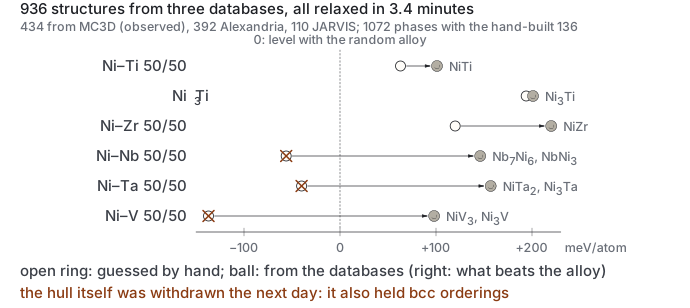
The test is E81, whose sixteen hand-built structures were ten parts fiction.
The three systems where guessing failed are the three the databases fix, and they are
fixed by precisely the phases named in the E81 withdrawal as the real ground states and then
not computed: the mu phase Nb7Ni6, Ni3Ta, Ni3V. A negative entry in that table meant the
structure was fiction; every one is now positive and correctly beaten.
All six sit above the 40 meV/atom a candidate needs to qualify, so a nickel search against
the previous hull would have produced winners that are line compounds. It no longer can.
The general lesson, which outlives nickel. The 136 prototypes were a reasonable choice
for eight metals that mostly make Laves phases, and they encode an assumption about what
competes. That assumption does not travel: Cr, Co, Cu and Ni make L1_2, D0_24, B2, sigma and
mu. A hull assembled by hand is a hull that can only find what its author already thought of,
which is the same failure as E56 wearing different clothes. Taking the competitor set from
the databases removes the author from the loop.
What is not done. The expansion covers nine elements (E83), not twelve, so the fly cannot
yet propose Cr, Co or Cu compositions; and the ladder's rungs still load the eight-element
hull by default. Both are wiring, not physics.