EXPERIMENTS.md · lines 5113–5194E91 — Carrying kinetics into the screen: calibrating a four-millisecond activation energy
E90 established that the screen the generator learns from asks about thermodynamic stability
at 90 K, where a five-element alloy's mixing entropy is worth about 16 meV/atom, and that
this is why every element added makes the score worse. The requirement is not that, it is
that nothing happens anywhere between 90 and 1000 K, and what makes a high-entropy alloy an
engineering material is that decomposition is unreachable rather than unfavoured.
The ladder already answers this - it is what rescues MoNbTaW in E74 - but the kinetics cost
twenty minutes, from a MACE vacancy formation energy and a climbing-image barrier, and the
screen has four milliseconds. So the screen needs an activation energy it can afford.
The candidate is the oldest rule in diffusion: Q is proportional to the melting point.
For body-centred cubic metals Q/(k_B T_m) sits near 17, and the rule-of-mixtures melting
point is already computed as a descriptor in microseconds.
This is calibrated before it is used, against the four activation energies the ladder
measured properly: Mo0.62Ta0.38 4.93 eV, Ta0.39Mo0.34W0.18Nb0.08 5.20, Mo0.50Ta0.33W0.15
5.03, Ta0.53Mo0.47 4.60.
Predicted: the rule reproduces those four within 0.5 eV, which is the spread the ladder
itself quotes on Q and is small against the 4.6 to 5.2 eV range. If it does, the screen can
carry a kinetic term; if it does not, the term has to come from somewhere else, because a Q
wrong by an electron volt is a diffusion distance wrong by orders of magnitude at 1000 K.
Falsified if the four disagree by more than 0.5 eV, or if the ordering of the four is
wrong - a rule that gets the absolute scale right and the ranking backwards is worse than
none, because ranking is what the generator uses.
Outcome. The rule ranks correctly and the screen, given the requirement as written,
explores.
The melting-point rule reproduced the four measured activation energies to 0.53 eV at the
textbook constant - marginally outside the 0.5 predicted, and one-signed, always under - and
to 0.31 eV at a fitted 18.4. It ranked all four correctly, which was the stated criterion.
Four points is thin and the constant is the weakest number in the method; it is recorded as
such in the code.
The screen now asks the requirement rather than a proxy for it. Across twelve
temperatures spanning the window, the driving force is taken where atoms can actually travel
the couple of nanometres a nucleus needs. A probability saturates - five of eight test alloys
returned exactly 1.000 - so the headline stays in meV/atom: the worst driving force among
reachable temperatures, or, if nothing is reachable anywhere, the hot driving force credited
200 meV/atom for being frozen.
The monotonic penalty on element count is gone, and it was not removed by hand. MoNbTaW,
the one alloy in this system with an experiment behind it, now ranks first - ahead of every
binary - because it is the alloy whose vacancies do not move. Two real Senkov alloys that the
90 K screen called unstable are now placed correctly. NbTiVZr and the twelve-element
equiatomic remain the only compositions where decomposition is reachable, and they stay
rejected.
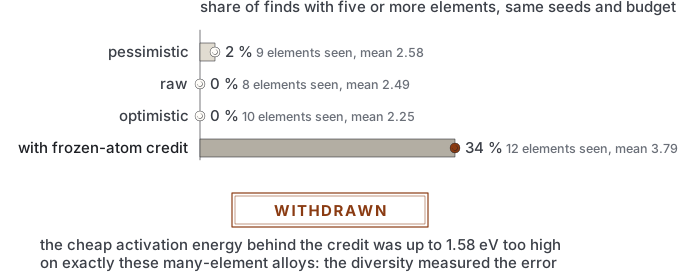
And the generator explores. Identical seeds, identical budget, four objectives:
All twelve elements now appear, against nine; the mean composition holds four elements rather
than two and a half; a third of what it finds is a five-element alloy or larger, against two
per cent. It also found more compositions, not fewer, so nothing was traded for the
diversity.
The earlier diagnosis in E90 was right and the earlier fix was wrong. Changing what the
generator was paid - optimistic instead of pessimistic - did nothing, because the problem was
never the uncertainty term. It was that the screen asked about 90 K thermodynamics while the
requirement is about a window and about whether anything can happen inside it. Given the
question it was actually meant to answer, the search explores without being told to.