Is the coarse sampling grid used in the DFT calculations accurate enough?
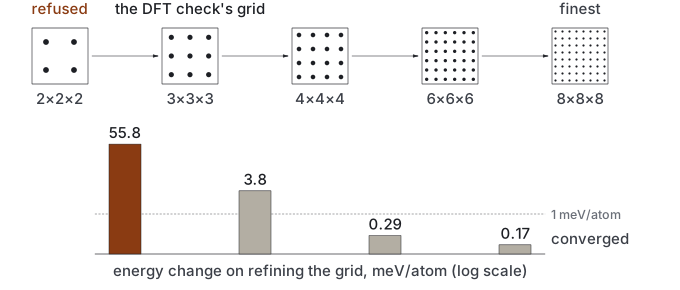
Yes. The series converges (6×6×6 and 8×8×8 agree to 0.17 meV/atom), and the 3×3×3 grid in use costs about 3.8 meV/atom.
In the log: The k-point series completes: 6x6x6 is converged, 3x3x3 costs 3.8 meV/atom
recordedDate not stated in the log; it was written between the commit of 2026-09-13 08:16 and the first commit that contains it, 2026-09-16 02:04rung 4 · DFT0 predictions · 1 result paragraphEXPERIMENTS.md lines 4871–4891
What E87 did and how it came out, drawn from this record and the files it names (book/assets/diagrams/exp/E87.svg).
Results
EXPERIMENTS.md · line 4871
E87 — The k-point series completes: 6x6x6 is converged, 3x3x3 costs 3.8 meV/atom
The convergence run begun two days ago finished. Total energies for the 16-atom cell, in Ry,
and the step to the next grid in meV/atom:
grid
total energy (Ry)
step to next
2x2x2
-6745.84324883
55.8
3x3x3
-6745.77767999
3.8
4x4x4
-6745.78214958
0.29
6x6x6
-6745.78248796
0.17
8x8x8
-6745.78229045
-
6x6x6 and 8x8x8 agree to 0.17 meV/atom, so the series is converged and the figure quoted
in E75 and E78 stands: the 3x3x3 grid the DFT rung uses carries about 4 meV/atom, against
the 1 and 4 meV/atom agreement it was measuring. 2x2x2 is unusable at 56 and the rung refuses
it.
It took 38 hours because it ran on one MPI rank, the defect found in E76 and fixed
afterwards; at six ranks the alloy runs took 16 to 23 iterations in minutes. The number is
sound - the setting was only ever the launcher - but the cost was avoidable.
The full record
EXPERIMENTS.md · lines 4871–4891
E87 — The k-point series completes: 6x6x6 is converged, 3x3x3 costs 3.8 meV/atom
The convergence run begun two days ago finished. Total energies for the 16-atom cell, in Ry,
and the step to the next grid in meV/atom:
grid
total energy (Ry)
step to next
2x2x2
-6745.84324883
55.8
3x3x3
-6745.77767999
3.8
4x4x4
-6745.78214958
0.29
6x6x6
-6745.78248796
0.17
8x8x8
-6745.78229045
-
6x6x6 and 8x8x8 agree to 0.17 meV/atom, so the series is converged and the figure quoted
in E75 and E78 stands: the 3x3x3 grid the DFT rung uses carries about 4 meV/atom, against
the 1 and 4 meV/atom agreement it was measuring. 2x2x2 is unusable at 56 and the rung refuses
it.
It took 38 hours because it ran on one MPI rank, the defect found in E76 and fixed
afterwards; at six ranks the alloy runs took 16 to 23 iterations in minutes. The number is
sound - the setting was only ever the launcher - but the cost was avoidable.
Related entries
E75 — DFT rung: prediction recorded before the first result
E78 — First principles agrees with the potential about the ranking, to 1 and 4 meV/atom
E76 — A factor of sixteen that would have read as a physics result