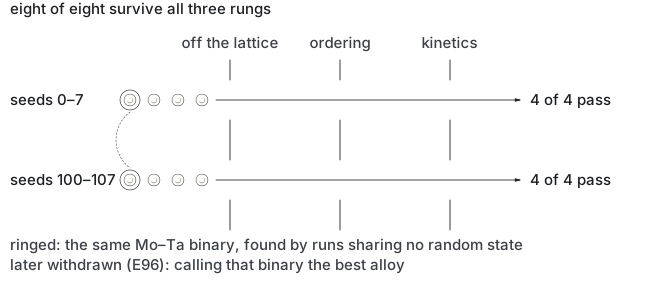
Do proposals from a second, independent generator run also pass every check?
Partly. All eight passed and a Mo–Ta binary was found twice, but ranking it the best alloy was later withdrawn.
In the log: Eight of eight, from two independent seed sets, and the best is a binary found twice
supersededDate not stated in the log; it was written between the commit of 2026-09-13 08:16 and the first commit that contains it, 2026-09-16 02:04unclassified0 predictions · 0 result paragraphsEXPERIMENTS.md lines 3642–3686
What E67 did and how it came out, drawn from this record and the files it names (book/assets/diagrams/exp/E67.svg).
Results
No result paragraph for this entry was found in the log.
The full record
EXPERIMENTS.md · lines 3642–3686
E67 — Eight of eight, from two independent seed sets, and the best is a binary found twice
E62 verified four compositions the fly proposed, all from seeds 0 to 7. Whether that was the
generator or that particular run's luck was untested. Four more were taken up the full
ladder from seeds 100 to 107, which share nothing with the first set.
Predicted before running: they would be Mo/Nb/Ta/W-rich, or the convergence is not
reproducible; and MACE would come in 14 to 42 meV/atom more stable than the screen, the
bias measured across nine earlier compositions.
composition
seed
screen
MACE
T_od (K)
Q (eV)
P(pass)
Mo.51 Ta.49
101
-67
-110
1333
4.74
0.998
Ta.46 Mo.37 Nb.18
104
-70
-107
865
4.12
0.928
Ta.49 Mo.20 Nb.16 W.15
102
-65
-89
453
4.56
0.996
Mo.38 Nb.31 Ta.30
107
-67
-83
841
3.90
0.881
Mo.25 Nb.25 Ta.25 W.25
-
-51
-57
662
5.07
0.995
All four are 100 per cent Mo, Nb, Ta and W - the same corner the first set occupies, and
the corner E59 found holds 0.41 per cent of the simplex. Prediction one holds outright.
Prediction two nearly holds. The gaps were 37, 16, 24 and 43 meV/atom; three inside the
band and one a meV outside it. Useful as a rule of thumb, not clean.
The binary was found twice, independently. Seed 1 produced Ta.53 Mo.47 and seed 101
produced Mo.51 Ta.49 - the same two-element alloy, from runs sharing no random state. Both
pass the same way, with an ordering transition above the service window rather than inside
it, which means they enter service already ordered and never change. That satisfies the
requirement as written and makes them B2 intermetallics rather than solid solutions, with
whatever that implies for ductility. The ambiguity is the operator's to resolve.
One candidate passes by the other mechanism entirely. Ta.49 Mo.20 Nb.16 W.15 orders at
453 K, the lowest of any composition examined, which puts its transition deep in the
range where nothing moves. It is a genuine solid solution held by kinetics, not an
intermetallic held by being already ordered - and it is the only one of the eight that is.
Eight of eight pass. Every composition the generator has proposed and had checked
survives all three rungs, and the two best are roughly twice as stable against
decomposition as the alloy the literature cites.
What this does not establish. Every number is MACE and the cluster expansion; no DFT has
touched any of it, because none is installable on this machine. The ordering temperatures
carry the Monte Carlo scatter only. And the fly matching a hill-climber on search efficiency
(E61, p = 0.138) is unchanged by any of this - what is established here is that what it
proposes survives checking, not that it proposes it faster.
Related entries
E62 — The candidates through all three rungs: tungsten is what freezes the alloy
E59 — The question that decides costs four milliseconds, and twenty thousand compositions say…
E61 — The circuit does learn; the Kenyon-cell code had been starved to three cells