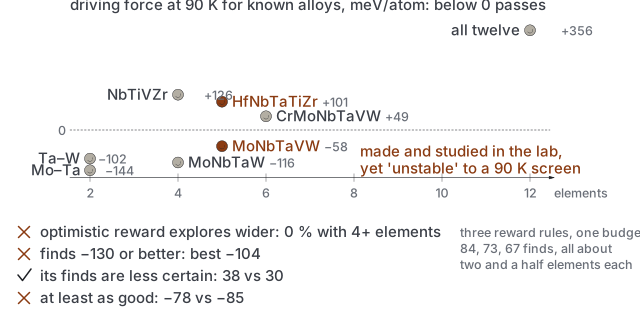
Would rewarding exploration make the generator propose alloys with more elements?
No. The optimistic reward saw one more element but found fewer alloys and none with four or more; the screen itself favours simple binaries.
In the log: The reward was pessimistic, so the search stopped exploring
falsifiedDate not stated in the log; it was written between the commit of 2026-09-13 08:16 and the first commit that contains it, 2026-09-16 02:04rung 3 · kinetics0 predictions · 2 result paragraphsEXPERIMENTS.md lines 5019–5111
What E90 did and how it came out, drawn from this record and the files it names (book/assets/diagrams/exp/E90.svg).
Results
EXPERIMENTS.md · line 5019
E90 — The reward was pessimistic, so the search stopped exploring
E72 built the conservative bound drive + sigma to stop the generator being paid for finding
where the expansion is wrong, and noted in the same entry that penalising uncertainty is
"backwards for a rung that acquires data: a search meant to improve the model should go where
the model is least sure, which is exactly what drive + sigma now punishes." That note was
written and then not acted on.
The cost is now measured. On the focused twelve-element expansion, 84 distinct
compositions from 4800 proposals:
elements appearing anywhere above 5 per cent
9 of 12 (never Co, never Cu)
compositions that are binaries
40 of 84
compositions with four or more elements
7 of 84
best conservative score found
-85
best conservative score available, measured directly
-113 (Mo0.62 Ta0.38)
The generator searched a twelve-element space and returned mostly binaries, never proposed
two of the elements, and missed a composition 28 meV/atom better than anything it found,
which is a plain binary an L1 distance of 0.35 from its own best. This is not a high-entropy
alloy search.
And E89 made it self-reinforcing. Sampling the training set where the generator already
goes lowers sigma there, which raises the reward there, which sends it there more. The fix
for a leverage problem was correct in itself and compounds this one.
The two questions are different and were conflated. Where might something good be hiding
is answered by an optimistic bound, drive - sigma; what can be afforded for expensive
verification is answered by a pessimistic one, drive + sigma. The ladder exists to resolve
the gap between them. Using the pessimistic bound as the reward asks the generator to
propose only what is already known to be safe.
Predicted, running all three acquisitions on identical seeds:
Optimistic explores wider: more than 9 elements appear, and the share of compositions
with four or more elements rises above the present 8 per cent.
Optimistic finds better raw driving forces, including something at or below -130, since
Mo0.62 Ta0.38 at -144 raw is reachable and was not reached.
Optimistic's finds are less reliable on average - higher mean sigma - which is the
price and the reason the ladder, not the reward, must do the filtering.
Ranked by the conservative bound afterwards, the optimistic run's best is at least as
good as the pessimistic run's. If it is not, exploring cost more than it paid.
Outcome. The acquisition function is not the cause, and the real cause is the objective.
acquisition
found
elements seen
>=4-element
best drive
best conservative
pessimistic
84
9
8%
-110
-85
raw
73
8
7%
-104
-78
optimistic
67
10
0%
-104
-78
Predictions 2 and 4 are falsified and 1 only half holds. Optimistic saw one more element
and then found fewer compositions, no four-element ones at all, and a worse answer on every
measure that counts. Rewarding exploration did not produce exploration. Prediction 3 holds -
its mean sigma is 38 against 30 - so it did go to less certain places; they were simply not
better places.
All three collapse to about two and a half elements, which points past the search. Scoring
known alloys directly, on the same screen:
alloy
elements
drive
conservative
Mo0.62 Ta0.38
2
-144
-113
Ta0.50 W0.50
2
-102
-77
MoNbTaW
4
-116
-90
MoNbTaVW (Senkov)
5
-58
-34
CrMoNbTaVW
6
+49
+77
HfNbTaTiZr (Senkov)
5
+101
+124
NbTiVZr
4
+126
+153
equiatomic, all twelve
12
+356
+381
The trend is monotonic: every element added makes the score worse. The generator is not
failing to explore. It is finding, correctly, that this objective is maximised by simple
well-matched binaries, and it reports them.
Two of those are real alloys that have been made and characterised, HfNbTaTiZr and
MoNbTaVW, and this screen calls them unstable. That is not obviously an error. The screen
asks whether the solid solution lies below the cheapest mixture of competitors at 90 K,
where the configurational entropy of a five-element equiatomic alloy is worth about 16
meV/atom against enthalpy penalties of hundreds. At low temperature a high-entropy alloy
genuinely is metastable; it is stabilised hot and retained on cooling because the atoms
cannot move. The kinetic argument that makes this an engineering answer already exists in
the ladder - it is what rescues MoNbTaW in E74 - but it lives at the top of the ladder, and
the screen the generator learns from has no kinetics in it at all.
So the objective, not the search, decides that the answer is a binary. Asking this
generator for high-entropy alloys while paying it for 90 K stability is asking for two
different things. Which of these is wanted is the operator's decision and is recorded here
rather than chosen: constrain the search to four or more elements; or move the screen's
question to the service temperature where entropy is worth having; or carry the reachability
term down from the ladder into the screen, so metastability counts.
EXPERIMENTS.md · line 5064
Outcome. The acquisition function is not the cause, and the real cause is the objective.
The full record
EXPERIMENTS.md · lines 5019–5111
E90 — The reward was pessimistic, so the search stopped exploring
E72 built the conservative bound drive + sigma to stop the generator being paid for finding
where the expansion is wrong, and noted in the same entry that penalising uncertainty is
"backwards for a rung that acquires data: a search meant to improve the model should go where
the model is least sure, which is exactly what drive + sigma now punishes." That note was
written and then not acted on.
The cost is now measured. On the focused twelve-element expansion, 84 distinct
compositions from 4800 proposals:
elements appearing anywhere above 5 per cent
9 of 12 (never Co, never Cu)
compositions that are binaries
40 of 84
compositions with four or more elements
7 of 84
best conservative score found
-85
best conservative score available, measured directly
-113 (Mo0.62 Ta0.38)
The generator searched a twelve-element space and returned mostly binaries, never proposed
two of the elements, and missed a composition 28 meV/atom better than anything it found,
which is a plain binary an L1 distance of 0.35 from its own best. This is not a high-entropy
alloy search.
And E89 made it self-reinforcing. Sampling the training set where the generator already
goes lowers sigma there, which raises the reward there, which sends it there more. The fix
for a leverage problem was correct in itself and compounds this one.
The two questions are different and were conflated. Where might something good be hiding
is answered by an optimistic bound, drive - sigma; what can be afforded for expensive
verification is answered by a pessimistic one, drive + sigma. The ladder exists to resolve
the gap between them. Using the pessimistic bound as the reward asks the generator to
propose only what is already known to be safe.
Predicted, running all three acquisitions on identical seeds:
Optimistic explores wider: more than 9 elements appear, and the share of compositions
with four or more elements rises above the present 8 per cent.
Optimistic finds better raw driving forces, including something at or below -130, since
Mo0.62 Ta0.38 at -144 raw is reachable and was not reached.
Optimistic's finds are less reliable on average - higher mean sigma - which is the
price and the reason the ladder, not the reward, must do the filtering.
Ranked by the conservative bound afterwards, the optimistic run's best is at least as
good as the pessimistic run's. If it is not, exploring cost more than it paid.
Outcome. The acquisition function is not the cause, and the real cause is the objective.
acquisition
found
elements seen
>=4-element
best drive
best conservative
pessimistic
84
9
8%
-110
-85
raw
73
8
7%
-104
-78
optimistic
67
10
0%
-104
-78
Predictions 2 and 4 are falsified and 1 only half holds. Optimistic saw one more element
and then found fewer compositions, no four-element ones at all, and a worse answer on every
measure that counts. Rewarding exploration did not produce exploration. Prediction 3 holds -
its mean sigma is 38 against 30 - so it did go to less certain places; they were simply not
better places.
All three collapse to about two and a half elements, which points past the search. Scoring
known alloys directly, on the same screen:
alloy
elements
drive
conservative
Mo0.62 Ta0.38
2
-144
-113
Ta0.50 W0.50
2
-102
-77
MoNbTaW
4
-116
-90
MoNbTaVW (Senkov)
5
-58
-34
CrMoNbTaVW
6
+49
+77
HfNbTaTiZr (Senkov)
5
+101
+124
NbTiVZr
4
+126
+153
equiatomic, all twelve
12
+356
+381
The trend is monotonic: every element added makes the score worse. The generator is not
failing to explore. It is finding, correctly, that this objective is maximised by simple
well-matched binaries, and it reports them.
Two of those are real alloys that have been made and characterised, HfNbTaTiZr and
MoNbTaVW, and this screen calls them unstable. That is not obviously an error. The screen
asks whether the solid solution lies below the cheapest mixture of competitors at 90 K,
where the configurational entropy of a five-element equiatomic alloy is worth about 16
meV/atom against enthalpy penalties of hundreds. At low temperature a high-entropy alloy
genuinely is metastable; it is stabilised hot and retained on cooling because the atoms
cannot move. The kinetic argument that makes this an engineering answer already exists in
the ladder - it is what rescues MoNbTaW in E74 - but it lives at the top of the ladder, and
the screen the generator learns from has no kinetics in it at all.
So the objective, not the search, decides that the answer is a binary. Asking this
generator for high-entropy alloys while paying it for 90 K stability is asking for two
different things. Which of these is wanted is the operator's decision and is recorded here
rather than chosen: constrain the search to four or more elements; or move the screen's
question to the service temperature where entropy is worth having; or carry the reachability
term down from the ladder into the screen, so metastability counts.
Related entries
E72 — A pure element screened as stable, and the relaxation model was not to blame
E89 — Sampling the expansion where the search actually goes
E74 — The generator's own candidates up the ladder: better than the reference on the hull,…