EXPERIMENTS.md · lines 4697–4797E85 — Twelve elements: prediction before fitting
The expansion is widened from nine to twelve - the eight refractory metals plus Cr, Co, Cu
and Ni - so the fly can propose across the space the hull of E84 already covers. Everything
else is held: the same fixed lattice at 3.2935 A, the same cutoffs, shared-lattice
references, corners as training points at weight 10.
The four new anchors, measured:
Every one is at or above vanadium's 505, which was the largest of the original eight, and
cobalt is more than twice it. Copper and chromium sit at nearly the same bcc spacing yet
differ by 470 meV/atom, which is stiffness rather than size - the expansion now has to span
a range roughly twice what it did.
Predicted:
- CV RMSE between 10 and 20 meV/atom, from 7.41 at nine elements and 5.68 at eight.
- All twelve corners pin to within the new CV error. They are training points whose
targets are zero by definition, and this held at nine.
- The refractory predictions survive. On the 120 nickel-free relaxation-survey
compositions the twelve-element fit stays within about 15 meV/atom of the eight-element
one, as the nine-element fit did (it shifted by 3).
Prediction 3 is the one that decides the architecture. If it fails, one expansion cannot
serve both the refractory work and the wider space, and the twelve elements need their own
fit rather than a widened one - which is a real cost, because every recorded refractory
result would then live on a different model from any new work.
Outcome. Predictions 1 to 3 hold; the hull of E84 is wrong and is withdrawn.
The twelve-element expansion fits: CV RMSE 9.09 meV/atom against 7.41 at nine and 5.68 at
eight, just below the predicted 10-to-20 band. All twelve corners pin within 2 meV/atom.
On the 120 refractory relaxation-survey compositions the twelve-element fit reads MAE 19.3
against the eight-element 19.1, a mean shift of 3.9 - so one expansion serves both, and
the architecture question prediction 3 was posed to settle is settled in the easy direction.
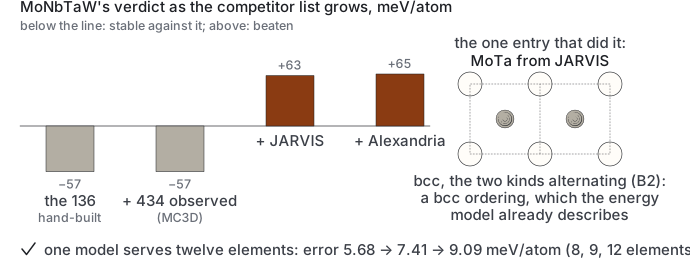
But wiring it to the E84 hull turned every refractory answer positive. MoNbTaW went from
-114 to +15 meV/atom and Mo0.62Ta0.38 from -149 to +38. That is not a widening of the search,
it is the headline result of the project being overturned, so it was traced rather than
accepted.
The 434 observed phases changed the refractory verdict by nothing at all. The entire
120 meV swing rests on one entry: MoTa [jarvis], a two-atom Pm-3m cell at -11.5358 eV/atom,
191 meV/atom below the Mo/Ta linear average - in a system the assessed phase diagram calls a
continuous bcc solid solution.
It is B2. A bcc lattice with the two species alternating. And that is the error, which is
mine and not the database's: the off-lattice hull exists to hold phases the expansion
cannot see - hcp, omega, Laves, fcc - because those are the rivals a bcc cluster expansion
can never lose to (E56). A B2 structure is a bcc superstructure. It is exactly what the
expansion does describe, and whether it forms is the ordering question, which T_od and
the Monte Carlo already answer.
Putting bcc orderings into the hull makes the screen ask whether a disordered solid solution
lies below its own ordered state. At 0 K it never does. Every composition in the system
therefore screens positive, and it looks like a discovery rather than a double count.
So E84's hull is withdrawn as built. What survives from E84 is the method and the nickel
result: the databases really do supply the Ni-Ti, Ni-Nb, Ni-Ta and Ni-V compounds that hand-
picked prototypes missed, and those are genuinely off-lattice. What must change is the
filter. A structure earns a place on the off-lattice hull only if its underlying lattice -
with the decoration ignored - is not bcc.
The filter is right in principle and too strict in practice; the twelve-element hull is
not yet trustworthy and is not in use for anything recorded.
Classifying all 936 relaxed structures by their bare lattice removed 241 bcc
superstructures, MoTa [jarvis] among them, correctly identified as Im-3m with a one-atom
primitive cell. MoNbTaW improved from +15 to +6 meV/atom - and it should be -57.
The census of what survives says why. Of the refractory-only binaries kept, 58 are
I4/mmm, against 46 Fm-3m, 45 P6_3/mmc and 29 Fd-3m. The last three are fcc, hcp and C15
Laves: genuinely off-lattice, exactly what the hull is for. I4/mmm is very often a
tetragonally distorted bcc superstructure, and a test that demands exact Im-3m cannot see
one. TaW2, MoNb2, MoTa2 and Mo2Ta - the four Alexandria phases now doing the damage - are of
that kind.
So the discriminator has to be geometric rather than symmetric. Coordination number is the
honest one and is indifferent to distortion: bcc has eight nearest neighbours, fcc and hcp
have twelve, and Laves has twelve and sixteen. Counting neighbours inside about 1.15 times
the nearest-neighbour distance separates bcc-derived from close-packed whether or not the
cell has relaxed off cubic. That is the next change and it is not made here.
Nothing recorded is affected. build() still loads offlattice_hull.json for any
eight-element expansion, so every result in this file stands on the hull it was measured
against; only the twelve-element path touches offlattice_hull12.json, and no verdict has
been taken from it.