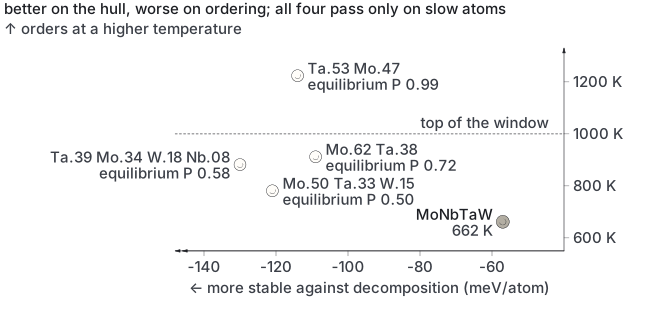
Do the generator's own best compositions beat MoNbTaW through every check?
Partly. All four are 1.9 to 2.3 times more stable against decomposition, but order at higher temperatures; they pass only because atoms move slowly.
In the log: The generator's own candidates up the ladder: better than the reference on the hull, worse on ordering
supersededDate not stated in the log; it was written between the commit of 2026-09-13 08:16 and the first commit that contains it, 2026-09-16 02:04rung 2 · hull, MACE0 predictions · 0 result paragraphsEXPERIMENTS.md lines 4060–4103, lines 4634–4647
What E74 did and how it came out, drawn from this record and the files it names (book/assets/diagrams/exp/E74.svg).
Pre-registration
The pre-registration, as written
E74's verdicts are re-measured rather than rewritten. All four still clear P = 0.9 and
the ranking on the hull is untouched, because that ranking never came from the expansion.
The numbers above replace the withdrawn ones for these four compositions only; the ordering
temperatures quoted in E54, E56, E59, E62, E64, E67 and E68 remain withdrawn.
Where predictions 3 and 4 came from, and why they were wrong. Both were extrapolated
from two spot checks in E80, which moved MoNbTaW 501 to 635 K and Mo0.62Ta0.38 1077 to
1342 K. Those were run with three seeds on a different temperature grid; the ladder uses
four seeds, steps_per_site 90 and linspace(200, 1600, 8). I quoted shifts of up to 265 K
from one sampling scheme as though they predicted another, which is the same mistake as E79 -
taking a number from one configuration and asserting it about a different one.
The one clear improvement is Mo0.50 Ta0.33 W0.15, whose scatter fell from 461 K to 104.
A 461 K bar on a determination inside a 910 K window was not a measurement of anything.
Results
No result paragraph for this entry was found in the log.
The full record
This entry is written in 2 separate places in the log, shown here in log order.
EXPERIMENTS.md · lines 4060–4103
E74 — The generator's own candidates up the ladder: better than the reference on the hull, worse on ordering
Four of the fifty-eight compositions the generator produced under the corrected screen
(E72), carried through the relaxation, the ordering temperature and the kinetics on the
settings E62 used, so the numbers are comparable.
composition
screen
MACE
T_od
P equilibrium
P in service
Ta0.39 Mo0.34 W0.18 Nb0.08
-136
-130
882
0.582
0.996
Mo0.50 Ta0.33 W0.15
-140
-121
781
0.501
0.998
Ta0.53 Mo0.47
-138
-114
1224
0.988
0.999
Mo0.62 Ta0.38
-147
-109
912
0.715
0.990
MoNbTaW, same settings
-57
662
0.995
On the hull they are a real improvement. Every one sits further below the off-lattice
hull than MoNbTaW, the best by a factor of 2.3. The generator was asked for stability
against decomposition and it delivered it.
On ordering they are worse than the alloy they beat, and the service probability hides
it. Three of the four are close to a coin toss at equilibrium - one is 0.501 exactly -
and reach 0.99 only through the kinetic discount. Their ordering temperatures are 781 to
1224 K against MoNbTaW's 662, so ordering is favoured over more of the window and at
temperatures where atoms move faster. The discount still applies, and not marginally:
transport over the life of the part runs 0.0005 to 0.016 nm against the 0.3 nm a local
shuffle needs, two decades of margin in every case. But the verdict rests on the activation
energy, 4.6 to 5.2 eV, far more heavily than the reference's does.
Ta0.53Mo0.47 is not a solid solution and the number does not say so. Its transition is
at 1224 K, above the window, so it is ordered across the whole of 90 to 1000 K and has no
transition inside it. That satisfies the requirement as written and scores 0.999. It is an
ordered compound. Mo-Ta was flagged in advance as the system where the literature reports
an ordering tendency, and this is that tendency, found and then scored as a pass.
The screen over-reports stability, one-signed, on four of four. Screen minus relaxed:
-38, -6, -19, -24 meV/atom, mean -22. The largest is 1.08 sigma against the quoted 35, so
the spread is honest, but a one-signed offset is a bias and sigma is the wrong instrument
for it. E70 predicted this when the relaxation model's sign flipped; it is now measured.
Four points is too few to fit a correction, so it is recorded rather than applied, and the
relaxed numbers are the ones to quote.
What this does not establish. The elitist hill-climber's best under an earlier screen
was -93 meV/atom, and all four of these beat it. That is not a comparison: the arms were
scored by different screens. Whether the generator beats a hill-climber remains open and
has been negative three times (E61, E71, p = 0.172).
EXPERIMENTS.md · lines 4634–4647
E74's verdicts are re-measured rather than rewritten. All four still clear P = 0.9 and
the ranking on the hull is untouched, because that ranking never came from the expansion.
The numbers above replace the withdrawn ones for these four compositions only; the ordering
temperatures quoted in E54, E56, E59, E62, E64, E67 and E68 remain withdrawn.
Where predictions 3 and 4 came from, and why they were wrong. Both were extrapolated
from two spot checks in E80, which moved MoNbTaW 501 to 635 K and Mo0.62Ta0.38 1077 to
1342 K. Those were run with three seeds on a different temperature grid; the ladder uses
four seeds, steps_per_site 90 and linspace(200, 1600, 8). I quoted shifts of up to 265 K
from one sampling scheme as though they predicted another, which is the same mistake as E79 -
taking a number from one configuration and asserting it about a different one.
The one clear improvement is Mo0.50 Ta0.33 W0.15, whose scatter fell from 461 K to 104.
A 461 K bar on a determination inside a 910 K window was not a measurement of anything.
Related entries
E72 — A pure element screened as stable, and the relaxation model was not to blame
E62 — The candidates through all three rungs: tungsten is what freezes the alloy