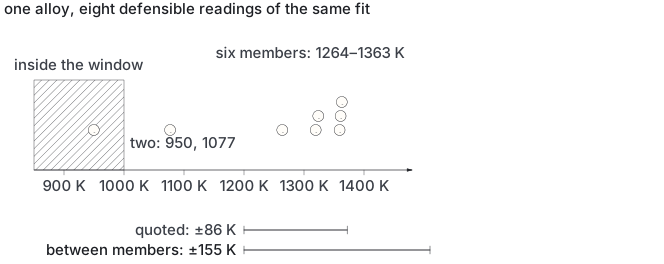
Are the quoted ordering-temperature error bars as wide as the model's own uncertainty?
No. Model uncertainty dominates: the bars were 1.7 to 2.1 times too narrow (Mo–Ta: 177 K, not 86 K).
In the log: The ordering temperatures are quoted twice as tightly as they deserve
mixedDate not stated in the log; it was written between the commit of 2026-09-13 08:16 and the first commit that contains it, 2026-09-16 02:04rung 1 · ordering0 predictions · 0 result paragraphsEXPERIMENTS.md lines 3690–3740
What E68 did and how it came out, drawn from this record and the files it names (book/assets/diagrams/exp/E68.svg).
Results
No result paragraph for this entry was found in the log.
The full record
EXPERIMENTS.md · lines 3690–3740
E68 — The ordering temperatures are quoted twice as tightly as they deserve
Every transition temperature in this record carries the scatter between Monte Carlo runs at
different seeds. That is the sampling error of one fixed Hamiltonian and says nothing about
whether the Hamiltonian is right. The expansion was fitted with a bootstrap and fifty
parameter vectors sit unused in data/ce_8element.npz, each a defensible reading of the
same 1,953 structures.
Predicted before running: 50 to 150 K between members, comparable to the sampling scatter,
so the quoted bars would be about a factor of root two too tight.
model (between members)
sampling (within)
combined
quoted until now
MoNbTaW
93 K
65 K
113 K
65 K
Mo.51 Ta.49
155 K
86 K
177 K
86 K
The range was about right and the characterisation was wrong. The model does not merely
contribute comparably - it dominates, and the bars are understated by 1.7 to 2.1 times,
not root two.
The spread is not Gaussian. For the binary, six members cluster between 1263 and 1363 K
and two sit at 950 and 1077. A standard deviation flatters that; what it means is that
roughly a quarter of defensible parameter sets put the transition inside the service window
rather than above it.
Five of six candidates now straddle the window edge at two sigma, MoNbTaW being the
exception at 662 +/- 113. That includes both binaries, whose entire account of why they pass
ordered above the window, never changing inside it - depends on the transition being above
1000 K.
The verdict survives; the mechanism does not. Re-running the binary's verdict at each
member's own transition temperature:
T_od
mechanism
P(pass)
949
transition inside, kinetics must hold it
0.971
1076
ordered throughout
0.962
1263
ordered throughout
0.988
1363
ordered throughout
0.996
It passes either way, because at 949 K its activation energy of 4.74 eV still leaves an atom
0.0016 nm in a thousand hours. So Mo.51 Ta.49 remains a candidate at P = 0.96 or better
under every member, and E67's ranking stands.
What does not stand is the claim that it passes as a B2 intermetallic. On this evidence
about a quarter of the time it would be a solid solution held by frozen kinetics instead.
Whether the operator ends up with an intermetallic or a solid solution is not determined
by this calculation, and the difference matters for ductility even though it does not
matter for the requirement as written.
Every T_od quoted in E62 and E67 should be read with its bar multiplied by roughly two.
Related entries
E67 — Eight of eight, from two independent seed sets, and the best is a binary found twice
E62 — The candidates through all three rungs: tungsten is what freezes the alloy