No result paragraph for this entry was found in the log.
EXPERIMENTS.md · lines 3480–3543E64 — Tungsten costs off-lattice stability; the rest of the story was confounding
An adversarial reading of E60 proposed that the free screen is a proxy whose gradient points
the wrong way - that optimising off-lattice stability necessarily drives the ordering
temperature up, the way maximising a necessary condition manufactures reward hacking.
Across the 343 surveyed compositions the two terms are mildly aligned, not opposed.
corr(screen driving force, ordering temperature) = +0.252, and the screen is minimised,
so pushing it down pushes the ordering temperature down too. Best decile by screen: T_od
434 +/- 132 K; worst decile 547 +/- 200 K. So the inversion claim does not hold here.
Over the five compositions carried to the full ladder a different pattern appeared: the
ordering temperature tracked tungsten at -0.815 and the driving force at +0.588,
while the screen itself correlated with neither (-0.170). That suggested tungsten was the
axis all three terms turned on, helping two of them - and it was a hypothesis built on five
compositions that differ in several things at once.
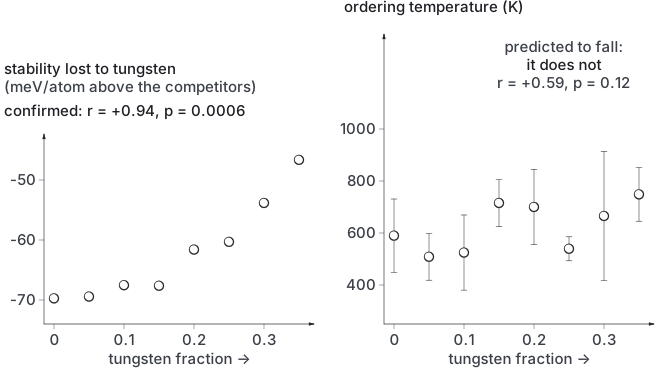
So it was tested. A series at fixed Ta:Mo:Nb = 0.40:0.26:0.25, moving only tungsten,
with the prediction written down before the run: ordering temperature falls as tungsten
rises, driving force becomes less negative.
Half of it was wrong.
Confirmed: tungsten costs off-lattice stability. corr +0.939, p = 0.0006, monotone
across all eight points, -70 to -47 meV/atom. This is now established rather than inferred.
Falsified: tungsten does not lower the ordering temperature. corr +0.593, p = 0.12 -
the opposite sign to the prediction, and in any case unresolvable: the determinations carry
+/- 126 K on average against a total range of 240 K, so the scatter is 52 per cent of the
span. The -0.815 measured across the five candidates was confounding, and this entry's
earlier claim that "tungsten lowers the ordering temperature" is withdrawn.
Also falsified, and this one corrects E62. The migration barrier rose with tungsten
across those same five compositions - 0.76 eV at no tungsten, 1.51 at W = 0.27 - and E62
read that as the mechanism freezing the alloy. Under control, moving only tungsten:
corr(W, E_m) = -0.03, p = 0.97. No relationship. corr(W, E_f) = +0.992, p = 0.008,
monotone across every point. Tungsten makes a vacancy harder to create, not harder to
move - which is what a strongly bound element should do, since pulling an atom out of a
tungsten-rich neighbourhood costs more. The alloy is frozen because its vacancies are rare,
not because they are slow.
The total activation energy does rise with tungsten, +0.674, but on four points that is
p = 0.33 and is not established.
What survives. One relationship of the three, and not the one the story was built on:
tungsten costs off-lattice stability, monotone over eight points at p = 0.0006. It also
raises the vacancy formation energy over four points at p = 0.008. It does not measurably
touch the ordering temperature or the migration barrier. Two hypotheses formed from five
confounded compositions, both stated with a mechanism, both dead within the hour.
The two survivors of E62 still sit at opposite ends of the tungsten range and both still
clear the requirement; what is withdrawn is the account of why.