No result paragraph for this entry was found in the log.
EXPERIMENTS.md · lines 3785–3876E70 — The screen was correcting the wrong strain
E69 found the relaxation model had no resolving power inside the corner the generator works
in and left it at that, with a note in the docstring. A survey of relaxations spread
deliberately across the simplex - 56 so far, running to 120 - shows the problem is not local.
Predicted: the misfit model would hold across the whole space at about its stated 18
meV/atom, since that is the regime it was fitted for.
It has no skill anywhere. Leave-one-out across 51 diverse compositions:
The misfit form does not beat predicting the mean.
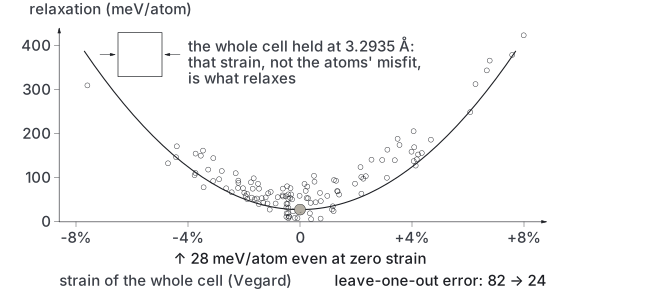
The right strain is the cell's, not the atoms'. Misfit measures how unlike the atoms are
to one another. What costs the energy is the whole cell being held at 3.2935 A when the
composition would rather sit between 2.98 and 3.60 - a strain running from -4.4 to +6.3 per
cent across this design space. Correlation with relaxation: +0.89 against +0.23.
This is the same thing E53 found charged to every mixing energy, in a different place, and
it went unnoticed for the same reason: the quantity with "misfit" in its name looked like
the one that mattered.
Validated against something it was not fitted to. E53 measured, by a completely
different route, what each element pays for being held at the shared lattice. Applying the
new model to the pure elements:
Correlation +0.97 on eight elements with nothing fitted to them. The least-strained are
matched closely - Nb 5 against 4, Ta 6 against 6 - and the most-strained are overshot by
about a factor of 1.8, which is what a harmonic form does where a real crystal softens. So
the model has the physics and not the magnitude at large strain, and should not be trusted
beyond a few per cent.
What it actually buys. Held out on the thirteen compositions of E69, none of them in the
survey:
So it is much better across the space and only modestly better inside the corner, where the
Vegard strain barely varies either. The spread is unchanged at 13 meV, and the spread is
what governs ranking - which is the only thing the screen is asked for. The absolute values
improve; the generator's local discrimination does not.
And the first fix was wrong too, in a way that mattered more. Replacing misfit with
Vegard strain while still forcing the fit through the origin made the quadratic too steep.
Screening the 20,000-composition survey with it put vanadium-rich compositions in every
one of the top six - V.69, V.73, V.81 - because vanadium carries the largest strain in the
set and a through-origin quadratic overshoots there by hundreds of meV. That is the corner
E56 established is full of Laves artefacts, and the screen had just been taught to
manufacture them.
The missing piece was an intercept. At zero cell strain the measured relaxation is 28
meV/atom, not zero: the atoms still move off their sites when the box is the right size.
With the intercept, vanadium-rich compositions in the top six go from six to none, and
the most stable are Mo/Nb/Ta/W - the corner the full ladder independently confirms.
Final coefficients: 27.7 + 6.07 v^2 + 0.89 delta^2, in meV/atom with strains in per cent.
Held out on the thirteen compositions of E69, relaxed before this survey existed:
Better on every measure, and the sign flipped. The old model under-reported stability,
which is the safe direction for a rung that promotes rather than rejects - it could miss a
candidate but never invent one. This one slightly over-reports. Nine meV against a forty meV
threshold is small, but the screen can now flatter a composition, which it could not before,
and anything it promotes still has to survive the rungs above it.