No result paragraph for this entry was found in the log.
EXPERIMENTS.md · lines 3131–3207E59 — The question that decides costs four milliseconds, and twenty thousand compositions say Mo-Nb-Ta-W
The off-lattice term rejected all seven of the survey's qualifiers (E56) and the ordering
temperature decided none of them. That is worth noticing, because the ordering temperature
is the expensive part: thirty-six seconds of Monte Carlo. The driving force needs none of
it - the expansion's random-limit energy is a dot product, the hull's cheapest mixture is a
small linear program, and the mixing entropy is a logarithm.
What stood in the way was relaxation. A cluster expansion lives on a perfect lattice and
cannot give back the energy an alloy recovers by letting its atoms move off their sites.
Measured across the nine audited compositions that is 16 meV/atom for MoNbTaW and 112 for
a V-Hf alloy - not small, not constant, and set against driving forces of 100 to 185 that
decide the verdict.
It is predictable. Elasticity puts the distortion energy at the square of the atomic size
misfit, so only the constant comes from the data:
relaxation (meV/atom) = 1.83 * delta^2, delta = rms size misfit in per cent
Correlation 0.83 on nine points, leave-one-out residual 18.5 meV/atom, worst miss 38,
against a spread of 27.8 if it were ignored. Against the MACE answer it approximates, the
resulting screen has mean error +2 and spread 16 meV/atom at 4.4 ms per composition -
eight thousand times faster than the Monte Carlo rung, and it puts MoNbTaW at -51 where the
full calculation gives -57.
That is a screening accuracy, so the rung says when it cannot answer: a candidate whose
driving force is inside forty meV of zero is promoted rather than judged.
The +2 +/- 16 figure above is in-sample and should not be quoted. The constant k was
fitted on those same nine compositions and then the screen was scored against them. Five
compositions later confirmed at the dearer rung (E60) give the honest number: a bias of
-14 meV/atom with all five errors the same sign and a spread of only 6. The screen is
biased rather than noisy in this corner, and the bias runs conservative - it under-reports
stability, so it does not manufacture false positives - but it is a systematic and the
absolute values it prints are not the answer.
These figures were computed with the relaxation model E70 later replaced. Rescreened
with the corrected one, on the same twenty thousand compositions:
The old model under-corrected the relaxation everywhere, so everything looked less stable
than it is. The composition of the answer does not move - the most stable are Mo/Nb/Ta/W
under both - but the target is five times less rare than this entry reported, and the -40
meV qualifying threshold used in E60 and E61 was one that no uniform draw in twenty
thousand could reach. The numbers below are the old ones, left as they were measured.
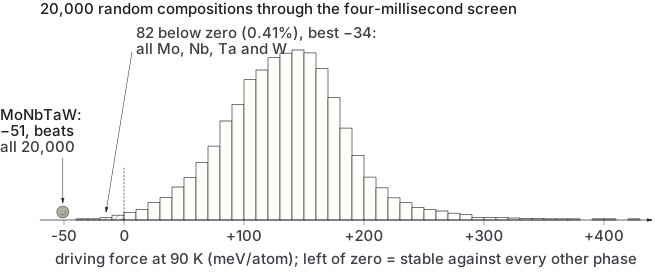
Twenty thousand compositions, drawn uniformly over the simplex, screened in seconds:
Every one of the eight most stable is dominated by Mo, Nb, Ta and W, and not one contains
Hf, Ti, V or Zr above 0.05:
-34   Nb.42 Ta.22 Mo.14 W.14      -28   Nb.66 Mo.22 W.06
-30   Mo.39 Ta.39 Nb.12           -28   Ta.39 Mo.28 W.16 Nb.11
-30   Ta.35 W.30 Mo.21            -27   Ta.57 W.23 Mo.12
-25   Mo.35 Ta.34 Ti.11 Nb.08     -25   Mo.50 Ta.35
The group-5/6 corner, rediscovered from the calculation alone with no literature input -
the same corner the original survey rejected, and the same one the ageing experiments have
been pointing at since 2011.
And equiatomic MoNbTaW, at -51 meV/atom, beats all twenty thousand. Uniform sampling
over an eight-element simplex does not find a composition concentrated in four particular
elements with the other four near zero. The target is real, it has a gradient, and luck
does not reach it - which is what a generator is for, and what makes the comparison in
E60 worth running.