Was the first DFT crash a problem with the calculation settings?
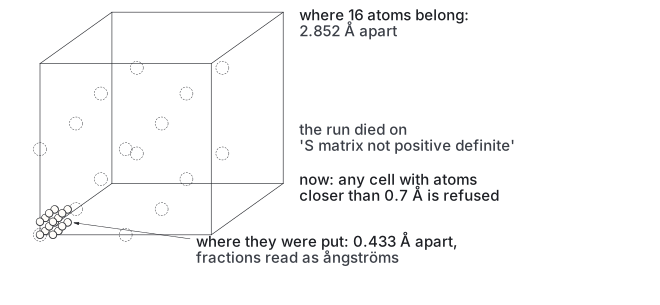
No. Atoms sat 0.433 Å apart instead of 2.852 Å, because fractional positions were read as ångströms. A geometry check now refuses such cells.
In the log: The DFT reference was 16 atoms sitting on top of each other
recordedDate not stated in the log; it was written between the commit of 2026-09-13 08:16 and the first commit that contains it, 2026-09-16 02:04rung 4 · DFT0 predictions · 0 result paragraphsEXPERIMENTS.md lines 4042–4058
What E73 did and how it came out, drawn from this record and the files it names (book/assets/diagrams/exp/E73.svg).
Results
No result paragraph for this entry was found in the log.
The full record
EXPERIMENTS.md · lines 4042–4058
E73 — The DFT reference was 16 atoms sitting on top of each other
The first DFT run stopped at the first diagonalization with S matrix not positive definite, which reads like a pseudopotential or cutoff fault and is the kind of message
that sends you tuning cutoffs. The cutoffs were fine: 50 Ry against 400 Ry of charge
density is the ratio these PAW sets want, and a 16-atom job at the same setting had been
running successfully for two days.
The geometry was not. The nearest pair of atoms was 0.433 A apart, against the 2.852 A
that bcc at this lattice constant gives. The cell was built from ASE's
get_scaled_positions, which is fractional, and written under ATOMIC_POSITIONS angstrom;
0.25 x sqrt(3) = 0.433 is the arithmetic. Every atom was inside its neighbour.
Crystal now measures its own closest approach across periodic images and refuses anything
under 0.7 A, naming the cause. The check costs microseconds. It is worth having because
this failure was loud only by luck — the overlap was extreme enough to break the overlap
matrix, and a milder version of the same mistake converges and returns a number.