No result paragraph for this entry was found in the log.
EXPERIMENTS.md · lines 3357–3426E62 — The candidates through all three rungs: tungsten is what freezes the alloy
The four compositions the generator found (E60) were thermodynamic verdicts only. Taken up
the kinetic rung, with each one's ordering temperature re-determined at eight seeds and two
hundred sweeps, and with ordering judged at its own transition rather than at the ceiling:
All five measured in one run under identical settings - eight vacancy sites, five bands,
one seed - because the first version of this table took the reference from a separate audit
and compared across runs.
And that accident supplied the error bar. The reference was measured twice: Q = 5.07
here and 4.92 in the migration audit, the same quantity from independent occupancy and site
sampling. +/- 0.15 eV, which at 1000 K is a factor of two in how far an atom travels.
So the differences at the top are not meaningful. 0.999, 0.997 and 0.995 are one
answer, not three.
What is meaningful is the off-lattice margin, which improves from -57 to -93 meV/atom and
was confirmed at the dearer rung, and the direction of failure at the bottom.
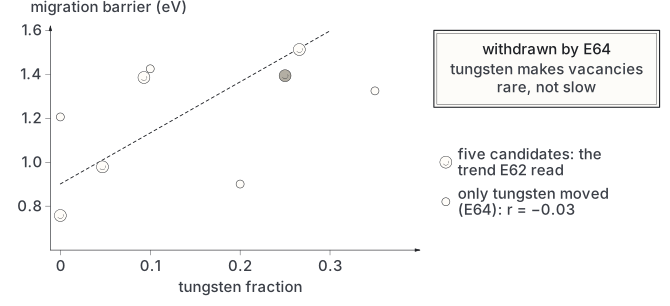
Tungsten appears to be what freezes it. Across these five the migration barrier tracks
the tungsten content and nothing else in the set:
This reading is wrong and E64 withdraws it. These five compositions differ in several
things at once. A controlled series moving only tungsten finds no relationship between
tungsten and the migration barrier at all (corr -0.03, p = 0.97); what tungsten actually
does is raise the vacancy formation energy, monotonically and strongly (+0.99, p = 0.008).
The alloy is frozen because vacancies are rare in it, not because they are slow. The table
above is left in place because the numbers are real; the mechanism read off it was not.
Below about nine per cent the barrier falls away and the ordering temperature rises at the
same time - 636 and 640 K with tungsten, 877 and 938 K without - so the tungsten-poor
alloys both want to order more and can. The composition with no tungsten at all reaches
0.66 nm at the top of the window against the 0.3 nm an ordering event needs.
Five points, so the functional form is not claimed. The direction is what tungsten's
melting point and its own migration barrier would predict, and it is the same trade the
generator was making: it bought off-lattice stability by exchanging tungsten for tantalum,
and the exchange has a floor.
An independent check the numbers were not fitted to. For bcc metals the self-diffusion
activation energy is empirically about 15 to 18 times kT_m. Across these five, using a rule
of mixtures for the melting point:
Correlation +0.956, and every ratio inside or at the top of the empirical band. Nothing
here was calibrated against that relation; it is a property the calculation had to have and
does.
What this does not establish. Every number here is MACE-MPA-0 and a bcc cluster
expansion. The pre-exponential in the diffusion distance is a textbook 1e-5 m^2/s and not
computed; the ordering temperature carries +/- 100 K; the service model is a thousand hours
at a fixed ceiling rather than a duty cycle. The ranking survives all of that. The
probabilities do not deserve three digits.