Are the survey's best alloys really stable, or does another crystal structure beat them?
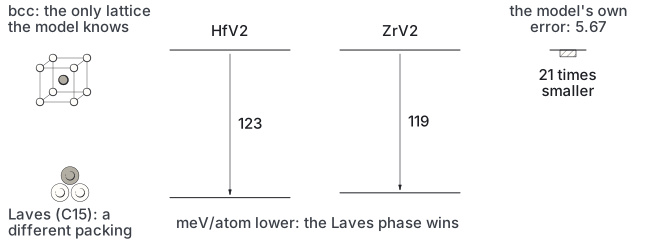
No. A Laves crystal structure, invisible to our lattice-only model, sits 119 to 123 meV/atom lower in energy at HfV2 and ZrV2.
In the log: The three qualifiers are on the wrong lattice; the expansion cannot see what beats them
recordedDate not stated in the log; it was written between the commit of 2026-09-13 08:16 and the first commit that contains it, 2026-09-16 02:04unclassified0 predictions · 0 result paragraphsEXPERIMENTS.md lines 2839–2886
What E54 did and how it came out, drawn from this record and the files it names (book/assets/diagrams/exp/E54.svg).
Results
No result paragraph for this entry was found in the log.
The full record
EXPERIMENTS.md · lines 2839–2886
E54 — The three qualifiers are on the wrong lattice; the expansion cannot see what beats them
The design-space survey found exactly three compositions meeting the service window, all
Hf/V/Zr-rich near-binaries, all qualifying by staying ordered above 1000 K. A literature
review of single-phase refractory stability came back with a specific objection: in the
Hf-V and Zr-V corner the phase that actually forms is the cubic C15 Laves, HfV2 and ZrV2,
which does not sit on a bcc lattice and therefore cannot appear anywhere in a bcc cluster
expansion - not as a competitor, not as an instability, not at all.
That is checkable here, so it was checked. MACE-MPA-0, full relaxation of cell and
positions, C15 built from the MgCu2 prototype against the bcc solid solution at the same
composition:
C15 Laves (eV/atom)
bcc solid solution (eV/atom)
C15 below bcc
HfV2
-9.3548
-9.2316 +/- 0.0031
123 meV/atom
ZrV2
-8.8731
-8.7541 +/- 0.0035
119 meV/atom
The bcc figure is the mean of three random 54-atom occupancies. The C15 cells were
confirmed as Fd-3m (227) before and after relaxation, and relax to a = 7.292 and 7.355 A
against experimental 7.39 and 7.44 A - 1.3 per cent low, the ordinary underbinding of a
PBE-trained model, which is what says the structure is the one intended.
The margin is 21 times the expansion's own cross-validation error of 5.67 meV/atom.
It is larger than the entire ordering effect the expansion exists to measure. At these
compositions bcc is not an approximation that costs a little accuracy; it is the wrong
lattice, and the transition temperature reported there is the ordering temperature of a
structure that never forms.
So the survey's three hits are withdrawn. They are not marginal results awaiting a better
rung - they are answers to a question about a phase that loses by a fifth of an electron
volt per atom.
What this says about the guard added the same day. Leverage against the design matrix
was introduced to mark compositions where the expansion is extrapolating, and it does
that correctly: it puts a 70/30 binary at 0.76 of the training edge and a 4:1 at 1.07.
But it would not have caught this. Leverage measures distance from the training set
within the hypothesis space, and every training structure was bcc, so a composition can
sit comfortably inside the fitted region and still be on the wrong lattice. The two
failures are independent: one is about where the parameters were constrained, the other
about what the model is able to express. A guard against the first is not a guard against
the second, and reporting only leverage would have dressed this result in a reassuring
number.
The missing rung. The ladder's three rungs are the same expansion with more seeds and
more sweeps, so none of them can overturn a lattice assumption they all share - they
agree with each other and are wrong together. The rung that answers this is off-lattice
and it is cheap: the two comparisons above took about four minutes each on one CPU.