No result paragraph for this entry was found in the log.
EXPERIMENTS.md · lines 3931–4040E72 — A pure element screened as stable, and the relaxation model was not to blame
A pure element cannot have a mixing energy. Screened against an off-lattice hull that
contains that element's own ground state, it must come out at exactly zero. It did not:
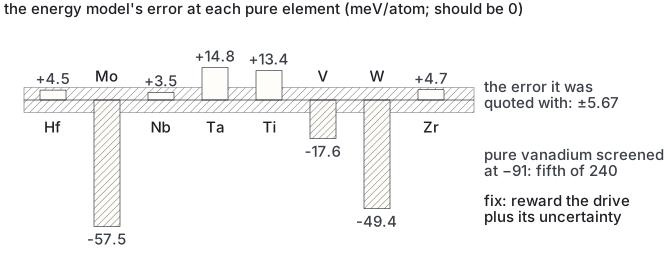
pure vanadium screened at -91 meV/atom and ranked fifth of the 240 compositions the
generator proposed, ahead of every alloy but four.
The obvious suspect was the relaxation model, which E70 had just rebuilt and which is
applied to the candidate and not to the hull. It was the wrong suspect, and chasing it cost
two rebuilds before the decomposition below was done.
First, the anchors were being ignored. E53 relaxed all eight elements and stored both
energies, so what each pays for being held at the shared lattice is measured, not fitted:
V 505, Zr 486, Hf 388, Mo 226, W 184, Ti 11, Ta 6, Nb 4 meV/atom. The fitted model had
never seen them and missed vanadium by 74.
Making a fit reproduce them turned out to be impossible by weighting, and SymPy says why.
Writing the model as a function on the simplex and evaluating at a corner, a constant term
survives as itself and a Vegard-strain term survives as the elemental strain, which is
-9.5 per cent at vanadium and nowhere near zero. Only quantities that vanish at a corner
can be added to an exact elemental mixture without spoiling it: the pair sum
1 - sum x^2, the size misfit, the variance of the elemental lattice constants. So
relaxation(x) = sum_i x_i A_i - 4.94 delta^2
where A_i are the eight measured values. One fitted parameter instead of four,
leave-one-out 18.9 meV/atom against the previous 24.0, and every corner exact by
construction rather than by fitting.
And it made no difference to the false positive. With the corners exact, pure
molybdenum screened at -58 rather than improving. Decomposing the screen term by term
found why, and it was never the relaxation:
The false positive equals the expansion's own error at that corner, to a tenth of a
meV/atom, for every element. The expansion is wrong by 58 meV/atom at pure molybdenum,
ten times the 5.67 meV/atom cross-validation error it is quoted with.
It is not a reference-convention offset. Correcting the expansion by a linear function of
composition pinned to those eight errors makes the interior worse — against MACE on 120
compositions on the same lattice and the same references, mean absolute error goes from
19.6 to 23.4 meV/atom and the bias from +4 to +13. The expansion is well calibrated where
it was trained and fails by extrapolation at the corners, which is the one region a
344-parameter fit on 1953 structures has no business being confident about.
Hafnium, titanium and zirconium screened at +193, +102 and +97, and those are not errors.
Their hull minimum is hcp, 189, 89 and 92 meV/atom below bcc, so a bcc solid solution of
pure hafnium really does sit that far up. The screen was right about three of the eight and
wrong about three; the remaining two are inside their own noise.
The fix is leverage, which was already being computed and never used here. Leverage
against the design matrix measures exactly this — distance from the training set within the
hypothesis space — and it separates cleanly: the 120 interior compositions have a median of
0.17 and a maximum of 2.93, while all eight corners are between 3.3 and 5.9. It carries its
textbook meaning too, since the variance of a linear prediction is the residual variance
times the leverage, so the screen's resolution goes as its square root:
sigma(x) = 24.5 meV/atom * sqrt( leverage(x) / 0.17 )
with 24.5 the measured spread against MACE at a composition of ordinary leverage. This is
not a correction and does not claim to fix the expansion. It reports where the expansion
cannot be trusted. At a corner it gives 108 to 145 meV/atom, which swamps every false
positive; at the compositions the generator actually likes it gives 21 to 33.
The reward is now the conservative driving force, drive + sigma. Rewarding the raw
value pays the generator for finding places the model is wrong, which is what it had been
doing. Rescored this way, all eight pure elements are rejected, near-corner proposals such
as Mo0.93Ta0.07 collapse from -89 to +1, and the ranking is unchanged where it was earned:
Ninety-nine of the 240 survive a conservative reading, and the corner that survives is
Mo-Ta-W, one element away from the MoNbTaW that is the only alloy in this system with an
experiment behind it.
The screen's uncertainty was still missing a term. The expansion's error is one
source; the relaxation ESTIMATE the screen subtracts is another, with a leave-one-out of
18.9 meV/atom, and only the first was in sigma. They are independent, so they add in
quadrature. The first candidate taken up the ladder showed the gap: Mo0.62Ta0.38 screened
at -147 and relaxed to -109, a move of 38 against a quoted 30. With both terms sigma is 35,
and the conservative estimate becomes -113 against the -109 the expensive rung found -
which is what a calibrated screen should do, predict the next rung rather than flatter it.
One tension worth naming. Penalising uncertainty is right for a rung that promotes
candidates to expensive verification, and backwards for a rung that acquires data: a
search meant to improve the model should go where the model is least sure, which is
exactly what drive + sigma now punishes. It costs nothing here, because high leverage in
this space means near a corner and a corner is a pure element, which cannot be the answer
to a question about alloys. It would cost something in a space where the unexplored region
might contain the answer, and the repair there is to route a high-sigma candidate up the
ladder rather than down the ranking — the uncertain flag the screen already returns, and
which nothing yet reads.
What this costs: the expansion should not be trusted near a corner at all, and the ladder
now says so rather than discovering it per composition. The honest repair is to refit the
expansion with the eight elemental structures included, which would pin the corners for
about eight extra training structures. That is not done here, because refitting changes
every ordering temperature recorded in this file.