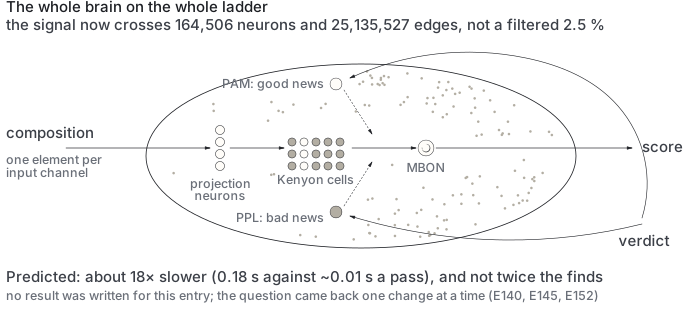
Does running the generator on the whole fly brain, through every check, find more alloys?
Not yet. No result was written for this run; the whole-brain question was answered later, one change at a time.
In the log: The whole brain on the whole ladder
supersededDate not stated in the log; it was written between the commit of 2026-09-16 14:53 and the first commit that contains it, 2026-09-16 15:53unclassified0 predictions · 0 result paragraphsEXPERIMENTS.md lines 8468–8499
What E139 did and how it came out, drawn from this record and the files it names (book/assets/diagrams/exp/E139.svg).
Results
No result paragraph for this entry was found in the log.
The full record
EXPERIMENTS.md · lines 8468–8499
E139 — The whole brain on the whole ladder
164,506 neurons, 25,135,527 edges, against the full ladder — screen, ordering confirm, and
the corrected feasibility — restricted to the high-entropy class the project is named for.
This is the configuration the project was built to test and it has never been run.
What changed to make it possible: the substrate went from 5,311 mushroom-body neurons to the
whole connectome (E137), the reward now carries every correction from E96, E99 and E132
(E133), and out-of-class proposals are refused rather than scored (E134).
The wiring of ladder to brain is unchanged and anatomical: the composition enters at the
projection neurons, one element per channel; the Kenyon cells are the sparse expansion;
the verdict enters as reward at PAM (appetitive) and PPL (aversive); the score is read
from the MBONs, signed by their own measured compartment input. What is new is that signal
now propagates through all 164,506 neurons between those points rather than through a
type-filtered 2.5 per cent.
Predicted:
The whole brain is slower per proposal but not prohibitively — 0.18 s per forward pass
measured, against roughly 0.01 s for the 5,311-neuron circuit, so about 18x. A run that
took minutes takes hours.
Distinct in-class finds per unit spend do not improve much over E136's 5.0. The
proposals come from 24 walkers doing run-and-tumble on the learned field, and the walker
count is unchanged. Representational capacity was never obviously the binding constraint.
The best find is within about 10 meV/atom of CrossEntropy's -78, as at 5,311 neurons
the fly reached -74. A larger substrate should not lower the ceiling.
Falsified if distinct finds per unit spend rise by more than a factor of two. That would
mean representational capacity was the limit, that the mushroom-body filter had been
starving the search all along, and that the whole-brain substrate is the fix. That is the
outcome worth having.
Related entries
E137 — The fly is using 2.5 per cent of the brain, and it is a filter, not a limit
E96 — The screen was rewarding the ordering hazard, and the binary optimum is withdrawn
E99 — Checking rung 0's ordering gate against rung 1, on the fly's own finds
E132 — What the feasible set becomes with the falsified kinetic gate removed
E133 — Let the generator search the space instead of a lookup table
E134 — The project has never required an alloy to be a high-entropy alloy
E136 — The fly has not been used, and nothing found so far is new