Does removing the discredited 'too slow to happen' credit shrink the feasible set further?
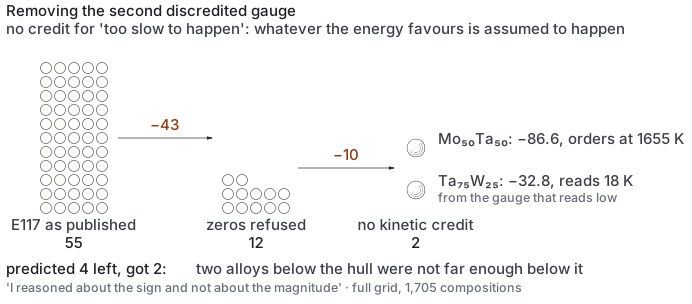
Yes. It fell from 12 to 2 (Mo–Ta and Ta–W), not the 4 predicted; only equal-share Mo–Ta is cleared by both checks.
In the log: What the feasible set becomes with the falsified kinetic gate removed
mixedDate not stated in the log; it was written between the commit of 2026-09-16 11:53 and the first commit that contains it, 2026-09-16 12:56rung 3 · kinetics0 predictions · 2 result paragraphsEXPERIMENTS.md lines 8007–8035, lines 8037–8077
What E132 did and how it came out, drawn from this record and the files it names (book/assets/diagrams/exp/E132.svg).
Results
EXPERIMENTS.md · line 8007
E132 — What the feasible set becomes with the falsified kinetic gate removed
E131 left half the job. The ordering half of feasibility collapsed 55 -> 12 once E99's
withdrawal was honoured. The other half, p_survives_window, is still computed from the Q
proxy E92 falsified, and E93's stated remedy - "The term stays out of the screen" - was never
applied.
How it enters.verifier.py:228-231: p_fav is the thermodynamic favourability of
decomposition from the driving force, r = reachable(nm, 2.0) is the kinetic gate from
q_est, and p_happens = max_T(p_fav * r). Removing the falsified term means r = 1 -
assume anything thermodynamically favoured does happen. That is the conservative reading and
the safe direction for a rung that promotes.
Predicted:
With r = 1, p_survives_window > 0.9 requires the driving force to stay negative right
across the window, because p_fav saturates quickly once d goes positive.
Of E131's 12 survivors, only the four with negative driving force remain -
Mo0.50Ta0.50 (-86.6), Ta0.75W0.25 (-32.8), Mo0.25Nb0.25Ta0.25Ti0.25 (-15.2) and
Mo0.25Nb0.25V0.25W0.25 (-14.5). The other eight are above the hull (+21 to +154) and are
currently rescued only by being called frozen.
So the fully corrected feasible set is about 4, and 1 if E131's robustness argument
is also applied, since only Mo0.50Ta0.50 is cleared by the ordering gate inside the
regime E99 validated it in.
Falsified if removing the kinetic gate changes the set by little - fewer than two
compositions lost - which would mean the gate is rarely binding, and that E92's falsification,
while real, does not propagate to the verdicts. That would be the good outcome and I do not
expect it.
EXPERIMENTS.md · line 8037
E132 result: prediction 1 confirmed, prediction 2 FALSIFIED — it is two, not four — and the
falsification condition did not trigger. The feasible set is 55 -> 12 -> 2.
screen() now reports ordering_known, p_survives_window_conservative and
kinetic_term_trusted alongside the old numbers, so both withdrawn instruments declare what
they do not stand behind instead of returning a clean-looking pass. Nothing was deleted: the
original fields remain, so entries computed against them stay reproducible.
Full grid re-run, 1705 compositions:
E117 criteria as published                55
+ E99 honoured (a zero is not a pass)     12
+ E92/E93 honoured (no kinetic credit)     2

Mo0.50 Ta0.50   drive  -86.6   T_ord 1655 K   p_conservative 0.996
Ta0.75 W0.25    drive  -32.8   T_ord   18 K   p_conservative 0.902
Prediction 1 confirmed. The conservative reading does require the driving force to stay
well below the hull: Ta0.75 V0.25 goes from p = 0.963 to 0.179 once the kinetic gate is
removed. It was passing on the falsified term alone.
Prediction 2 falsified. I predicted the four negative-driving-force survivors would all
remain. Two do not: Mo0.25Nb0.25Ta0.25Ti0.25 at -15.2 and Mo0.25Nb0.25V0.25W0.25 at -14.5
are below the hull but not far enough below it for p_fav to stay small across the window, so
they fail p_conservative > 0.9. I reasoned about the sign and not about the magnitude.
Prediction 3's second half stands.Ta0.75 W0.25 reads T_order = 18 K from the
instrument E99 measured as one-signed and always downward, at x_major 0.75 - exactly the
regime where it returned 0.00 against a real 649 K transition. One composition,
Mo0.50 Ta0.50, is cleared by both instruments inside the regime each was validated in.
The falsification condition did not trigger - it required fewer than two compositions lost
and ten of twelve were lost. E92's falsification propagates all the way to the verdicts.
And the enrichment rises again. On the fully corrected criteria the whole grid passes at
0.12 per cent and the best 50 by reward at 4 per cent - a 34-fold enrichment,
against 12-fold as published and 14-fold after E131. Every correction so far has made the
reward look like a better filter while making the feasible set smaller. The generator was
never the problem.
232 passing, one new test pinning both refusals.
The full record
This entry is written in 2 separate places in the log, shown here in log order.
EXPERIMENTS.md · lines 8007–8035
E132 — What the feasible set becomes with the falsified kinetic gate removed
E131 left half the job. The ordering half of feasibility collapsed 55 -> 12 once E99's
withdrawal was honoured. The other half, p_survives_window, is still computed from the Q
proxy E92 falsified, and E93's stated remedy - "The term stays out of the screen" - was never
applied.
How it enters.verifier.py:228-231: p_fav is the thermodynamic favourability of
decomposition from the driving force, r = reachable(nm, 2.0) is the kinetic gate from
q_est, and p_happens = max_T(p_fav * r). Removing the falsified term means r = 1 -
assume anything thermodynamically favoured does happen. That is the conservative reading and
the safe direction for a rung that promotes.
Predicted:
With r = 1, p_survives_window > 0.9 requires the driving force to stay negative right
across the window, because p_fav saturates quickly once d goes positive.
Of E131's 12 survivors, only the four with negative driving force remain -
Mo0.50Ta0.50 (-86.6), Ta0.75W0.25 (-32.8), Mo0.25Nb0.25Ta0.25Ti0.25 (-15.2) and
Mo0.25Nb0.25V0.25W0.25 (-14.5). The other eight are above the hull (+21 to +154) and are
currently rescued only by being called frozen.
So the fully corrected feasible set is about 4, and 1 if E131's robustness argument
is also applied, since only Mo0.50Ta0.50 is cleared by the ordering gate inside the
regime E99 validated it in.
Falsified if removing the kinetic gate changes the set by little - fewer than two
compositions lost - which would mean the gate is rarely binding, and that E92's falsification,
while real, does not propagate to the verdicts. That would be the good outcome and I do not
expect it.
EXPERIMENTS.md · lines 8037–8077
E132 result: prediction 1 confirmed, prediction 2 FALSIFIED — it is two, not four — and the
falsification condition did not trigger. The feasible set is 55 -> 12 -> 2.
screen() now reports ordering_known, p_survives_window_conservative and
kinetic_term_trusted alongside the old numbers, so both withdrawn instruments declare what
they do not stand behind instead of returning a clean-looking pass. Nothing was deleted: the
original fields remain, so entries computed against them stay reproducible.
Full grid re-run, 1705 compositions:
E117 criteria as published                55
+ E99 honoured (a zero is not a pass)     12
+ E92/E93 honoured (no kinetic credit)     2

Mo0.50 Ta0.50   drive  -86.6   T_ord 1655 K   p_conservative 0.996
Ta0.75 W0.25    drive  -32.8   T_ord   18 K   p_conservative 0.902
Prediction 1 confirmed. The conservative reading does require the driving force to stay
well below the hull: Ta0.75 V0.25 goes from p = 0.963 to 0.179 once the kinetic gate is
removed. It was passing on the falsified term alone.
Prediction 2 falsified. I predicted the four negative-driving-force survivors would all
remain. Two do not: Mo0.25Nb0.25Ta0.25Ti0.25 at -15.2 and Mo0.25Nb0.25V0.25W0.25 at -14.5
are below the hull but not far enough below it for p_fav to stay small across the window, so
they fail p_conservative > 0.9. I reasoned about the sign and not about the magnitude.
Prediction 3's second half stands.Ta0.75 W0.25 reads T_order = 18 K from the
instrument E99 measured as one-signed and always downward, at x_major 0.75 - exactly the
regime where it returned 0.00 against a real 649 K transition. One composition,
Mo0.50 Ta0.50, is cleared by both instruments inside the regime each was validated in.
The falsification condition did not trigger - it required fewer than two compositions lost
and ten of twelve were lost. E92's falsification propagates all the way to the verdicts.
And the enrichment rises again. On the fully corrected criteria the whole grid passes at
0.12 per cent and the best 50 by reward at 4 per cent - a 34-fold enrichment,
against 12-fold as published and 14-fold after E131. Every correction so far has made the
reward look like a better filter while making the feasible set smaller. The generator was
never the problem.
232 passing, one new test pinning both refusals.
Related entries
E131 — Do E117's 55 feasible compositions rest on two withdrawn instruments?
E99 — Checking rung 0's ordering gate against rung 1, on the fly's own finds
E92 — Does the four-millisecond activation energy survive the alloys it now recommends?
E93 — What the cheap activation energy was missing, derived rather than fitted
E117 — Is rung 0's reward anti-aligned with the actual requirement?