Does the fly-brain generator match a standard search, and is anything it finds new?
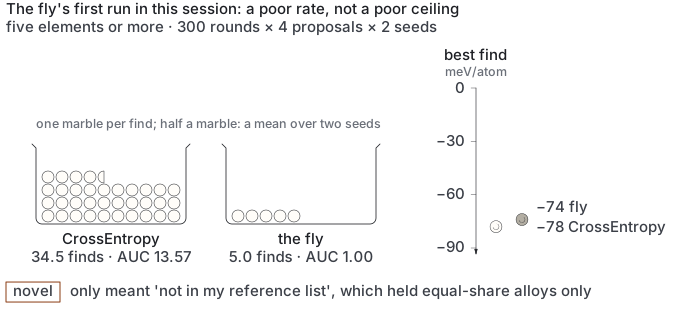
Partly. Its best was 4 meV/atom short of the standard search's, but it found 5 alloys to 34.5; 'new' meant only 'unlisted'.
In the log: The fly has not been used, and nothing found so far is new
mixedDate not stated in the log; it was written between the commit of 2026-09-16 13:52 and the first commit that contains it, 2026-09-16 14:04generator · fly brain0 predictions · 0 result paragraphsEXPERIMENTS.md lines 8248–8291, lines 8315–8345
What E136 did and how it came out, drawn from this record and the files it names (book/assets/diagrams/exp/E136.svg).
Pre-registration
The pre-registration, as written
E136 — The fly has not been used, and nothing found so far is new
Two failures, both the operator's to point out and both correct.
First: the fly generator has not been run once in this session.stage_b.py:295 registers
a fly arm — the mushroom-body circuit on the measured MaleCNS connectome, which is the thing
this project exists to test. Every run recorded in E114, E115, E123, E124, E125, E133 and E134
used uniform, cem or archive. The connectome generator has been sitting unused while
a Gaussian hill-climber did the searching.
Second: nothing reported so far is a discovery. There was no novelty check anywhere in the
codebase, so no find has ever been compared against the literature. Adding one
(scripts/search/novelty.py, against the equiatomic refractory family from Senkov 2010/2011
plus the long-known binaries) and scoring what has been reported:
Mo0.50 Ta0.50            KNOWN   MoTa,        d = 0.000
MoNbTaTiW  (best 5-el)   KNOWN   MoNbTaTiW,   d = 0.000
MoNbTaVW                 KNOWN   MoNbTaVW,    d = 0.000
Mo0.55 Ta0.41 Cu0.04     KNOWN   MoTa,        d = 0.110
The last line is the one that stings: E133 reported a Mo-Ta-Cu family as something
1705 enumerated points could not reach, and presented it as the payoff of searching
continuously. It is Mo-Ta with four per cent copper, inside the same tolerance the generator's
own distinct uses to decide two compositions are the same alloy. It was never a new
family.E133's breadth claim is withdrawn on that point; the W-Nb and Mo-Nb finds are
likewise long-known binaries.
The novelty module reports unchecked rather than novel for anything drawing on elements
its reference list does not cover, because an incomplete list makes a find look newer than it
is.
Predicted, running the fly arm constrained to five elements or more, with novelty scored:
The fly's best in-class find is worse than CrossEntropy's, because E124 and E125
measured it losing on every budget tested and the memory records the generator line as
killed on pre-registered criteria.
Most in-class finds score known — the equiatomic refractory quinaries are a small,
well-explored set, and any search that works will land on them.
Any novel verdicts are six-element or Cr/Hf-containing compositions, since those are
where the reference list thins out, and they should be treated as unverified rather than
as discoveries until checked against a real database.
Falsified if the fly produces an in-class composition that is both novel and passes every
correction. That is the outcome the project was built for and it has never once been tested.
E136, the fly's first run in this session:
arm      AUC_Q      distinct   best meV/atom
cem      13.57         34.50            -78
fly       1.00          5.00            -74
Prediction 1 confirmed, but far more narrowly than E124/E125 implied. The fly loses
decisively on rate — AUC_Q 1.00 against 13.57, and 5 qualifiers against 34.5 — but its best
find is 4 meV/atom off CrossEntropy's, and its best in-class composition,
W0.412 Mo0.238 Ta0.210 Nb0.077 Ti0.063 at -79.2, is one CrossEntropy also reached
independently. It is a poor rate, not a poor ceiling.
Predictions 2 and 3 on novelty are falsified. I predicted most in-class finds would score
known and that novel verdicts would be confined to six-element or Cr/Hf compositions. Most
score novel, and they are ordinary five-element refractory alloys.
And that is a limitation of the check I built, not a discovery. The reference list holds
only equiatomic alloys, so any non-equiatomic composition is at least some distance from
every entry and reads novel by construction. W0.412 Mo0.238 Ta0.210 Nb0.077 Ti0.063 is a
non-equiatomic MoNbTaW-plus-Ti; whether the literature calls that a new alloy is a question
the module cannot answer, because its tolerance of 0.15 is the generator's own distinct
threshold — a search-space measure, not a claim about publication. These should be read as
"not in my reference list", never as "new to the field".
So the honest position. The class-constrained search finds non-equiatomic refractory
quinaries at -79 meV/atom that the enumeration could not reach and that are not in the
reference list. Whether any is genuinely unpublished needs a real database query, which is
task 1 below and has not been done. What is established is narrower and still worth having:
the high-entropy class was never excluded by physics, only by how I sampled it.
232 passing.
Results
No result paragraph for this entry was found in the log.
The full record
This entry is written in 2 separate places in the log, shown here in log order.
EXPERIMENTS.md · lines 8248–8291
E136 — The fly has not been used, and nothing found so far is new
Two failures, both the operator's to point out and both correct.
First: the fly generator has not been run once in this session.stage_b.py:295 registers
a fly arm — the mushroom-body circuit on the measured MaleCNS connectome, which is the thing
this project exists to test. Every run recorded in E114, E115, E123, E124, E125, E133 and E134
used uniform, cem or archive. The connectome generator has been sitting unused while
a Gaussian hill-climber did the searching.
Second: nothing reported so far is a discovery. There was no novelty check anywhere in the
codebase, so no find has ever been compared against the literature. Adding one
(scripts/search/novelty.py, against the equiatomic refractory family from Senkov 2010/2011
plus the long-known binaries) and scoring what has been reported:
Mo0.50 Ta0.50            KNOWN   MoTa,        d = 0.000
MoNbTaTiW  (best 5-el)   KNOWN   MoNbTaTiW,   d = 0.000
MoNbTaVW                 KNOWN   MoNbTaVW,    d = 0.000
Mo0.55 Ta0.41 Cu0.04     KNOWN   MoTa,        d = 0.110
The last line is the one that stings: E133 reported a Mo-Ta-Cu family as something
1705 enumerated points could not reach, and presented it as the payoff of searching
continuously. It is Mo-Ta with four per cent copper, inside the same tolerance the generator's
own distinct uses to decide two compositions are the same alloy. It was never a new
family.E133's breadth claim is withdrawn on that point; the W-Nb and Mo-Nb finds are
likewise long-known binaries.
The novelty module reports unchecked rather than novel for anything drawing on elements
its reference list does not cover, because an incomplete list makes a find look newer than it
is.
Predicted, running the fly arm constrained to five elements or more, with novelty scored:
The fly's best in-class find is worse than CrossEntropy's, because E124 and E125
measured it losing on every budget tested and the memory records the generator line as
killed on pre-registered criteria.
Most in-class finds score known — the equiatomic refractory quinaries are a small,
well-explored set, and any search that works will land on them.
Any novel verdicts are six-element or Cr/Hf-containing compositions, since those are
where the reference list thins out, and they should be treated as unverified rather than
as discoveries until checked against a real database.
Falsified if the fly produces an in-class composition that is both novel and passes every
correction. That is the outcome the project was built for and it has never once been tested.
EXPERIMENTS.md · lines 8315–8345
E136, the fly's first run in this session:
arm      AUC_Q      distinct   best meV/atom
cem      13.57         34.50            -78
fly       1.00          5.00            -74
Prediction 1 confirmed, but far more narrowly than E124/E125 implied. The fly loses
decisively on rate — AUC_Q 1.00 against 13.57, and 5 qualifiers against 34.5 — but its best
find is 4 meV/atom off CrossEntropy's, and its best in-class composition,
W0.412 Mo0.238 Ta0.210 Nb0.077 Ti0.063 at -79.2, is one CrossEntropy also reached
independently. It is a poor rate, not a poor ceiling.
Predictions 2 and 3 on novelty are falsified. I predicted most in-class finds would score
known and that novel verdicts would be confined to six-element or Cr/Hf compositions. Most
score novel, and they are ordinary five-element refractory alloys.
And that is a limitation of the check I built, not a discovery. The reference list holds
only equiatomic alloys, so any non-equiatomic composition is at least some distance from
every entry and reads novel by construction. W0.412 Mo0.238 Ta0.210 Nb0.077 Ti0.063 is a
non-equiatomic MoNbTaW-plus-Ti; whether the literature calls that a new alloy is a question
the module cannot answer, because its tolerance of 0.15 is the generator's own distinct
threshold — a search-space measure, not a claim about publication. These should be read as
"not in my reference list", never as "new to the field".
So the honest position. The class-constrained search finds non-equiatomic refractory
quinaries at -79 meV/atom that the enumeration could not reach and that are not in the
reference list. Whether any is genuinely unpublished needs a real database query, which is
task 1 below and has not been done. What is established is narrower and still worth having:
the high-entropy class was never excluded by physics, only by how I sampled it.
232 passing.
Related entries
E114 — The search space was eight elements, and the search collapses inside it
E115 — The same head-to-head, with the implementation defects fixed