EXPERIMENTS.md · lines 5804–5868E99 — Checking rung 0's ordering gate against rung 1, on the fly's own finds
The gate deployed in E98 is built from a two-sublattice partition: species are split into
two groups, one group on the bcc corner sites and the other on the body centres. That
construction represents B2 and its relatives, which live at or near equiatomic. It cannot
represent an A3B ordering, because the corner sublattice is exactly half the sites and a
0.75/0.25 composition cannot be segregated onto it.
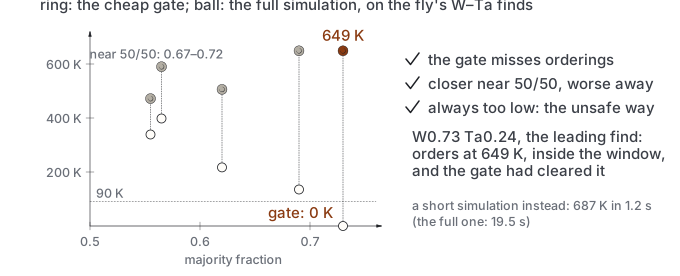
The fly's best find is W0.73 Ta0.24, and the gate returned T_order = 0 for it - no
ordering tendency at all. That is either a real property of the alloy or the construction
failing to reach the structure that orders. D0_3 and A15 both sit near that stoichiometry and
neither is a two-sublattice split of this cell.
Predicted:
- The Monte Carlo finds ordering in
W0.73 Ta0.24 where the gate says none. Rung 1
samples occupations directly and is not restricted to any sublattice decomposition.
- The gate agrees better near equiatomic.
W0.56 Ta0.44 and Ta0.56 W0.44, which the
gate puts at 422 and 438 K, should come back close; the ratio should degrade as the
composition moves away from 50/50.
- The error is therefore one-signed and unsafe - the gate under-reports ordering off
stoichiometry, which is the direction that lets an orderer through.
Falsified if the Monte Carlo agrees that W0.73 Ta0.24 has no ordering transition, in
which case the construction is adequate and the fly's leading candidate stands.
Rung 1 is Monte Carlo over the expansion, so it costs CPU and no potential - it can run while
the 54-atom DFT holds the memory.
Outcome. All three predictions hold. The gate deployed last night is unsafe off
stoichiometry and is withdrawn as a clearance.
The ratio degrades monotonically with distance from equiatomic and the error is one-signed:
the gate always under-reports. The fly's leading candidate from the E98 campaign orders at
649 K, inside the window, and the gate cleared it. The E98 ladder campaign results are
withdrawn.
A hypothesis of mine that the data refuses. I expected the generator to have found the
blind spot - reward hacking one level up, moving off equiatomic because that is where the
gate cannot see. It did not. The ratio of majority fraction to equiatomic is 1.50, 1.54 and
1.55 across the pessimistic, effective and ladder campaigns: unchanged whether the gate was
present or not. Off-stoichiometry is simply where these alloys sit, so the gate is broken
across most of the space rather than being gamed in a corner of it. That is worse as an
instrument and better as a dynamic, and it was worth checking rather than asserting.
What the gate is still good for. A nonzero T_order is a real signal - the construction
found an ordered state lower than random, and that state exists. A zero is not a clearance.
It is kept on those terms, with the validity domain written into the module rather than left
in this file.
The sub-rung, measured. Rung 1 at its full setting is 19.5 s; at ten sweeps, one seed and
four temperatures it returns 687 K against the reference 649, an error of +38 K, in 1.2
seconds. That is 400 times the gate and 16 times cheaper than rung 1, which is the shape of
a sub-rung: the cheap gate flags what it can see, the short Monte Carlo clears what it
cannot, and the full rung 1 settles anything that matters. The open question is what the
generator should learn from, since a reward it can only evaluate at 1.2 s per proposal is a
different search from one at 3 ms.