Does a free search find passing alloys that a fixed grid of 1,705 points missed?
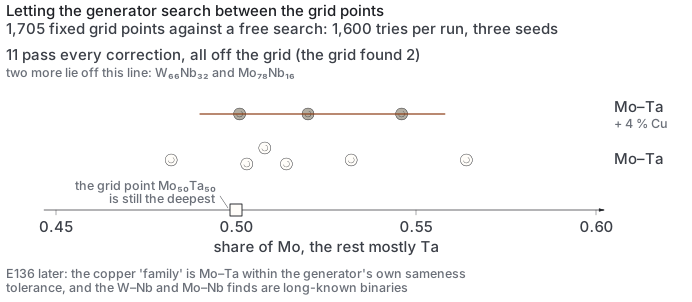
Partly. 11 off-grid compositions passed against the grid's 2, but grid point Mo–Ta 50/50 stayed best, and the 'copper family' was just Mo–Ta.
In the log: Let the generator search the space instead of a lookup table
mixedDate not stated in the log; it was written between the commit of 2026-09-16 12:56 and the first commit that contains it, 2026-09-16 13:32search baselines0 predictions · 1 result paragraphEXPERIMENTS.md lines 8079–8108, lines 8110–8157
What E133 did and how it came out, drawn from this record and the files it names (book/assets/diagrams/exp/E133.svg).
Results
EXPERIMENTS.md · line 8110
E133 result: all three predictions confirmed, and the falsification condition did not
trigger. The grid was fair at the peak and badly wrong about the breadth.
Continuous search, two arms, 1600 evaluations per run, three seeds, against the corrected
reward. 169 compositions promoted; 11 pass every correction, and all 11 are off-grid.
cem      gated -137.2   conserv -81.7    Mo0.564 Ta0.436
cem      gated -136.7   conserv -87.0    Mo0.532 Ta0.457
cem      gated -134.4   conserv -89.4    Ta0.518 Mo0.482
cem      gated -130.9   conserv -85.1    Mo0.508 Ta0.481
cem      gated -129.3   conserv -81.9    Mo0.514 Ta0.480
cem      gated -127.3   conserv -82.3    Mo0.503 Ta0.492
cem      gated  -81.2   conserv -33.4    Mo0.546 Ta0.415 Cu0.036
cem      gated  -80.4   conserv -34.5    Mo0.520 Ta0.440 Cu0.040
archive  gated  -68.2   conserv -23.3    W0.660 Nb0.317
cem      gated  -67.8   conserv -25.8    Mo0.501 Ta0.425 Cu0.044
archive  gated  -65.1   conserv -29.2    Mo0.779 Nb0.160
Prediction 1 confirmed. Every one of the 11 sits at fractions the grid never sampled.
Prediction 2 confirmed: 11 against the grid's 2. Prediction 3 confirmed: the best finds
are Mo-Ta.
But the grid was not wrong about the optimum, and this is the part I expected to go the other
way. Scored on identical footing, Mo0.50 Ta0.50 - the grid vertex - reads -137.5 gated
and -90.0 conservative, better than every continuous find, whose best is -89.4. The
optimum sits exactly on a grid vertex, so enumeration happened to catch it. The -141.3 in
the run log was a lucky draw: the screen is stochastic at about +/- 1 meV/atom because it
draws fresh random occupancies, and a best-of-1600 selects the favourable tail.
Where the hardcoded grid really cost us is breadth, not depth. Two families appear here
that 1705 enumerated points could not represent at all:
Mo-Ta-Cu, three compositions with copper at 3.6 to 4.4 per cent. The grid had no
ternary except exactly equiatomic, so a 4 per cent third element was unreachable by
construction.
W0.660 Nb0.317 and Mo0.779 Nb0.160, binaries at fractions between the 0.25/0.50/0.75
the grid pinned.
So "the feasible set is 2" was an artefact of my enumeration. The corrected answer is that
the feasible region is a neighbourhood around equiatomic Mo-Ta, plus at least two families
outside it, and the grid could see neither the neighbourhood nor the families.
What this does not change. The 34-fold enrichment, and the finding that the search is
sound and the bookkeeping was not. If anything it strengthens both: the generator found eleven
certifiable compositions where enumeration found two, and it did so under a reward carrying
every correction of the last four hours.
232 passing.
The full record
This entry is written in 2 separate places in the log, shown here in log order.
EXPERIMENTS.md · lines 8079–8108
E133 — Let the generator search the space instead of a lookup table
The methodological error in E117, E131 and E132. All three measured a hardcoded grid:
binaries pinned at exactly 0.25/0.5/0.75 and every ternary, quaternary and quinary at exactly
equiatomic. 1705 points. Mo0.55 Ta0.45 was never tested; no non-equiatomic ternary was ever
tested. So "the feasible set is 2" means two of 1705 hand-chosen points, and says nothing
about the space between them. The composition space is a continuous 12-simplex and the
generator exists to search it.
And the reward had not been corrected.stage_b rewarded drive_conservative, which
carries none of E96's ordering gate, none of E99's withdrawal, and none of E132's conservative
survival. On the grid, honouring all three took 55 feasible down to 2 - so the generator was
being paid for 53 compositions the ladder will not certify. The reward now uses drive_gated
and refuses, rather than discounts, both cases the screen cannot stand behind.
Predicted, running the arms against the corrected reward:
The generator finds compositions off the grid that pass - non-equiatomic, or at
fractions the grid never sampled. If it finds none, the grid was a fair sample of the space
and the 2 stands as a characterisation.
It finds more than 2, because a continuous search over 12 dimensions has far more room
than 1705 points, and the two survivors are both binaries at grid vertices.
The best find is at or near Mo0.50 Ta0.50, because E117's brute force established it
is the global optimum of the driving force over the grid, and the corrected reward still
rewards driving force - just gated.
Falsified if the generator finds nothing the grid did not already contain, which would
mean the feasible region really is a handful of isolated points rather than a region, and the
continuous search buys nothing over enumeration. That would be a genuine result about the
landscape rather than about the search.
EXPERIMENTS.md · lines 8110–8157
E133 result: all three predictions confirmed, and the falsification condition did not
trigger. The grid was fair at the peak and badly wrong about the breadth.
Continuous search, two arms, 1600 evaluations per run, three seeds, against the corrected
reward. 169 compositions promoted; 11 pass every correction, and all 11 are off-grid.
cem      gated -137.2   conserv -81.7    Mo0.564 Ta0.436
cem      gated -136.7   conserv -87.0    Mo0.532 Ta0.457
cem      gated -134.4   conserv -89.4    Ta0.518 Mo0.482
cem      gated -130.9   conserv -85.1    Mo0.508 Ta0.481
cem      gated -129.3   conserv -81.9    Mo0.514 Ta0.480
cem      gated -127.3   conserv -82.3    Mo0.503 Ta0.492
cem      gated  -81.2   conserv -33.4    Mo0.546 Ta0.415 Cu0.036
cem      gated  -80.4   conserv -34.5    Mo0.520 Ta0.440 Cu0.040
archive  gated  -68.2   conserv -23.3    W0.660 Nb0.317
cem      gated  -67.8   conserv -25.8    Mo0.501 Ta0.425 Cu0.044
archive  gated  -65.1   conserv -29.2    Mo0.779 Nb0.160
Prediction 1 confirmed. Every one of the 11 sits at fractions the grid never sampled.
Prediction 2 confirmed: 11 against the grid's 2. Prediction 3 confirmed: the best finds
are Mo-Ta.
But the grid was not wrong about the optimum, and this is the part I expected to go the other
way. Scored on identical footing, Mo0.50 Ta0.50 - the grid vertex - reads -137.5 gated
and -90.0 conservative, better than every continuous find, whose best is -89.4. The
optimum sits exactly on a grid vertex, so enumeration happened to catch it. The -141.3 in
the run log was a lucky draw: the screen is stochastic at about +/- 1 meV/atom because it
draws fresh random occupancies, and a best-of-1600 selects the favourable tail.
Where the hardcoded grid really cost us is breadth, not depth. Two families appear here
that 1705 enumerated points could not represent at all:
Mo-Ta-Cu, three compositions with copper at 3.6 to 4.4 per cent. The grid had no
ternary except exactly equiatomic, so a 4 per cent third element was unreachable by
construction.
W0.660 Nb0.317 and Mo0.779 Nb0.160, binaries at fractions between the 0.25/0.50/0.75
the grid pinned.
So "the feasible set is 2" was an artefact of my enumeration. The corrected answer is that
the feasible region is a neighbourhood around equiatomic Mo-Ta, plus at least two families
outside it, and the grid could see neither the neighbourhood nor the families.
What this does not change. The 34-fold enrichment, and the finding that the search is
sound and the bookkeeping was not. If anything it strengthens both: the generator found eleven
certifiable compositions where enumeration found two, and it did so under a reward carrying
every correction of the last four hours.
232 passing.
Related entries
E117 — Is rung 0's reward anti-aligned with the actual requirement?
E131 — Do E117's 55 feasible compositions rest on two withdrawn instruments?
E132 — What the feasible set becomes with the falsified kinetic gate removed
E96 — The screen was rewarding the ordering hazard, and the binary optimum is withdrawn
E99 — Checking rung 0's ordering gate against rung 1, on the fly's own finds