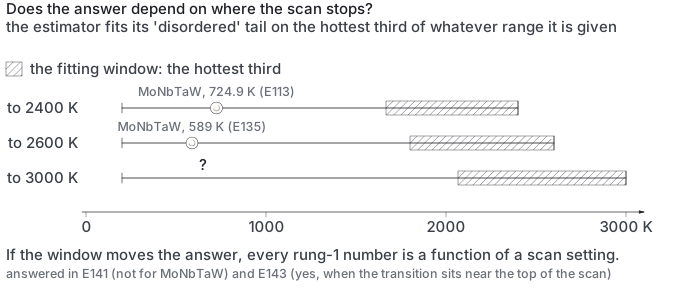
Does the ordering temperature depend on how hot the simulation's scan goes?
Partly. Not when the alloy orders well inside the scan; near or beyond the scan's top, the answer moved by 972 K.
In the log: Is the rung-1 answer an artefact of the temperature range scanned?
mixedDate not stated in the log; it was written between the commit of 2026-09-16 14:04 and the first commit that contains it, 2026-09-16 14:53rung 1 · ordering0 predictions · 0 result paragraphsEXPERIMENTS.md lines 8444–8466
What E138 did and how it came out, drawn from this record and the files it names (book/assets/diagrams/exp/E138.svg).
Results
No result paragraph for this entry was found in the log.
The full record
EXPERIMENTS.md · lines 8444–8466
E138 — Is the rung-1 answer an artefact of the temperature range scanned?
E135's control failed: MoNbTaW read 589 K on a 200-2600 K ladder against E113's validated
724.9 +/- 23 K on a 200-2400 K one. The estimator fits its A/T^2 disordered tail on the
hottest third of whatever range it is given, so changing the ceiling changes the fitting
window and therefore the baseline. If that is the cause, every rung-1 number in this project
is a function of a scan parameter, which no physical transition temperature can be.
Predicted:
MoNbTaW's reported transition moves monotonically with the ceiling - scanning to 2400,
2600 and 3000 K on identical seeds and sweeps gives three different answers, with the
higher ceilings reading lower, because a hotter fitting window fits a smaller A and so
subtracts less.
The spread across ceilings exceeds the 23 K seed scatter E113 measured, by a lot. E135
against E113 is already 136 K on one seed.
MoNbTaTiW stays above 1000 K at every ceiling, because the qualitative gap is about
800 K and no plausible baseline error closes it.
Falsified if the three ceilings agree within the seed scatter, in which case the 589 vs
724.9 discrepancy is something else - a change in rungs.transition, or seed variance larger
than E113 measured - and the estimator is not grid-dependent after all. That would be the
better outcome and it would move the problem, not remove it.
Related entries
E135 — Do the refractory high-entropy alloys really order inside the window?