Are five-element refractory alloys shut out by physics, or only by how they were sampled?
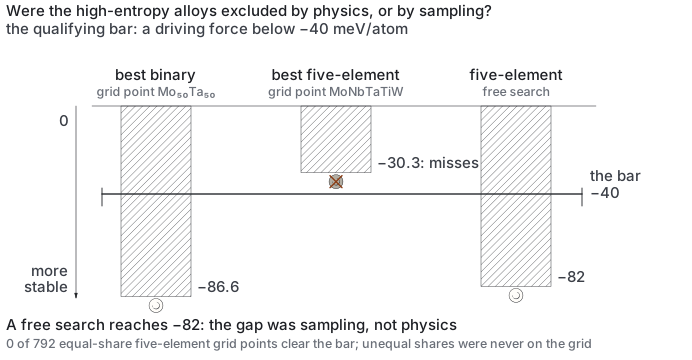
Withdrawn. The claim that physics excludes them fell: a free search reached −82 meV/atom, past the −40 bar that the grid's best (−30.3) missed.
In the log: The project has never required an alloy to be a high-entropy alloy
withdrawnDate not stated in the log; it was written between the commit of 2026-09-16 13:32 and the first commit that contains it, 2026-09-16 13:52generator · fly brain0 predictions · 1 result paragraphEXPERIMENTS.md lines 8159–8214, lines 8293–8294, lines 8296–8313
What E134 did and how it came out, drawn from this record and the files it names (book/assets/diagrams/exp/E134.svg).
Pre-registration
The pre-registration, as written
E134, constrained to five elements or more:
arm        AUC_Q      distinct   best meV/atom
cem        18.01         39.67            -82
archive     0.00          0.00            +35
Prediction 2 is falsified on exactly the stated condition — "falsified if a five-element
composition reaches -40, which would mean the gap is a sampling artefact and the class was
excluded by my enumeration rather than by physics." It reaches -82. The 56 meV/atom gap I
reported between binaries and high-entropy alloys was an artefact of sampling five-element
space only at exact equiatomic. E134's claim that the class fails on dilution is withdrawn.
The in-class finds are non-equiatomic refractory quinaries, which is precisely what 792
equiatomic grid points could not represent:
E134/E136 results: prediction 2 of E134 FALSIFIED — the class was excluded by my
enumeration, not by physics. And the fly, finally run, is 4 meV/atom off the best.
The full record
This entry is written in 3 separate places in the log, shown here in log order.
EXPERIMENTS.md · lines 8159–8214
E134 — The project has never required an alloy to be a high-entropy alloy
The stated goal is a refractory high-entropy alloy - five elements or more, near equiatomic.
No such constraint exists anywhere in the code.grep over forager/ and scripts/ finds
no element-count requirement in any objective, reward, filter or promotion rule. The ladder
has been ranking a 12-simplex by driving force with no notion of alloy class, and driving
force structurally favours binaries: mixing enthalpy dilutes as elements are added, while a
binary concentrates the single strongest pair bond.
Measured on the corrected 1705-point grid:
elements   in grid   drive < -40   passes every correction
       2       198             7                         2
       3       220             2                         0
       4       495             1                         0
       5       792             0                         0
Zero of 792 five-element compositions clear the qualifying bar. Not one. And the bar is not
marginally out of reach:
best binary      Mo0.50 Ta0.50            -86.6 meV/atom
best 5-element   Mo Nb Ta Ti W (equi)     -30.3 meV/atom     gap 56
The best five-element composition in the whole grid is MoNbTaTiW, which is a real and
well-studied refractory high-entropy alloy. It misses the -40 bar by 10 meV/atom and it orders
at 121 K - inside the 90-1000 K window - so it fails the phase requirement independently.
MoNbTaVW is the same story at 367 K.
Two separate problems, and only one is a bug.
The bug: nothing enforces or even reports alloy class, so a high-entropy alloy can never
surface in a ranking dominated by binaries. Every "best find" this project has ever reported
was a binary or near-binary for this reason, and the operator has had to point it out more
than once.
The physics, which is not a bug: at equiatomic, where E99 says the ordering gate is most
reliable, the refractory five-element alloys order at 120 to 370 K. That is inside the
window. If the reading is right they genuinely fail the requirement, and the answer to "find
a RHEA that holds one phase from 90 K to 1000 K" may be that none of these does.
The qualifying bar is the other half of the bug. -40 meV/atom was set against what binaries
achieve. Within the five-element class the best available is -30.3, so the bar excludes the
entire class by construction. A threshold has to be relative to what is achievable in-class or
it is not a threshold, it is a class filter wearing a number.
Predicted, before constraining the search to the high-entropy class:
A constrained search finds five-element compositions better than -30.3, because the grid
sampled five-element space only at exact equiatomic - 792 points of a continuous region -
and E133 showed the grid misses whole families off its vertices.
None of them clears -40, because the 56 meV/atom gap to the binaries is a property of
dilution rather than of sampling.
Some order outside the window, since the grid's equiatomic five-element ordering
temperatures span 121 to 367 K and non-equiatomic compositions will spread wider.
Falsified if a five-element composition reaches -40, which would mean the gap is a sampling
artefact and the class was excluded by my enumeration rather than by physics.
EXPERIMENTS.md · lines 8293–8294
E134/E136 results: prediction 2 of E134 FALSIFIED — the class was excluded by my
enumeration, not by physics. And the fly, finally run, is 4 meV/atom off the best.
EXPERIMENTS.md · lines 8296–8313
E134, constrained to five elements or more:
arm        AUC_Q      distinct   best meV/atom
cem        18.01         39.67            -82
archive     0.00          0.00            +35
Prediction 2 is falsified on exactly the stated condition — "falsified if a five-element
composition reaches -40, which would mean the gap is a sampling artefact and the class was
excluded by my enumeration rather than by physics." It reaches -82. The 56 meV/atom gap I
reported between binaries and high-entropy alloys was an artefact of sampling five-element
space only at exact equiatomic. E134's claim that the class fails on dilution is withdrawn.
The in-class finds are non-equiatomic refractory quinaries, which is precisely what 792
equiatomic grid points could not represent: