No result paragraph for this entry was found in the log.
EXPERIMENTS.md · lines 8347–8395E137 — The fly is using 2.5 per cent of the brain, and it is a filter, not a limit
What is actually loaded. data/malecns_circuit.json holds 5,311 neurons:
4,062 Kenyon cells (KCab 1810, KCg 1557, KCa 695), 316 PAM, 97 MBON, and projection neurons.
Its extraction spec reads:
node_policy  type_regex
type_regex   ^(KC|MBON|PAM|PPL|APL)|PN
max_nodes    20000
eligible_nodes_before_cap  5311
The cap was never binding. max_nodes is 20,000 and only 5,311 neurons were eligible, so
the type filter is the entire constraint. It selects the mushroom body and nothing else.
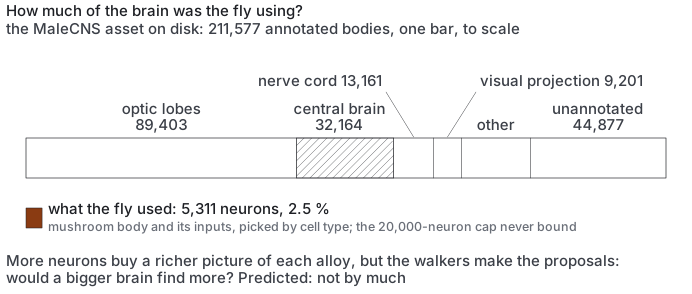
What is available. The raw MaleCNS asset is on disk - 1.05 GB of edges, 14 MB of
annotations, no network needed - and holds 211,577 annotated bodies:
ol_intrinsic       89,403     optic lobe, visual processing
cb_intrinsic       32,164     central brain: mushroom body, central complex, the rest
vnc_intrinsic      13,161
visual_projection   9,201
(unannotated)      44,877
So the circuit in use is 2.5 per cent of the annotated connectome, and connectome.py
already supports a superclass node policy that would take the central brain whole.
The honest uncertainty, stated before the test. More neurons buy representational
capacity: 4,062 Kenyon cells at 10 per cent sparsity give about 406 active per input, and
discrimination between compositions scales with that. But the proposals do not come from the
representation - they come from FlyGenerator's 24 walkers doing run-and-tumble on the field
the circuit learns. Diversity of output is a property of the walker dynamics, and it is not
obvious that a bigger circuit changes it at all. That is the thing worth measuring rather
than assuming.
Predicted, extracting cb_intrinsic and re-running the fly against the same target:
- The extraction yields 25,000 to 32,000 nodes, five to six times the present circuit,
and the induced edge count rises faster than the node count because the central brain is
more densely connected than a type-filtered subgraph.
- The forward pass slows roughly in proportion to edges, so a run costs several times
more per proposal. If it slows by much more than the edge ratio the implementation does
not scale and that is the finding.
- Distinct in-class finds per unit spend do NOT improve much - I expect within a factor
of two of E136's 5.0 - because the bottleneck is the walkers, not the representation.
Falsified if distinct finds per unit spend rise substantially - say beyond twice E136's
rate - which would mean representational capacity really was the limit and the whole-brain
circuit is the fix the operator has been asking for. That is the outcome worth having and it
has never been tested.