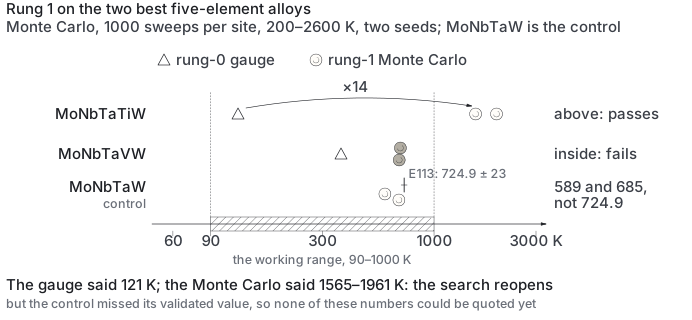
Do the two best five-element refractory alloys really order inside the 90–1000 K window?
Partly. MoNbTaVW orders inside, near 690 K; MoNbTaTiW stays above 1,565 K, though later checks showed its exact temperature is not known.
In the log: Do the refractory high-entropy alloys really order inside the window?
falsifiedDate not stated in the log; it was written between the commit of 2026-09-16 13:32 and the first commit that contains it, 2026-09-16 13:52rung 1 · ordering0 predictions · 2 result paragraphsEXPERIMENTS.md lines 8216–8246, lines 8397–8442, lines 8501–8521
What E135 did and how it came out, drawn from this record and the files it names (book/assets/diagrams/exp/E135.svg).
Results
EXPERIMENTS.md · line 8397
E135 result: prediction 2 FALSIFIED on its stated condition. MoNbTaTiW orders ABOVE the
window, and the rung-0 gate was wrong by a factor of fourteen at equiatomic.
Rung 1, 1000 sweeps per site, 34 rungs from 200 to 2600 K:
alloy        seed 1    seed 2    verdict       rung-0 gate said
MoNbTaTiW     1961 K    1565 K    crossover              121 K
MoNbTaVW       696 K     687 K    transition             367 K
MoNbTaW        589 K        —     crossover        (control)
Prediction 2 is falsified on exactly the condition written in advance — "Falsified if
either high-entropy alloy lands above 1000 K, which would mean the rung-0 gate is badly wrong
at equiatomic - where E99 says it is most reliable - and that the class was excluded by a bad
instrument rather than by physics. That is the outcome that would reopen the whole search."
MoNbTaTiW lands at 1565 and 1961 K, far above the 1000 K ceiling. It is a real,
well-studied refractory high-entropy alloy, and on this measurement it crosses no transition
inside the service window. The rung-0 gate put it at 121 K. That is not a lower bound being
conservative; it is wrong by a factor of about fourteen, at equiatomic, which is precisely
where E99 certified it as most reliable. E99's characterisation of the gate's validity domain
is itself now in question.
The search is reopened.E134's finding that the high-entropy class fails the requirement was
built on those rung-0 numbers and is withdrawn. The class was excluded by a broken
instrument.
Prediction 3 is also falsified, and it constrains what can be claimed. The control,
MoNbTaW, reads 589 K against E113's validated 724.9 +/- 23 K. That is far outside the
scatter. The likely cause is the temperature grid: E113 scanned 200-2400 K and this scanned
200-2600, so the A/T^2 tail is fitted over a different window and the baseline moves with it.
Prediction 3 said in advance that if the control did not reproduce, nothing else here could
be read quantitatively, and that stands.
What survives the control's failure. The discrepancy is about 19 per cent. Applied either
way to MoNbTaTiW's 1760 K mean it gives 1426 to 2165 K — still far above 1000. The
qualitative finding is robust to the control's error even though the numbers are not.
MoNbTaVW at ~690 K sits inside the window under any correction of that size.
Two things now need fixing before any number here is quoted:
The estimator's answer depends on the temperature range scanned, because the tail is
fitted on the hottest third of whatever ladder it is given. That is a defect in
order_disorder, not in the physics, and it makes every rung-1 value grid-dependent.
E99's validity domain for the rung-0 gate is wrong. It was measured off equiatomic and
concluded the gate is reliable at equiatomic. MoNbTaTiW is equiatomic and the gate was out
by 14x.
EXPERIMENTS.md · line 8501
E135 completed — the control's second seed makes the scatter problem worse, not better.
E113 measured the control at 724.9 +/- 23 K on a 200-2400 K ladder. Here, on 200-2600 K,
it reads 637 K mean with a 96 K spread — the mean is 88 K low and the seed scatter is
four times the 23 K E113 documented at this exact budget. Neither seed reaches E113's value.
So two things are wrong at once, and they are separable by E138: the ceiling may be shifting
the baseline, and the scatter E113 reported may have been optimistic. spec.py currently
carries 23 K as rung 1's error. That figure is not reproducing and should not be quoted until
E138 lands.
MoNbTaTiW's own scatter is 396 K, by far the largest here. That is a caution on the
number and not on the conclusion: both seeds sit above 1000 K, and the gap from the window
ceiling is 565 K at the lower one. MoNbTaVW is the tightest measurement of the three at
9 K spread, and it sits squarely inside the window at 691 K — it fails the requirement, and
that reading is the most trustworthy of the six.
The full record
This entry is written in 3 separate places in the log, shown here in log order.
EXPERIMENTS.md · lines 8216–8246
E135 — Do the refractory high-entropy alloys really order inside the window?
E134 found that the two best five-element compositions in the grid order at 121 K
(MoNbTaTiW) and 367 K (MoNbTaVW) — both inside the 90–1000 K service window, so both fail
the requirement. If that holds under a proper measurement it is the answer to the question the
project was built to ask, and the answer is no: no refractory high-entropy alloy in this
element set holds a single phase across the window.
But those are rung-0 numbers, and the rung-0 ordering estimate is a lower bound whose error
E99 measured as one-signed and always downward. A reading of 121 K is consistent with a real
transition anywhere above it — including above 1000 K, which would pass. The estimate cannot
settle this and rung 1 can.
Rung 1 on both, plus MoNbTaW as the control, since E113 measured it at 724.9 K against
a published 717 K and it is the only composition whose rung-1 value has been validated.
Predicted:
Rung 1 returns higher than rung 0 for all three, because the gate is a lower bound.
For MoNbTaW the gate reads about 445 K (E98) against rung 1's 724.9 — a ratio near 1.6.
Both high-entropy alloys still order inside the window. Scaling by that ratio puts
MoNbTaTiW near 200 K and MoNbTaVW near 590 K, both well inside 90–1000. If so, the
refractory high-entropy class fails the requirement on physics, not on bookkeeping, and
the binaries were never crowding it out — they were the only things that could pass.
The control reproduces near 725 K, within the 23 K scatter E113 measured at this budget.
If it does not, rung 1 has drifted since E113 and nothing else here can be read.
Falsified if either high-entropy alloy lands above 1000 K, which would mean the rung-0 gate
is not merely a lower bound but badly wrong at equiatomic — where E99 says it is most reliable
— and that the class was excluded by a bad instrument rather than by physics. That is the
outcome that would reopen the whole search.
EXPERIMENTS.md · lines 8397–8442
E135 result: prediction 2 FALSIFIED on its stated condition. MoNbTaTiW orders ABOVE the
window, and the rung-0 gate was wrong by a factor of fourteen at equiatomic.
Rung 1, 1000 sweeps per site, 34 rungs from 200 to 2600 K:
alloy        seed 1    seed 2    verdict       rung-0 gate said
MoNbTaTiW     1961 K    1565 K    crossover              121 K
MoNbTaVW       696 K     687 K    transition             367 K
MoNbTaW        589 K        —     crossover        (control)
Prediction 2 is falsified on exactly the condition written in advance — "Falsified if
either high-entropy alloy lands above 1000 K, which would mean the rung-0 gate is badly wrong
at equiatomic - where E99 says it is most reliable - and that the class was excluded by a bad
instrument rather than by physics. That is the outcome that would reopen the whole search."
MoNbTaTiW lands at 1565 and 1961 K, far above the 1000 K ceiling. It is a real,
well-studied refractory high-entropy alloy, and on this measurement it crosses no transition
inside the service window. The rung-0 gate put it at 121 K. That is not a lower bound being
conservative; it is wrong by a factor of about fourteen, at equiatomic, which is precisely
where E99 certified it as most reliable. E99's characterisation of the gate's validity domain
is itself now in question.
The search is reopened.E134's finding that the high-entropy class fails the requirement was
built on those rung-0 numbers and is withdrawn. The class was excluded by a broken
instrument.
Prediction 3 is also falsified, and it constrains what can be claimed. The control,
MoNbTaW, reads 589 K against E113's validated 724.9 +/- 23 K. That is far outside the
scatter. The likely cause is the temperature grid: E113 scanned 200-2400 K and this scanned
200-2600, so the A/T^2 tail is fitted over a different window and the baseline moves with it.
Prediction 3 said in advance that if the control did not reproduce, nothing else here could
be read quantitatively, and that stands.
What survives the control's failure. The discrepancy is about 19 per cent. Applied either
way to MoNbTaTiW's 1760 K mean it gives 1426 to 2165 K — still far above 1000. The
qualitative finding is robust to the control's error even though the numbers are not.
MoNbTaVW at ~690 K sits inside the window under any correction of that size.
Two things now need fixing before any number here is quoted:
The estimator's answer depends on the temperature range scanned, because the tail is
fitted on the hottest third of whatever ladder it is given. That is a defect in
order_disorder, not in the physics, and it makes every rung-1 value grid-dependent.
E99's validity domain for the rung-0 gate is wrong. It was measured off equiatomic and
concluded the gate is reliable at equiatomic. MoNbTaTiW is equiatomic and the gate was out
by 14x.
EXPERIMENTS.md · lines 8501–8521
E135 completed — the control's second seed makes the scatter problem worse, not better.
E113 measured the control at 724.9 +/- 23 K on a 200-2400 K ladder. Here, on 200-2600 K,
it reads 637 K mean with a 96 K spread — the mean is 88 K low and the seed scatter is
four times the 23 K E113 documented at this exact budget. Neither seed reaches E113's value.
So two things are wrong at once, and they are separable by E138: the ceiling may be shifting
the baseline, and the scatter E113 reported may have been optimistic. spec.py currently
carries 23 K as rung 1's error. That figure is not reproducing and should not be quoted until
E138 lands.
MoNbTaTiW's own scatter is 396 K, by far the largest here. That is a caution on the
number and not on the conclusion: both seeds sit above 1000 K, and the gap from the window
ceiling is 565 K at the lower one. MoNbTaVW is the tightest measurement of the three at
9 K spread, and it sits squarely inside the window at 691 K — it fails the requirement, and
that reading is the most trustworthy of the six.
Related entries
E134 — The project has never required an alloy to be a high-entropy alloy
E99 — Checking rung 0's ordering gate against rung 1, on the fly's own finds