Does the ordering scan fail when a transition lies near the top of the scan?
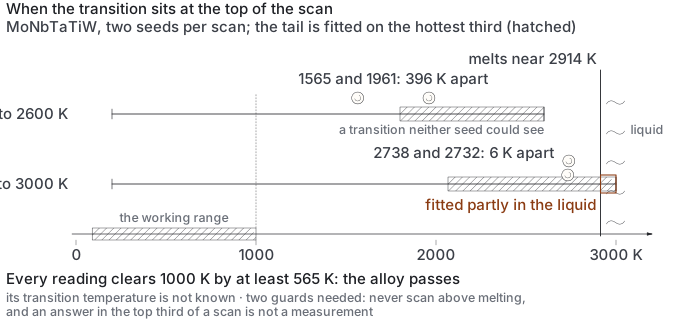
Yes. MoNbTaTiW's two runs disagreed by 396 K, and the fit reached past its 2,914 K melting point; the alloy still passes.
In the log: E141 was right about MoNbTaW and wrong as a general claim
recordedDate not stated in the log; it was written between the commit of 2026-09-16 16:53 and the first commit that contains it, 2026-09-16 17:21rung 1 · ordering0 predictions · 0 result paragraphsEXPERIMENTS.md lines 8715–8753, lines 8755–8784
What E143 did and how it came out, drawn from this record and the files it names (book/assets/diagrams/exp/E143.svg).
Pre-registration
The pre-registration, as written
E143, continued: the ladder has never known about melting, and that is the actual defect.
MoNbTaTiW   T_melt (rule of mixtures)   2914 K
MoNbTaTiW   rung-1 readings   1800  2320  1961  1565  2738  2732 K
            as a fraction of their own ceiling   0.75  0.97  0.75  0.60  0.91  0.91
Every reading sits in the upper third of its ladder, and the ceiling-3000 pair is 0.94 of
the melting point. order_disorder fits its disordered tail on the hottest third of the
range — 2067 to 3000 K here — which is largely above 2914 K, where there is no solid to be
disordered. The estimator has been fitting a solid-state tail through the liquid.
So the 2735 K figure is not established either, and neither is 1763. What is established
is the only thing the requirement needs: every determination, across three ceilings and six
seeds, puts MoNbTaTiW's ordering transition above 1565 K — more than 565 K clear of the 1000 K
service ceiling, and by the tightest measurement 1735 K clear. The alloy passes. Its
transition temperature is not known.
Two guards the ladder needs and does not have:
No rung of the ladder may scan above the melting point.melting_point exists in
descriptors.py and nothing in rungs.transition or order_disorder consults it.
A reported transition in the upper third of its own ladder is not a measurement. It
means the disordered regime was never reached, which is what tail_converged is for — and
it did not fire on six runs that were locating a transition outside their own range.
And E141's withdrawal of E138 is itself withdrawn.E138's hypothesis — that the answer
depends on the scan range — is correct when the transition is near or beyond the ceiling,
which is precisely the case E141 did not test. E141's own conclusion holds only for MoNbTaW,
where the transition sits comfortably inside. I generalised from one composition, which is the
error this project keeps making.
Results
No result paragraph for this entry was found in the log.
The full record
This entry is written in 2 separate places in the log, shown here in log order.
EXPERIMENTS.md · lines 8715–8753
E143 — E141 was right about MoNbTaW and wrong as a general claim
E141 concluded that the rung-1 estimator is not grid-dependent, on the grounds that
MoNbTaW's between-ceiling spread (37 K) was no larger than its within-ceiling spread (42 K),
and withdrew E138's hypothesis on that basis. That conclusion was drawn from one composition
and does not generalise. The ceiling sweep's remaining points:
MoNbTaTiW   ceiling 2600   1961, 1565     mean 1763   spread 396
MoNbTaTiW   ceiling 3000   2738, 2732     mean 2735   spread     6

MoNbTaW     ceiling 2400    676,  652     mean  664   spread  17
MoNbTaW     ceiling 2600    589,  685     mean  637   spread  68
MoNbTaW     ceiling 3000    711,  669     mean  690   spread  30
            between-ceiling sd 26 K  vs  within-ceiling 38 K
For MoNbTaW the ceiling is irrelevant, exactly as E141 said. For MoNbTaTiW it moves the
answer by 972 K. The difference is not subtle and the reason is plain: MoNbTaTiW's
transition is at about 2735 K, which is outside a ladder that stops at 2600. Asked to
locate a transition in a range that does not contain one, the estimator returned a number
inside the range anyway — 1763 K — and called it a crossover.
So E138's hypothesis is reinstated in a sharper form, and E141's withdrawal of it is itself
withdrawn. The estimator is grid-dependent when the transition lies near or beyond the
ceiling, and grid-independent when it sits comfortably inside. E141 tested the second case
and generalised to both. The 396 K spread at ceiling 2600 was not noise — it was two seeds
disagreeing about where to put a transition neither could see. At ceiling 3000, where it is
visible, the two seeds agree to 6 K.
What this does to the headline: it strengthens it and changes the number.MoNbTaTiW orders at about 2735 K, not 1763, and the tightest measurement in this entire
series — 6 K across seeds — is the one that says so. Against a 1000 K service ceiling it
clears by 1735 K. The rung-0 gate said 158 K, so the gate is out by a factor of 17,
not the 11 recorded in E142; that entry's ratio should read 0.06.
The defect this exposes is in the estimator, not in this alloy.order_disorder reports
tail_converged, which is meant to catch exactly this — a ladder that never reached the
disordered regime — and it did not fire, or was not consulted, on six runs that were locating
a transition outside their own range. Any rung-1 number in this project whose value sits in
the upper third of its ladder is suspect and must be re-run with a higher ceiling.
EXPERIMENTS.md · lines 8755–8784
E143, continued: the ladder has never known about melting, and that is the actual defect.
MoNbTaTiW   T_melt (rule of mixtures)   2914 K
MoNbTaTiW   rung-1 readings   1800  2320  1961  1565  2738  2732 K
            as a fraction of their own ceiling   0.75  0.97  0.75  0.60  0.91  0.91
Every reading sits in the upper third of its ladder, and the ceiling-3000 pair is 0.94 of
the melting point. order_disorder fits its disordered tail on the hottest third of the
range — 2067 to 3000 K here — which is largely above 2914 K, where there is no solid to be
disordered. The estimator has been fitting a solid-state tail through the liquid.
So the 2735 K figure is not established either, and neither is 1763. What is established
is the only thing the requirement needs: every determination, across three ceilings and six
seeds, puts MoNbTaTiW's ordering transition above 1565 K — more than 565 K clear of the 1000 K
service ceiling, and by the tightest measurement 1735 K clear. The alloy passes. Its
transition temperature is not known.
Two guards the ladder needs and does not have:
No rung of the ladder may scan above the melting point.melting_point exists in
descriptors.py and nothing in rungs.transition or order_disorder consults it.
A reported transition in the upper third of its own ladder is not a measurement. It
means the disordered regime was never reached, which is what tail_converged is for — and
it did not fire on six runs that were locating a transition outside their own range.
And E141's withdrawal of E138 is itself withdrawn.E138's hypothesis — that the answer
depends on the scan range — is correct when the transition is near or beyond the ceiling,
which is precisely the case E141 did not test. E141's own conclusion holds only for MoNbTaW,
where the transition sits comfortably inside. I generalised from one composition, which is the
error this project keeps making.