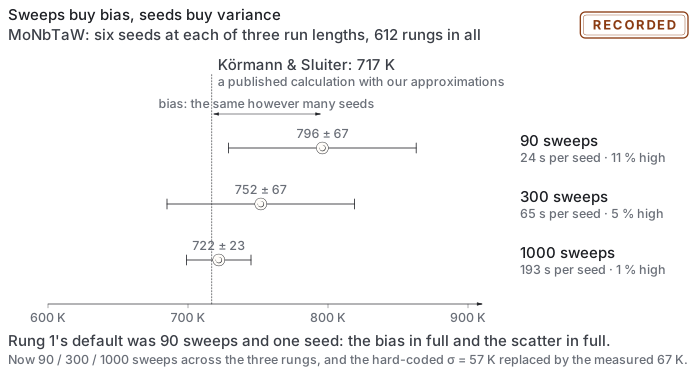
Does running more independent copies of the sampler remove its error in ordering temperature?
Partly. More copies shrink the scatter, but only longer runs remove the bias: 11 per cent high at 90 sweeps, 1 per cent at 1000.
In the log: What rung 1 actually needs: sweeps buy bias, seeds buy variance
recordedDate not stated in the log; it was written between the commit of 2026-09-13 08:16 and the first commit that contains it, 2026-09-16 02:04rung 1 · ordering0 predictions · 0 result paragraphsEXPERIMENTS.md lines 6582–6619
What E113 did and how it came out, drawn from this record and the files it names (book/assets/diagrams/exp/E113.svg).
Results
No result paragraph for this entry was found in the log.
Three full ladders on MoNbTaW - 90, 300 and 1000 sweeps per site, six independent seeds each,
34 rungs from 200 to 2400 K, 612 rungs in all - read with the repaired A/T^2 baseline. The
reference is Körmann & Sluiter's 717 K, the published calculation making our
approximations: static ideal lattice, unrelaxed, configurational entropy only.
sweeps/site   centre of mass       parabolic peak       cost/seed
         90    778 +/- 77 (1.08)    796 +/- 67 (1.11)        24 s
        300    776 +/- 79 (1.08)    752 +/- 67 (1.05)        65 s
       1000    722 +/- 23 (1.01)    722 +/- 23 (1.01)       193 s
The two quantities behave differently and the ladder had been spending on the wrong one.
Scatter falls with seeds, as 1/sqrt(n), and is what the code already reported. Bias does not:
at 90 sweeps the answer sits 11 per cent high however many seeds are averaged into it.
Rung 1's default was 90 sweeps and one seed, which is the worst corner of this table - the
bias in full and the scatter in full.
Changed: default_ladder now spends on sweeps first, 90 / 300 / 1000 across the three rungs,
and the hardcoded single-seed sigma = 57.0 is replaced by the measured figure at the budget
actually used, which at 90 sweeps is 67 and not 57.
Two corrections to what was written earlier today.
First, E110's claim that the centre-of-mass estimator scatters four times more than the peak
was an artefact of a defect in the repair itself: the drift mask was applied to the centre of
mass but not to the peak, so an unequilibrated cold rung could still set it. With the mask on
both, the two estimators agree wherever the sampling is converged. The parabolic peak is kept
for sub-rung resolution - a 50 K ladder otherwise quantises the answer onto a rung - not for
precision. Both are returned.
Second, the ladder ran to 2100 K and the tail is fitted on its hottest third. The published
comparison set reaches 1760 K, which sat inside that fitting window, so for the hottest
compositions A was fitted through the transition and the peak subtracted away. The ladder now
runs to 2600 K, and order_disorder reports tail_converged - measured by splitting the
fitting window and comparing its halves - instead of returning a number fitted through a
transition. On the converged MoNbTaW trace it reports 724.9 K, tail converged, verdict
crossover, against 717 K.