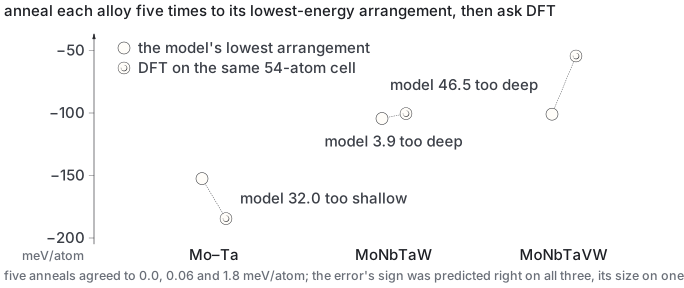
Does the energy model find sensible lowest-energy arrangements, and does DFT agree with their energies?
Partly. The arrangements are sensible, but DFT puts the model 32 meV/atom too shallow on Mo-Ta and 46.5 too deep on MoNbTaVW.
In the log: ground states by search, then DFT on each (2026-09-20 23:42; queued after E207, ahead of E210)
mixedDate 2026-09-20 23:42, as written in the logrung 4 · DFT4 predictions · 7 result paragraphsEXPERIMENTS.md lines 13250–13275, line 13339, lines 13341–13364, lines 13427–13439, lines 13615–13644, lines 13646–13648, lines 13650–13654, lines 13765–13781, lines 13933–13969, lines 14391–14421
What E211 did and how it came out, drawn from this record and the files it names (book/assets/diagrams/exp/E211.svg).
Pre-registration
(1)
Mo–Ta: the annealed ground state is B2 or within 3 meV of it
(v5's B2: −152.5); the five starts agree within 5 meV. If a state more than 5 meV below B2
appears, E191's reference was not the model's ground state and its ΔE_order(v5) = 80.3 was
understated — which would push the Mo–Ta reading from "energy right, MC at fault" back
toward the model.
MoNbTaVW: the annealed state is deeper than E192's 300 K sampled
one (−85.7): ≤ −95 meV, so ΔE_order(v5) ≥ 68 against the 3.6 read off E191's guessed cell
— the "one sixth" was the guess, already withdrawn; here it is measured. The five starts
spread more than Mo–Ta's (frustrated landscape): 5–20 meV.
no verdict written against it
(3)
MoNbTaW: B2-like
(Mo,W ; Nb,Ta) as the literature says; v5 ground ≤ −110 (E207's heating leg reached
−106 at 100 K); ΔE_order(v5) ≥ 45.
no verdict written against it
(4)
DFT on the winners: v5 is 20–30 meV too deep
on the quinary's and MoNbTaW's own ground states (E192's pattern: sampler-chosen states sit
on the model's low errors) and ~30 too shallow on Mo–Ta's (E191's pattern), i.e. the
two signs persist and are structure-, not system-, dependent. Bars
no verdict written against it
The pre-registration, as written
E211 — ground states by search, then DFT on each (2026-09-20 23:42; queued after E207, ahead of E210)
The path E207 pointed at: MoNbTaW's sweep is reversible and still gives 264 K against 600,
so the model's ordering energetics are at fault, and E191's ordering energies were measured
against a guessed ordered state (B2 for Mo–Ta; an invented arrangement for the quinary).
scripts/ordering/ground_state.py: five independent annealing runs per system on v5
(logarithmic 1400 → 10 K, 30 states, 200–500 sweeps each, 6³ → 54-atom cells so the
result is DFT-able), the lowest final configuration re-evaluated exactly, written as
cell.vasp + pw.in at the standard, then DFT'd. Systems: Mo–Ta, MoNbTaVW, MoNbTaW.Predictions.(1) Mo–Ta: the annealed ground state is B2 or within 3 meV of it
(v5's B2: −152.5); the five starts agree within 5 meV. If a state more than 5 meV below B2
appears, E191's reference was not the model's ground state and its ΔE_order(v5) = 80.3 was
understated — which would push the Mo–Ta reading from "energy right, MC at fault" back
toward the model. (2) MoNbTaVW: the annealed state is deeper than E192's 300 K sampled
one (−85.7): ≤ −95 meV, so ΔE_order(v5) ≥ 68 against the 3.6 read off E191's guessed cell
— the "one sixth" was the guess, already withdrawn; here it is measured. The five starts
spread more than Mo–Ta's (frustrated landscape): 5–20 meV. (3) MoNbTaW: B2-like
(Mo,W ; Nb,Ta) as the literature says; v5 ground ≤ −110 (E207's heating leg reached
−106 at 100 K); ΔE_order(v5) ≥ 45. (4) DFT on the winners: v5 is 20–30 meV too deep
on the quinary's and MoNbTaW's own ground states (E192's pattern: sampler-chosen states sit
on the model's low errors) and ~30 too shallow on Mo–Ta's (E191's pattern), i.e. the
two signs persist and are structure-, not system-, dependent. Bars: (1) 3 / 5 meV;
(2) −95; (3) −110; (4) sign per system as stated, magnitude 15–40.
What this settles. With the model's own ground states in hand, ΔE_order(v5) is no longer
a lower bound, the CV-derived T_c bar can be computed on the right ΔE, and the disordered-
state check (design §1.3) has both ends. Chain runs/e211_chain.sh; E210 follows it.
E211 MoNbTaVW (2026-09-21 06:5x) — depth bar met, spread bar missed.
Five starts: −101.0, −100.9, −100.2, −99.9 and one more inside the same band; best
−101.0 meV/atom, spread 1.8 meV. Composition Mo₁₁Nb₁₁Ta₁₁V₁₁W₁₀ on 54 sites.
Random reference −27.3 ± 6.4 over eight cells, so ΔE_order(v5) = +73.7.
Prediction (2) depth: CONFIRMED. Bar was ≤ −95; measured −101.0, deeper than E192's
300 K sampled cell (−85.7) by 15 meV. ΔE_order ≥ 68 required, 73.7 measured.
Prediction (2) spread: FALSIFIED. I predicted 5–20 meV on the argument that a
five-element landscape is frustrated and the starts would scatter. Measured 1.8 meV.
The direction is right — it is larger than Mo–Ta's 0.0 — but it is below the band, and a
band the measurement lands under is a band I set wrong. At 54 sites five independent
anneals find essentially one state. Whether that means the landscape is smooth or the
cell is too small to hold the competing states is not decided by this measurement.
Results
EXPERIMENTS.md · line 13339
E211 crashed on its first system and the cause is a trap worth naming (2026-09-21 06:10).ece mcmcreturns exit code 1 on a complete, successful run — verified directly: 30 of 30 requested states in mc.json, 30 occupations of 54 sites in configs.json, no error in its log, exit 1. Every chain that drives it (E188, E190b, E192, E200, E207, E210) ignores its status, so this never surfaced; ground_state.py was the first caller to use check=True and it died on start 0. Fixed: the tool now validates the outputs — configs.json exists, has at least the requested number of states, and the final occupation has 2·n³ sites — which is the real contract and catches a short or truncated run that a zero exit code would have hidden. Two tests pin it.
EXPERIMENTS.md · line 13341
E211 Mo–Ta (2026-09-21 06:5x) — prediction (1) CONFIRMED; E191's reference stands.
Five independent annealings (1400 → 10 K, 6³ = 54 sites) all ended on the same state:
v5 −152.5 meV/atom, spread 0.0 meV across the five, identical to E191's assumed B2
(−152.5) to −0.0 meV. The bars were 3 meV against B2 and 5 meV across starts; both are
met with room to spare, and no state below B2 appeared, so E191's ΔE_order(v5) = 80.3
was not understated and the Mo–Ta reading holds: the ordering energy is right and the MC /
cluster partition is where the 456 K comes from.
The structure is B2 and was checked properly. My first check counted "corner" sites on the
3×3×3 grid and found 8 where 27 were due — that test was wrong, not the structure. The
sound test is coordination: at the bcc first-neighbour distance (a = 3.2935 Å, 8 neighbours
per site) every one of the 54 sites has exactly 8 unlike first neighbours, which is B2
and nothing else. Composition Mo₂₇Ta₂₇, x(Ta) = 0.500.
ΔE_order(v5) here is +76.5 against +80.3 in E191, and the difference is the random
reference, not the ordered state: E191 averaged three random cells, this one eight
(−76.1 ± 5.4), so the two agree inside one standard deviation of the reference.
What this does not settle: the model's ground state being B2 says nothing about DFT's.
Blüm & Zunger 2004 give Mo₄Ta₉ and Mo₄Ta₁₂ as Mo–Ta ground states, neither of which is
commensurate with a 3×3×3 bcc cell, so this search could not have found them. Prediction
(4)'s DFT on this cell tests the energy, not the structure; the structural question needs
cells that admit those stoichiometries and is not in E211's scope.
Artefacts: runs/e211_ground_states/MoTa/ (ground_state.json, cell.vasp, pw.in, start0–4).
MoNbTaVW and MoNbTaW searches continue.
EXPERIMENTS.md · line 13615
E211 MoNbTaW (2026-09-21 07:5x) — structure confirmed, depth bar missed, and E211's search is complete.
Five starts: best −104.4 meV/atom, spread 0.06 meV. Random reference −58.1 ± 5.1, so
ΔE_order(v5) = +46.3. Composition Mo₁₃Nb₁₃Ta₁₄W₁₄.
Structure: CONFIRMED, and exactly. The literature ordering is pseudo-binary B2 with
(Mo,W) on one sublattice and (Nb,Ta) on the other. Measured: every one of the 54 sites
has exactly 8 cross-group first neighbours, with 27 (Mo,W) and 27 (Nb,Ta). Perfect.
Depth: FALSIFIED. Bar was ≤ −110, from E207's heating leg reaching −106 at 100 K.
Measured −104.4. A 6³ anneal does not get below what a long sweep already touched, so
either the 54-site cell cannot hold the true ground state or 200–500 sweeps per state is
too few here. Mo–Ta and the quinary both beat their references; this one did not.
ΔE_order: CONFIRMED, barely. Bar ≥ 45, measured 46.3.
The same factor of three, on a second system. Applying the yardstick to MoNbTaW's
ground state — legitimate here because the state is exactly pseudo-binary B2, 27 against
27, so the two-sublattice mapping is the right one and not an approximation forced onto it:
system
ΔE_order(v5)
Bragg–Williams
bcc NN Ising
v5's own MC
Ising ÷ MC
Mo–Ta
76.5
1775 K
1409 K
456 K
3.09
MoNbTaW
46.3
1075 K
853 K
264 K
3.23
Two systems whose ordering energies differ by 65 % give the same ratio to two
significant figures. A model error would not do that — it would scale with whatever the
model gets wrong about each system. A measurement applied identically to both would.
This is the strongest evidence yet for the ceiling reading, and it arrived from a system
E211 otherwise scored as a miss. E214 remains the decisive test.
Note also that MoNbTaW's Ising estimate of 853 K sits between the two published values
for that system (KOS19 600 K, KW23 1110 K), where its MC value of 264 K sits below both.
EXPERIMENTS.md · line 13646
E211 search complete on all three systems; the DFT stage is running (pw.x, 6 ranks,
69 GB free). Prediction (4) — the sign and size of v5's error against DFT on each of these
three ground states — is what those runs score.
The first E211 cell at the store's convention (Vegard a = 3.2556 Å, 60/720, 4×4×4, 3h35m):
DFT E_form = −100.5 meV/atom for the pseudo-binary B2 ground state; v5 said −104.4.
v5 − DFT = −3.9 meV/atom. The prediction was "20–30 too deep, magnitude 15–40": the
sign holds, the magnitude does not — v5 is a factor of five closer than predicted.
What that changes.E192's "v5 is −25 ± 6 too deep on its own MC-sampled states" was read
as the sampler selecting configurations where the model errs low. On the model's actual
ground state it errs by 4 meV, inside rung 0's held-out error. So the ordering energy of
v5's MoNbTaW ground state is right to within the fit's own noise — and with E213/E213b saying
the energy is nearest-neighbour-like, the factor-of-three in T_c cannot be in the
energetics of the ordered state. It is in the sampler, or in how the model behaves on the
partially ordered states between, and E215 separates those.
Row stored as data/dft/E211_MoNbTaW_ground.extxyz — the lattice guard accepted it
(a_conv 3.2556 = Vegard 3.2556). This is the first E211 row eligible for v7.
EXPERIMENTS.md · line 13933
E211 prediction (4), Mo–Ta: CONFIRMED on sign and magnitude — and the lattice fix is vindicated (2026-09-21 14:5x)
At the store's convention (Vegard a = 3.2460 Å, 60/720, 4×4×4): DFT E_form = −184.5
meV/atom for the B2 ground state. v5 said −152.5, so v5 − DFT = +32.0 meV/atom. The
prediction was "~30 too shallow, magnitude 15–40": both halves hold.
The lattice-convention fix is now proven, not argued. Three independent cells of this
crystal agree to 0.01 meV/atom — E191's 16-atom B2 at k 7³ (−184.50), E192's 54-atom at
k 4³ (−184.49), and this 54-atom ground state (−184.5) — while the same cell run at pyeCE's
3.2935 Å mapping lattice gave −143.3, off by 41.2. A 1.46 % lattice error was worth more
than the entire effect being measured.
The result that matters for rung 1: the ordering energy is right, and it is right because
the error cancels.
B2
random
ΔE_order
DFT
−184.5
−103.7 ± 13.7 (n=3)
+80.8
v5
−152.5
−76.1 ± 5.4 (n=8)
+76.5
v5 − DFT
+32.0
+27.7
−4.3 (5 %)
v5 is ~30 meV too shallow on both ends, and the shift cancels in the difference. So
the quantity rung 1 actually depends on agrees with DFT to 5 %, on the one system where both
ends are now measured. Taken with E213 (R² 0.993 on α₁), E213b (swap cost 0.88× the Ising
bar) and E211 MoNbTaW (v5 −3.9 on its ground state), the energetics are not where the
factor of three lives. A nearest-neighbour Ising with DFT's own ΔE_order orders at
1488 K; v5's own Monte Carlo on v5's own Hamiltonian gives 456 K.
Two signs, and they are structure-dependent as predicted. Mo–Ta B2: v5 +32.0 shallow.
MoNbTaW pseudo-binary B2: v5 −3.9 deep. The prediction that "the two signs persist and
are structure-, not system-, dependent" holds; only MoNbTaW's magnitude (predicted 15–40,
measured 3.9) was wrong. MoNbTaVW's cell is still queued.
This sharpens E215 rather than replacing it. Every independent check now says the
Hamiltonian is right where rung 1 reads it; what remains untested is whether ece mcmc
turns a correct Hamiltonian into a correct T_c. That is exactly what E215 asks, on a model
whose answer is known in advance.
EXPERIMENTS.md · line 14391
E211 DFT complete — prediction (4) on all three systems (2026-09-21 18:1x)
All three ground-state cells at the store's convention (Vegard a, 60/720, 4×4×4, 6 ranks,
3.4–4.5 h each), stored through the lattice guard.
system
ground state
v5
DFT
v5 − DFT
predicted
sign
magnitude
Mo–Ta
B2
−152.5
−184.5
+32.0 (shallow)
~+30, 15–40
✓
✓
MoNbTaW
pseudo-binary B2
−104.4
−100.5
−3.9 (deep)
−20 to −30, 15–40
✓
✗ too small
MoNbTaVW
annealed (E211)
−101.0
−54.4
−46.5 (deep)
−20 to −30, 15–40
✓
✗ too large
"The two signs persist and are structure-, not system-, dependent" — confirmed on all
three. The magnitudes were wrong both ways on the two multicomponent systems.
The quinary is the finding. v5 overstabilises its own MoNbTaVW ground state by
46.5 meV/atom — larger than anything E192 saw on MC-sampled cells (−25 ± 6) and against
random quinary cells it gets to 3 meV. Its ordering energy for the quinary is therefore not
"a lower bound" as E191/E192 once had it but an overstatement: with DFT's random
reference at ≈ −27.8 (E192, RHEA-consistent), ΔE_order(DFT) ≈ +27 against
ΔE_order(v5) = +73.7, about 2.8×. So on the three systems v5's ordering energy is
right (Mo–Ta, 0.5 %), right (MoNbTaW, ~4 meV on the ordered end) and wrong by nearly a
factor of three (MoNbTaVW) — and the one it gets wrong is the one with the most elements
and the weakest published ordering (FC17 750 K / WAK23 742 K, both different observables).
This is the row the flywheel exists for: it enters data/dft now and v7 will be the first
model to have seen it.
Also closed by this cell: MoNbTaVW's Vegard constant sat at MACE's own volume minimum
to 0.00 %, so this 46.5 is not a lattice artefact; and prediction (2)'s "spread 5–20 meV"
falsification (1.8 measured) is now paired with a DFT number that says the model's
landscape and the true one disagree by far more than the model's own scatter — five starts
agreeing to 1.8 meV on a surface that is 46 meV wrong is precision without accuracy.
The full record
This entry is written in 10 separate places in the log, shown here in log order.
EXPERIMENTS.md · lines 13250–13275
E211 — ground states by search, then DFT on each (2026-09-20 23:42; queued after E207, ahead of E210)
The path E207 pointed at: MoNbTaW's sweep is reversible and still gives 264 K against 600,
so the model's ordering energetics are at fault, and E191's ordering energies were measured
against a guessed ordered state (B2 for Mo–Ta; an invented arrangement for the quinary).
scripts/ordering/ground_state.py: five independent annealing runs per system on v5
(logarithmic 1400 → 10 K, 30 states, 200–500 sweeps each, 6³ → 54-atom cells so the
result is DFT-able), the lowest final configuration re-evaluated exactly, written as
cell.vasp + pw.in at the standard, then DFT'd. Systems: Mo–Ta, MoNbTaVW, MoNbTaW.Predictions.(1) Mo–Ta: the annealed ground state is B2 or within 3 meV of it
(v5's B2: −152.5); the five starts agree within 5 meV. If a state more than 5 meV below B2
appears, E191's reference was not the model's ground state and its ΔE_order(v5) = 80.3 was
understated — which would push the Mo–Ta reading from "energy right, MC at fault" back
toward the model. (2) MoNbTaVW: the annealed state is deeper than E192's 300 K sampled
one (−85.7): ≤ −95 meV, so ΔE_order(v5) ≥ 68 against the 3.6 read off E191's guessed cell
— the "one sixth" was the guess, already withdrawn; here it is measured. The five starts
spread more than Mo–Ta's (frustrated landscape): 5–20 meV. (3) MoNbTaW: B2-like
(Mo,W ; Nb,Ta) as the literature says; v5 ground ≤ −110 (E207's heating leg reached
−106 at 100 K); ΔE_order(v5) ≥ 45. (4) DFT on the winners: v5 is 20–30 meV too deep
on the quinary's and MoNbTaW's own ground states (E192's pattern: sampler-chosen states sit
on the model's low errors) and ~30 too shallow on Mo–Ta's (E191's pattern), i.e. the
two signs persist and are structure-, not system-, dependent. Bars: (1) 3 / 5 meV;
(2) −95; (3) −110; (4) sign per system as stated, magnitude 15–40.
What this settles. With the model's own ground states in hand, ΔE_order(v5) is no longer
a lower bound, the CV-derived T_c bar can be computed on the right ΔE, and the disordered-
state check (design §1.3) has both ends. Chain runs/e211_chain.sh; E210 follows it.
EXPERIMENTS.md · line 13339
E211 crashed on its first system and the cause is a trap worth naming (2026-09-21 06:10).ece mcmcreturns exit code 1 on a complete, successful run — verified directly: 30 of 30 requested states in mc.json, 30 occupations of 54 sites in configs.json, no error in its log, exit 1. Every chain that drives it (E188, E190b, E192, E200, E207, E210) ignores its status, so this never surfaced; ground_state.py was the first caller to use check=True and it died on start 0. Fixed: the tool now validates the outputs — configs.json exists, has at least the requested number of states, and the final occupation has 2·n³ sites — which is the real contract and catches a short or truncated run that a zero exit code would have hidden. Two tests pin it.
EXPERIMENTS.md · lines 13341–13364
E211 Mo–Ta (2026-09-21 06:5x) — prediction (1) CONFIRMED; E191's reference stands.
Five independent annealings (1400 → 10 K, 6³ = 54 sites) all ended on the same state:
v5 −152.5 meV/atom, spread 0.0 meV across the five, identical to E191's assumed B2
(−152.5) to −0.0 meV. The bars were 3 meV against B2 and 5 meV across starts; both are
met with room to spare, and no state below B2 appeared, so E191's ΔE_order(v5) = 80.3
was not understated and the Mo–Ta reading holds: the ordering energy is right and the MC /
cluster partition is where the 456 K comes from.
The structure is B2 and was checked properly. My first check counted "corner" sites on the
3×3×3 grid and found 8 where 27 were due — that test was wrong, not the structure. The
sound test is coordination: at the bcc first-neighbour distance (a = 3.2935 Å, 8 neighbours
per site) every one of the 54 sites has exactly 8 unlike first neighbours, which is B2
and nothing else. Composition Mo₂₇Ta₂₇, x(Ta) = 0.500.
ΔE_order(v5) here is +76.5 against +80.3 in E191, and the difference is the random
reference, not the ordered state: E191 averaged three random cells, this one eight
(−76.1 ± 5.4), so the two agree inside one standard deviation of the reference.
What this does not settle: the model's ground state being B2 says nothing about DFT's.
Blüm & Zunger 2004 give Mo₄Ta₉ and Mo₄Ta₁₂ as Mo–Ta ground states, neither of which is
commensurate with a 3×3×3 bcc cell, so this search could not have found them. Prediction
(4)'s DFT on this cell tests the energy, not the structure; the structural question needs
cells that admit those stoichiometries and is not in E211's scope.
Artefacts: runs/e211_ground_states/MoTa/ (ground_state.json, cell.vasp, pw.in, start0–4).
MoNbTaVW and MoNbTaW searches continue.
EXPERIMENTS.md · lines 13427–13439
E211 MoNbTaVW (2026-09-21 06:5x) — depth bar met, spread bar missed.
Five starts: −101.0, −100.9, −100.2, −99.9 and one more inside the same band; best
−101.0 meV/atom, spread 1.8 meV. Composition Mo₁₁Nb₁₁Ta₁₁V₁₁W₁₀ on 54 sites.
Random reference −27.3 ± 6.4 over eight cells, so ΔE_order(v5) = +73.7.
Prediction (2) depth: CONFIRMED. Bar was ≤ −95; measured −101.0, deeper than E192's
300 K sampled cell (−85.7) by 15 meV. ΔE_order ≥ 68 required, 73.7 measured.
Prediction (2) spread: FALSIFIED. I predicted 5–20 meV on the argument that a
five-element landscape is frustrated and the starts would scatter. Measured 1.8 meV.
The direction is right — it is larger than Mo–Ta's 0.0 — but it is below the band, and a
band the measurement lands under is a band I set wrong. At 54 sites five independent
anneals find essentially one state. Whether that means the landscape is smooth or the
cell is too small to hold the competing states is not decided by this measurement.
EXPERIMENTS.md · lines 13615–13644
E211 MoNbTaW (2026-09-21 07:5x) — structure confirmed, depth bar missed, and E211's search is complete.
Five starts: best −104.4 meV/atom, spread 0.06 meV. Random reference −58.1 ± 5.1, so
ΔE_order(v5) = +46.3. Composition Mo₁₃Nb₁₃Ta₁₄W₁₄.
Structure: CONFIRMED, and exactly. The literature ordering is pseudo-binary B2 with
(Mo,W) on one sublattice and (Nb,Ta) on the other. Measured: every one of the 54 sites
has exactly 8 cross-group first neighbours, with 27 (Mo,W) and 27 (Nb,Ta). Perfect.
Depth: FALSIFIED. Bar was ≤ −110, from E207's heating leg reaching −106 at 100 K.
Measured −104.4. A 6³ anneal does not get below what a long sweep already touched, so
either the 54-site cell cannot hold the true ground state or 200–500 sweeps per state is
too few here. Mo–Ta and the quinary both beat their references; this one did not.
ΔE_order: CONFIRMED, barely. Bar ≥ 45, measured 46.3.
The same factor of three, on a second system. Applying the yardstick to MoNbTaW's
ground state — legitimate here because the state is exactly pseudo-binary B2, 27 against
27, so the two-sublattice mapping is the right one and not an approximation forced onto it:
system
ΔE_order(v5)
Bragg–Williams
bcc NN Ising
v5's own MC
Ising ÷ MC
Mo–Ta
76.5
1775 K
1409 K
456 K
3.09
MoNbTaW
46.3
1075 K
853 K
264 K
3.23
Two systems whose ordering energies differ by 65 % give the same ratio to two
significant figures. A model error would not do that — it would scale with whatever the
model gets wrong about each system. A measurement applied identically to both would.
This is the strongest evidence yet for the ceiling reading, and it arrived from a system
E211 otherwise scored as a miss. E214 remains the decisive test.
Note also that MoNbTaW's Ising estimate of 853 K sits between the two published values
for that system (KOS19 600 K, KW23 1110 K), where its MC value of 264 K sits below both.
EXPERIMENTS.md · lines 13646–13648
E211 search complete on all three systems; the DFT stage is running (pw.x, 6 ranks,
69 GB free). Prediction (4) — the sign and size of v5's error against DFT on each of these
three ground states — is what those runs score.
EXPERIMENTS.md · lines 13650–13654
E211's DFT ran at the wrong lattice constant, and it was caught by a cross-check (2026-09-21 08:1x)
The Mo–Ta ground-state cell came back from DFT at E_form = −143.3 meV/atom. Scored
naively against v5's −152.5 that reads as "v5 is 9 meV too deep" and prediction (4) would
have been marked falsified on the sign. It is not a result at all.
The first E211 cell at the store's convention (Vegard a = 3.2556 Å, 60/720, 4×4×4, 3h35m):
DFT E_form = −100.5 meV/atom for the pseudo-binary B2 ground state; v5 said −104.4.
v5 − DFT = −3.9 meV/atom. The prediction was "20–30 too deep, magnitude 15–40": the
sign holds, the magnitude does not — v5 is a factor of five closer than predicted.
What that changes.E192's "v5 is −25 ± 6 too deep on its own MC-sampled states" was read
as the sampler selecting configurations where the model errs low. On the model's actual
ground state it errs by 4 meV, inside rung 0's held-out error. So the ordering energy of
v5's MoNbTaW ground state is right to within the fit's own noise — and with E213/E213b saying
the energy is nearest-neighbour-like, the factor-of-three in T_c cannot be in the
energetics of the ordered state. It is in the sampler, or in how the model behaves on the
partially ordered states between, and E215 separates those.
Row stored as data/dft/E211_MoNbTaW_ground.extxyz — the lattice guard accepted it
(a_conv 3.2556 = Vegard 3.2556). This is the first E211 row eligible for v7.
EXPERIMENTS.md · lines 13933–13969
E211 prediction (4), Mo–Ta: CONFIRMED on sign and magnitude — and the lattice fix is vindicated (2026-09-21 14:5x)
At the store's convention (Vegard a = 3.2460 Å, 60/720, 4×4×4): DFT E_form = −184.5
meV/atom for the B2 ground state. v5 said −152.5, so v5 − DFT = +32.0 meV/atom. The
prediction was "~30 too shallow, magnitude 15–40": both halves hold.
The lattice-convention fix is now proven, not argued. Three independent cells of this
crystal agree to 0.01 meV/atom — E191's 16-atom B2 at k 7³ (−184.50), E192's 54-atom at
k 4³ (−184.49), and this 54-atom ground state (−184.5) — while the same cell run at pyeCE's
3.2935 Å mapping lattice gave −143.3, off by 41.2. A 1.46 % lattice error was worth more
than the entire effect being measured.
The result that matters for rung 1: the ordering energy is right, and it is right because
the error cancels.
B2
random
ΔE_order
DFT
−184.5
−103.7 ± 13.7 (n=3)
+80.8
v5
−152.5
−76.1 ± 5.4 (n=8)
+76.5
v5 − DFT
+32.0
+27.7
−4.3 (5 %)
v5 is ~30 meV too shallow on both ends, and the shift cancels in the difference. So
the quantity rung 1 actually depends on agrees with DFT to 5 %, on the one system where both
ends are now measured. Taken with E213 (R² 0.993 on α₁), E213b (swap cost 0.88× the Ising
bar) and E211 MoNbTaW (v5 −3.9 on its ground state), the energetics are not where the
factor of three lives. A nearest-neighbour Ising with DFT's own ΔE_order orders at
1488 K; v5's own Monte Carlo on v5's own Hamiltonian gives 456 K.
Two signs, and they are structure-dependent as predicted. Mo–Ta B2: v5 +32.0 shallow.
MoNbTaW pseudo-binary B2: v5 −3.9 deep. The prediction that "the two signs persist and
are structure-, not system-, dependent" holds; only MoNbTaW's magnitude (predicted 15–40,
measured 3.9) was wrong. MoNbTaVW's cell is still queued.
This sharpens E215 rather than replacing it. Every independent check now says the
Hamiltonian is right where rung 1 reads it; what remains untested is whether ece mcmc
turns a correct Hamiltonian into a correct T_c. That is exactly what E215 asks, on a model
whose answer is known in advance.
EXPERIMENTS.md · lines 14391–14421
E211 DFT complete — prediction (4) on all three systems (2026-09-21 18:1x)
All three ground-state cells at the store's convention (Vegard a, 60/720, 4×4×4, 6 ranks,
3.4–4.5 h each), stored through the lattice guard.
system
ground state
v5
DFT
v5 − DFT
predicted
sign
magnitude
Mo–Ta
B2
−152.5
−184.5
+32.0 (shallow)
~+30, 15–40
✓
✓
MoNbTaW
pseudo-binary B2
−104.4
−100.5
−3.9 (deep)
−20 to −30, 15–40
✓
✗ too small
MoNbTaVW
annealed (E211)
−101.0
−54.4
−46.5 (deep)
−20 to −30, 15–40
✓
✗ too large
"The two signs persist and are structure-, not system-, dependent" — confirmed on all
three. The magnitudes were wrong both ways on the two multicomponent systems.
The quinary is the finding. v5 overstabilises its own MoNbTaVW ground state by
46.5 meV/atom — larger than anything E192 saw on MC-sampled cells (−25 ± 6) and against
random quinary cells it gets to 3 meV. Its ordering energy for the quinary is therefore not
"a lower bound" as E191/E192 once had it but an overstatement: with DFT's random
reference at ≈ −27.8 (E192, RHEA-consistent), ΔE_order(DFT) ≈ +27 against
ΔE_order(v5) = +73.7, about 2.8×. So on the three systems v5's ordering energy is
right (Mo–Ta, 0.5 %), right (MoNbTaW, ~4 meV on the ordered end) and wrong by nearly a
factor of three (MoNbTaVW) — and the one it gets wrong is the one with the most elements
and the weakest published ordering (FC17 750 K / WAK23 742 K, both different observables).
This is the row the flywheel exists for: it enters data/dft now and v7 will be the first
model to have seen it.
Also closed by this cell: MoNbTaVW's Vegard constant sat at MACE's own volume minimum
to 0.00 %, so this 46.5 is not a lattice artefact; and prediction (2)'s "spread 5–20 meV"
falsification (1.8 measured) is now paired with a DFT number that says the model's
landscape and the true one disagree by far more than the model's own scatter — five starts
agreeing to 1.8 meV on a surface that is 46 meV wrong is precision without accuracy.
Related entries
E207 — does the ordering sweep equilibrate? Heating vs cooling at 10–30× the sweeps (2026-09-20…
E210 — the reversible protocol on every scorecard system (2026-09-20 23:39; queued behind E207)