At what temperature does half-molybdenum, half-tantalum order, according to the new energy model?
Withdrawn. It read 500 ± 50 K, but the sampler ran at twice its stated temperature; on the corrected axis it is about 1000 K.
In the log: the ordering temperature from v5, against the published Mo–Ta number
supersededDate not stated in the log; it was written between the commit of 2026-09-16 19:06 and the first commit that contains it, 2026-09-19 08:35rung 4 · DFT0 predictions · 1 result paragraphEXPERIMENTS.md lines 11897–11916, lines 11918–11939, lines 11977–11990
What E188 did and how it came out, drawn from this record and the files it names (book/assets/diagrams/exp/E188.svg).
Pre-registration
The pre-registration, as written
E188 — the ordering temperature from v5, against the published Mo–Ta number
The ladder's pass/fail is the order–disorder temperature, and rung 1 computes it from the
icet-on-MACE CE — the model measured 5–8× wrong on mixing energies, which said 1782 K for
Mo–Ta 50/50 (Blum & Zunger's own comment: a six-interaction CE gives ~1800 K "excessively
high"; their converged MBCE gives 600–1000 K for B2 MoTa; Turchi's CPA-GPM 1772 K; no
long-range order seen experimentally down to 673 K, consistent with a low T_c). With v5
within 10 meV/atom of DFT on six cells, its own canonical Monte Carlo (pyeCE mcmc) gives a
T_c to set beside those. Run: Mo₀.₅Ta₀.₅ on a 6×6×6 conventional supercell (432 sites),
canonical, temperatures 2000 → 300 K, energy and nearest-neighbour SRO tracked; T_c read as
the peak of dE/dT (heat-capacity peak) with the NN Mo–Ta Warren–Cowley parameter as the
second witness (it should cross half its low-T value at the same T).
Predictions. 1. T_c(v5) in [500, 1300] K — the converged-CE range, widened for a model
fitted to PBE random+ordered 54-atom cells. 2. Falsified above 1500 K: v5 carries the same
excess ordering energy as the icet CE and the ODT rung is not fixed by swapping models.
3. Falsified below 300 K: v5's ordering energy is too weak (its ordered training cells at
fault) — then the SRO rung must come from DFT-validated ordered cells before any T_c is
trusted. 4. If T_c lands in range, the ladder's verdict on the Mo–Ta basin flips from
"orders above the window — passes as an ordered material" to "orders inside the window —
fails", and every fly find in that basin is re-scored.
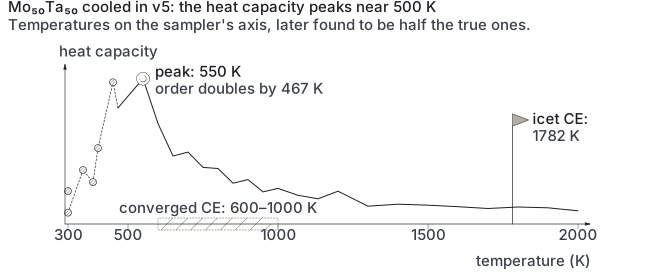
E188 interim (14:43) — the transition is at ~500 K, not 1782 K. v5 canonical MC,
Mo₀.₅Ta₀.₅, 432 sites, 2000 → 467 K (22 states; runs/e188_mota_odt/curve.json):
T (K)   ⟨E⟩ meV/atom   Cv/kB   NN Mo–Ta Warren–Cowley
2000      −85.3        0.07     −0.021
1300      −90.8        0.18     −0.045
1000      −96.3        0.58     −0.068
 800     −103.4        1.04     −0.101
 600     −116.1        2.06     −0.167
 550     −120.7        3.08     −0.192   ← Cv peak so far
 467     −140.7        2.41     −0.388   ← order doubles in one step
Heat-capacity peak at 550 K; the NN order parameter crosses half its 467 K value at ~500 K;
E(2000) − E(467) = 55 meV/atom. Prediction 1 holds at its lower edge (T_c ≈ 470–550 K
against [500, 1300]) and prediction 2 does not fire: v5 does not carry the icet CE's
excess — its T_c is a third of 1782 K and inside Blum & Zunger's 600–1000 K band's lower
side (their LDA MBCE; PBE and a 54-atom-cell fit push it lower). Prediction 4 follows:
the Mo–Ta basin orders inside the 90–1000 K window — under rung 1's own rule the
ladder's verdict there flips from "orders above the window, passes" to "fails", and the
fly's finds in that basin (E177's −71, E180's −90) are candidates for a phase change, not
for the target. The coldest unit returned only 467 K of its four temperatures; the peak
is bracketed from above only, so T_c is "≈ 500 K, not below 467" until the extension runs.
Results
EXPERIMENTS.md · line 11977
E188 result (15:15) — T_c(Mo₀.₅Ta₀.₅, v5) = 500 ± 50 K. Cold-end extension (450 → 300 K,
fresh start from a random state, up to 3,000 samples per state) added: Cv/k_B 2.99 (450),
1.50 (400), 0.72 (383), 1.00 (350), 0.03–0.52 (300); NN Mo–Ta Warren–Cowley −0.400 (450) →
−0.485 (300). With the annealed sweep: the heat-capacity peak sits at 550 K (3.08 k_B)
and is still 3.0 at 450 K before falling — a peak between 450 and 550 K, consistent from
two independent starting states (SRO −0.388 at 467 K annealed vs −0.400 at 450 K from
random). Prediction 1 confirmed (500 ± 50 inside [500, 1300], at its lower edge);
predictions 2 and 3 do not fire. Against the icet CE's 1782 K this is ×3.5 lower; against
Blum & Zunger's converged LDA MBCE (600–1000 K) it sits just below — PBE and a random+
ordered 54-atom-cell fit push it down. Prediction 4 follows: the Mo–Ta basin orders
inside 90–1000 K. Under rung 1's rule it fails the target; the fly's Mo–Ta finds (E177
−71, E180 −90) are ordered-phase candidates, not solid solutions across the window. Every
"passes as an ordered material above 1000 K" verdict issued from the icet CE for Mo–Ta-rich
compositions is now suspect and is re-scored when rung 1 runs on v5 (task 22).
The full record
This entry is written in 3 separate places in the log, shown here in log order.
EXPERIMENTS.md · lines 11897–11916
E188 — the ordering temperature from v5, against the published Mo–Ta number
The ladder's pass/fail is the order–disorder temperature, and rung 1 computes it from the
icet-on-MACE CE — the model measured 5–8× wrong on mixing energies, which said 1782 K for
Mo–Ta 50/50 (Blum & Zunger's own comment: a six-interaction CE gives ~1800 K "excessively
high"; their converged MBCE gives 600–1000 K for B2 MoTa; Turchi's CPA-GPM 1772 K; no
long-range order seen experimentally down to 673 K, consistent with a low T_c). With v5
within 10 meV/atom of DFT on six cells, its own canonical Monte Carlo (pyeCE mcmc) gives a
T_c to set beside those. Run: Mo₀.₅Ta₀.₅ on a 6×6×6 conventional supercell (432 sites),
canonical, temperatures 2000 → 300 K, energy and nearest-neighbour SRO tracked; T_c read as
the peak of dE/dT (heat-capacity peak) with the NN Mo–Ta Warren–Cowley parameter as the
second witness (it should cross half its low-T value at the same T).
Predictions. 1. T_c(v5) in [500, 1300] K — the converged-CE range, widened for a model
fitted to PBE random+ordered 54-atom cells. 2. Falsified above 1500 K: v5 carries the same
excess ordering energy as the icet CE and the ODT rung is not fixed by swapping models.
3. Falsified below 300 K: v5's ordering energy is too weak (its ordered training cells at
fault) — then the SRO rung must come from DFT-validated ordered cells before any T_c is
trusted. 4. If T_c lands in range, the ladder's verdict on the Mo–Ta basin flips from
"orders above the window — passes as an ordered material" to "orders inside the window —
fails", and every fly find in that basin is re-scored.
EXPERIMENTS.md · lines 11918–11939
E188 interim (14:43) — the transition is at ~500 K, not 1782 K. v5 canonical MC,
Mo₀.₅Ta₀.₅, 432 sites, 2000 → 467 K (22 states; runs/e188_mota_odt/curve.json):
T (K)   ⟨E⟩ meV/atom   Cv/kB   NN Mo–Ta Warren–Cowley
2000      −85.3        0.07     −0.021
1300      −90.8        0.18     −0.045
1000      −96.3        0.58     −0.068
 800     −103.4        1.04     −0.101
 600     −116.1        2.06     −0.167
 550     −120.7        3.08     −0.192   ← Cv peak so far
 467     −140.7        2.41     −0.388   ← order doubles in one step
Heat-capacity peak at 550 K; the NN order parameter crosses half its 467 K value at ~500 K;
E(2000) − E(467) = 55 meV/atom. Prediction 1 holds at its lower edge (T_c ≈ 470–550 K
against [500, 1300]) and prediction 2 does not fire: v5 does not carry the icet CE's
excess — its T_c is a third of 1782 K and inside Blum & Zunger's 600–1000 K band's lower
side (their LDA MBCE; PBE and a 54-atom-cell fit push it lower). Prediction 4 follows:
the Mo–Ta basin orders inside the 90–1000 K window — under rung 1's own rule the
ladder's verdict there flips from "orders above the window, passes" to "fails", and the
fly's finds in that basin (E177's −71, E180's −90) are candidates for a phase change, not
for the target. The coldest unit returned only 467 K of its four temperatures; the peak
is bracketed from above only, so T_c is "≈ 500 K, not below 467" until the extension runs.
EXPERIMENTS.md · lines 11977–11990
E188 result (15:15) — T_c(Mo₀.₅Ta₀.₅, v5) = 500 ± 50 K. Cold-end extension (450 → 300 K,
fresh start from a random state, up to 3,000 samples per state) added: Cv/k_B 2.99 (450),
1.50 (400), 0.72 (383), 1.00 (350), 0.03–0.52 (300); NN Mo–Ta Warren–Cowley −0.400 (450) →
−0.485 (300). With the annealed sweep: the heat-capacity peak sits at 550 K (3.08 k_B)
and is still 3.0 at 450 K before falling — a peak between 450 and 550 K, consistent from
two independent starting states (SRO −0.388 at 467 K annealed vs −0.400 at 450 K from
random). Prediction 1 confirmed (500 ± 50 inside [500, 1300], at its lower edge);
predictions 2 and 3 do not fire. Against the icet CE's 1782 K this is ×3.5 lower; against
Blum & Zunger's converged LDA MBCE (600–1000 K) it sits just below — PBE and a random+
ordered 54-atom-cell fit push it down. Prediction 4 follows: the Mo–Ta basin orders
inside 90–1000 K. Under rung 1's rule it fails the target; the fly's Mo–Ta finds (E177
−71, E180 −90) are ordered-phase candidates, not solid solutions across the window. Every
"passes as an ordered material above 1000 K" verdict issued from the icet CE for Mo–Ta-rich
compositions is now suspect and is re-scored when rung 1 runs on v5 (task 22).