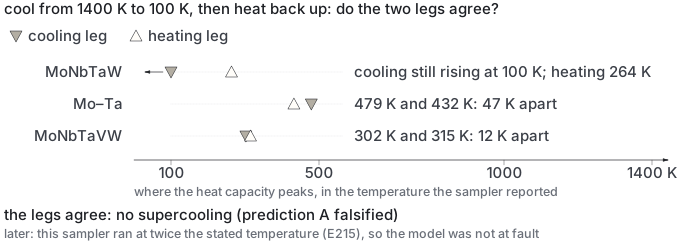
Did the ordering simulation settle properly, or did it cool too fast?
Yes. Heating and cooling agreed within 47 K; blaming the model for low temperatures was withdrawn once the sampler proved to run at double temperature.
In the log: does the ordering sweep equilibrate? Heating vs cooling at 10–30× the sweeps (2026-09-20 20:28; prediction before launch)
falsifiedDate 2026-09-20 20:28, as written in the logrung 1 · ordering0 predictions · 2 result paragraphsEXPERIMENTS.md lines 13054–13074, lines 13194–13214, lines 13216–13226, lines 13292–13310, lines 13312–13337
What E207 did and how it came out, drawn from this record and the files it names (book/assets/diagrams/exp/E207.svg).
Pre-registration
The pre-registration, as written
E207 — does the ordering sweep equilibrate? Heating vs cooling at 10–30× the sweeps (2026-09-20 20:28; prediction before launch)
Question. Is v5's low heat-capacity-peak temperature a property of the model or of a
cooling-only sweep that supercools? Protocol. v5, canonical ensemble, 6³ = 432 sites
(E200: size-converged), --sampling_frequency = one sweep per sample, --min 1000 --max 3000 sweeps per temperature (E190b: 100–1000), 30 temperatures per leg, cooling
1400 → 100 K then heating 100 → 1400 K in the same process, so the heating leg starts from
the coldest cooled state, as Kostiuchenko 2019 did. Floor 100 K, not 300 (E190 censored 7 of
12 systems at 300). Systems, in order: MoNbTaW (the literature's reference: Cv-peak
values 600 K unrelaxed / 300 relaxed / 750 / 1110), Mo–Ta (E188/E200: 500 / 457),
MoNbTaVW (E190b: 367; FC17 750 as an H_mix inflection).
Predictions. (A) On at least one system the heating and cooling peaks differ by
> 100 K: the sweep has not been equilibrating, and the true T_c lies between the two.
(B) MoNbTaW's heating peak lands in 450–750 K, inside the unrelaxed literature. (C) If
every system's two peaks agree within 65 K, the protocol is exonerated and the model's
ordering energetics are the cause; the ground-state search (design §2) is then the path.
(D) The SRO onset is direction-independent within 65 K on every system (it is a
high-temperature property and should not supercool). Error bar quoted on every T_c:
δT = T · √2·MAE/ΔE_order with MAE = 12.2 meV (Zarkevich & Johnson's rule), not seed scatter.
T_c error bars, derived (2026-09-20 20:31; bragg_williams.py::tc_error, SymPy, tested against Zarkevich & Johnson's ±197). δT_c = T_c·√2·σ/ΔE_order with σ = 12.2 meV (held-out MAE). Mo–Ta: 457 ± 98 K. MoNbTaVW: 367 ± 231 K (ΔE 27 from E192's sampled state; ± 293 with E191's guessed 21.6). Every T_c reported before today carried ± 65 (seed scatter) or ± 136 (E190); the model-limited bar is 2–4× larger for the quinary. Against FC17's 750 K, MoNbTaVW is 1.7σ away on an observable that is not even the same one. The quinary 'crisis' was never resolvable at this fit quality; Mo–Ta (± 98) is the system where a real test is possible, and E207 is running on both.
E207 MoNbTaW, read with the run-order reader (2026-09-20 23:39) — one correction to the entry above.
"Cv peaks nowhere inside 100–1400 K on either leg" was wrong: the heating leg resolves a
peak at 264 ± 65 K (max Cv 1.81 at 262 K); the cooling leg is censored at the 100 K floor
(Cv 2.03, still rising, where the (k_B T)⁻² normalisation amplifies variance noise). The
legs' energies and SRO coincide at every temperature and meet at the floor within 0.8 meV,
so there is no thermodynamic hysteresis; the 164 K "gap" the reader prints is between
a censored value and a resolved one, not supercooling. Best estimate: T_c(MoNbTaW, v5) =
264 ± 65 K (heating leg; CV-derived bar larger). Like-for-like ideal-lattice literature:
600 K (KOS19), 1110 K (KW23); relaxed: 300 K. Conclusion unchanged and sharpened: the
protocol is reversible at this depth, and v5 under-orders MoNbTaW by ~2× against the
observable and lattice it should match. Numbers in runs/e207_hysteresis/MoNbTaW/hysteresis.json.
E207 Mo–Ta (2026-09-21 02:40) — reversible, and the gap runs the wrong way for supercooling.
Cooling peak 479 K, heating peak 432 K, gap 47 K — inside the 65 K decision bar,
and negative: a supercooled sweep puts the cooling peak below the heating one, not
above. Floor mismatch 0.0 meV; SRO reaches −0.50 on both legs at 100 K; SRO onsets
1183 (cooling) and 1129 K (heating), 54 K apart. Prediction A falsified on a second
system; prediction D confirmed; prediction C's branch applies again.T_c(Mo–Ta, v5) = 455 ± 97 K (CV-derived bar), against E200's 8³ 457 and E188's 6³ 500 —
all three inside one bar, so cell size, sampling depth and direction have now all been
varied and none of them moves this number.
And the scorecard cannot test it. There is no Mo–Ta row in published_odt.py at
all — the Mo-and-Ta-bearing rows are MoNbTaVW, MoNbTaW and MoNbTa. The "published
600–1000 K" this record has cited for Mo–Ta three times (12554, 12573, 12985) came from
prose, not from the table, and is withdrawn as a scored comparison until a row with its
observable and lattice is entered. Kim & Widom 2023 do report the binary — their text has
MoNbTaW's 1110 K "compared with the binary case", implying Mo–Ta is higher — but the
number is not in hand and will not be invented; the paper is to be read. This is the
comparability finding arriving on the system with the tightest error bar: the one place a
real test was possible has nothing to test against.
Results
EXPERIMENTS.md · line 13194
E207, system 1 of 3 — MoNbTaW (2026-09-20 23:37). No hysteresis. Prediction A falsified; the protocol is exonerated for this system.
Cooling 1400→100 K and heating 100→1400 K, 6³, 1000–2000 sweeps per temperature, in one
process. The two legs coincide at every temperature: at 317 K both give E = −90 meV and
NN SRO −0.21; at 533 K both −76 / −0.10; at 750 K both −70 / −0.06; the end of cooling and
the start of heating at the 100 K floor agree to 0.8 meV (−105.3 vs −106.1) after a further
1000–2000 sweeps. Cv rises monotonically to the floor (0.10 at 1400 K → 2.03 at 100 K) and
peaks nowhere inside 100–1400 K on either leg; SRO reaches only −0.22 at 100 K.
Reading. A supercooled sweep would show the heating leg above the cooling leg between
200 and 600 K; it does not. At 10–30× E190b's sampling the sweep is reversible, so v5's
weak ordering of MoNbTaW is the model's, not the sampler's: its Cv-peak T_c is ≤ 100 K
against 600 K (Kostiuchenko, unrelaxed, same observable) and 300 K relaxed. Prediction C's
branch applies — the ground-state search and the disordered-state check (design §2, §1.3)
are the path, not more sweeps. Caveat stated: a sampler frozen equally on both legs would
also show no hysteresis, but it would not show SRO evolving smoothly and reversibly through
200–600 K with weak final order; a glass from a strongly ordering Hamiltonian looks
different. Mo–Ta (which does peak, E200: 457 K) is the cleaner test and runs next.
A wrong readout, corrected. The monitor's first line for this system reported "cooling:
no transition above 750 K; heating: still rising at 100 K". That was an artefact of my own
reader: curve_from_json sorts by temperature, so splitting its output in half compared
the hot half of both legs against the cold half of both. The legs must be split in run
order from the raw file. Fixed before the next system lands.
EXPERIMENTS.md · line 13312
E207 COMPLETE (2026-09-21 05:49) — the sweep is reversible on all three systems. The model is at fault, not the protocol.
system
cooling T_c
heating T_c
gap
floor mismatch
best estimate
SRO onset c/h
MoNbTaW
≤100 (censored)
264
—
−0.8 meV
264 ± 70 K
804 / 750
Mo–Ta
479
432
−47 K
0.0 meV
456 ± 97 K
1183 / 1129
MoNbTaVW
302
315
+12 K
−0.2 meV
309 ± 194 K
696 / 750
Prediction A (a gap > 100 K on at least one system) FALSIFIED. Every floor mismatch is
under 1 meV after 1000–2000 further sweeps at the same temperature; the two resolved gaps
are 47 K and 12 K, both inside the 65 K bar, and Mo–Ta's runs negative — the opposite sign
to supercooling. Prediction D (SRO onset direction-independent within 65 K) confirmed on
two of three: Mo–Ta 54 K, MoNbTaVW 54 K; MoNbTaW's 54 K also holds (804 vs 750).
Prediction B (MoNbTaW's heating peak in 450–750 K) falsified: 264 K.
Prediction C's branch is the one that applies. The supercooling hypothesis — the single
reading that tied together the low T_c, the seven censored systems, E192's over-deep sampled
states and v6's further fall — is dead. Sampling depth (10–30×), cell size (E200, 6³→8³) and
sweep direction have each been varied independently and none moves the answer. v5's
ordering energetics are wrong, and E211's ground-state search is now the whole question.What survives, and it is the more interesting reading: the Cv peak is low everywhere
(264 / 456 / 309) while the SRO onset is high everywhere (750–1183 K). The model orders
locally at the right temperature and never orders globally — which is what a Hamiltonian
with the right pair energies and a mis-partitioned many-body part looks like, and is exactly
what Blüm & Zunger say Mo–Ta needs many-body figures to capture. E211 tests it directly: if
the annealed ground states are much deeper than the guessed ones, the missing order is real
and the fit is the fault.
The full record
This entry is written in 5 separate places in the log, shown here in log order.
EXPERIMENTS.md · lines 13054–13074
E207 — does the ordering sweep equilibrate? Heating vs cooling at 10–30× the sweeps (2026-09-20 20:28; prediction before launch)
Question. Is v5's low heat-capacity-peak temperature a property of the model or of a
cooling-only sweep that supercools? Protocol. v5, canonical ensemble, 6³ = 432 sites
(E200: size-converged), --sampling_frequency = one sweep per sample, --min 1000 --max 3000 sweeps per temperature (E190b: 100–1000), 30 temperatures per leg, cooling
1400 → 100 K then heating 100 → 1400 K in the same process, so the heating leg starts from
the coldest cooled state, as Kostiuchenko 2019 did. Floor 100 K, not 300 (E190 censored 7 of
12 systems at 300). Systems, in order: MoNbTaW (the literature's reference: Cv-peak
values 600 K unrelaxed / 300 relaxed / 750 / 1110), Mo–Ta (E188/E200: 500 / 457),
MoNbTaVW (E190b: 367; FC17 750 as an H_mix inflection).
Predictions. (A) On at least one system the heating and cooling peaks differ by
> 100 K: the sweep has not been equilibrating, and the true T_c lies between the two.
(B) MoNbTaW's heating peak lands in 450–750 K, inside the unrelaxed literature. (C) If
every system's two peaks agree within 65 K, the protocol is exonerated and the model's
ordering energetics are the cause; the ground-state search (design §2) is then the path.
(D) The SRO onset is direction-independent within 65 K on every system (it is a
high-temperature property and should not supercool). Error bar quoted on every T_c:
δT = T · √2·MAE/ΔE_order with MAE = 12.2 meV (Zarkevich & Johnson's rule), not seed scatter.
T_c error bars, derived (2026-09-20 20:31; bragg_williams.py::tc_error, SymPy, tested against Zarkevich & Johnson's ±197). δT_c = T_c·√2·σ/ΔE_order with σ = 12.2 meV (held-out MAE). Mo–Ta: 457 ± 98 K. MoNbTaVW: 367 ± 231 K (ΔE 27 from E192's sampled state; ± 293 with E191's guessed 21.6). Every T_c reported before today carried ± 65 (seed scatter) or ± 136 (E190); the model-limited bar is 2–4× larger for the quinary. Against FC17's 750 K, MoNbTaVW is 1.7σ away on an observable that is not even the same one. The quinary 'crisis' was never resolvable at this fit quality; Mo–Ta (± 98) is the system where a real test is possible, and E207 is running on both.
EXPERIMENTS.md · lines 13194–13214
E207, system 1 of 3 — MoNbTaW (2026-09-20 23:37). No hysteresis. Prediction A falsified; the protocol is exonerated for this system.
Cooling 1400→100 K and heating 100→1400 K, 6³, 1000–2000 sweeps per temperature, in one
process. The two legs coincide at every temperature: at 317 K both give E = −90 meV and
NN SRO −0.21; at 533 K both −76 / −0.10; at 750 K both −70 / −0.06; the end of cooling and
the start of heating at the 100 K floor agree to 0.8 meV (−105.3 vs −106.1) after a further
1000–2000 sweeps. Cv rises monotonically to the floor (0.10 at 1400 K → 2.03 at 100 K) and
peaks nowhere inside 100–1400 K on either leg; SRO reaches only −0.22 at 100 K.
Reading. A supercooled sweep would show the heating leg above the cooling leg between
200 and 600 K; it does not. At 10–30× E190b's sampling the sweep is reversible, so v5's
weak ordering of MoNbTaW is the model's, not the sampler's: its Cv-peak T_c is ≤ 100 K
against 600 K (Kostiuchenko, unrelaxed, same observable) and 300 K relaxed. Prediction C's
branch applies — the ground-state search and the disordered-state check (design §2, §1.3)
are the path, not more sweeps. Caveat stated: a sampler frozen equally on both legs would
also show no hysteresis, but it would not show SRO evolving smoothly and reversibly through
200–600 K with weak final order; a glass from a strongly ordering Hamiltonian looks
different. Mo–Ta (which does peak, E200: 457 K) is the cleaner test and runs next.
A wrong readout, corrected. The monitor's first line for this system reported "cooling:
no transition above 750 K; heating: still rising at 100 K". That was an artefact of my own
reader: curve_from_json sorts by temperature, so splitting its output in half compared
the hot half of both legs against the cold half of both. The legs must be split in run
order from the raw file. Fixed before the next system lands.
EXPERIMENTS.md · lines 13216–13226
E207 MoNbTaW, read with the run-order reader (2026-09-20 23:39) — one correction to the entry above.
"Cv peaks nowhere inside 100–1400 K on either leg" was wrong: the heating leg resolves a
peak at 264 ± 65 K (max Cv 1.81 at 262 K); the cooling leg is censored at the 100 K floor
(Cv 2.03, still rising, where the (k_B T)⁻² normalisation amplifies variance noise). The
legs' energies and SRO coincide at every temperature and meet at the floor within 0.8 meV,
so there is no thermodynamic hysteresis; the 164 K "gap" the reader prints is between
a censored value and a resolved one, not supercooling. Best estimate: T_c(MoNbTaW, v5) =
264 ± 65 K (heating leg; CV-derived bar larger). Like-for-like ideal-lattice literature:
600 K (KOS19), 1110 K (KW23); relaxed: 300 K. Conclusion unchanged and sharpened: the
protocol is reversible at this depth, and v5 under-orders MoNbTaW by ~2× against the
observable and lattice it should match. Numbers in runs/e207_hysteresis/MoNbTaW/hysteresis.json.
EXPERIMENTS.md · lines 13292–13310
E207 Mo–Ta (2026-09-21 02:40) — reversible, and the gap runs the wrong way for supercooling.
Cooling peak 479 K, heating peak 432 K, gap 47 K — inside the 65 K decision bar,
and negative: a supercooled sweep puts the cooling peak below the heating one, not
above. Floor mismatch 0.0 meV; SRO reaches −0.50 on both legs at 100 K; SRO onsets
1183 (cooling) and 1129 K (heating), 54 K apart. Prediction A falsified on a second
system; prediction D confirmed; prediction C's branch applies again.T_c(Mo–Ta, v5) = 455 ± 97 K (CV-derived bar), against E200's 8³ 457 and E188's 6³ 500 —
all three inside one bar, so cell size, sampling depth and direction have now all been
varied and none of them moves this number.
And the scorecard cannot test it. There is no Mo–Ta row in published_odt.py at
all — the Mo-and-Ta-bearing rows are MoNbTaVW, MoNbTaW and MoNbTa. The "published
600–1000 K" this record has cited for Mo–Ta three times (12554, 12573, 12985) came from
prose, not from the table, and is withdrawn as a scored comparison until a row with its
observable and lattice is entered. Kim & Widom 2023 do report the binary — their text has
MoNbTaW's 1110 K "compared with the binary case", implying Mo–Ta is higher — but the
number is not in hand and will not be invented; the paper is to be read. This is the
comparability finding arriving on the system with the tightest error bar: the one place a
real test was possible has nothing to test against.
EXPERIMENTS.md · lines 13312–13337
E207 COMPLETE (2026-09-21 05:49) — the sweep is reversible on all three systems. The model is at fault, not the protocol.
system
cooling T_c
heating T_c
gap
floor mismatch
best estimate
SRO onset c/h
MoNbTaW
≤100 (censored)
264
—
−0.8 meV
264 ± 70 K
804 / 750
Mo–Ta
479
432
−47 K
0.0 meV
456 ± 97 K
1183 / 1129
MoNbTaVW
302
315
+12 K
−0.2 meV
309 ± 194 K
696 / 750
Prediction A (a gap > 100 K on at least one system) FALSIFIED. Every floor mismatch is
under 1 meV after 1000–2000 further sweeps at the same temperature; the two resolved gaps
are 47 K and 12 K, both inside the 65 K bar, and Mo–Ta's runs negative — the opposite sign
to supercooling. Prediction D (SRO onset direction-independent within 65 K) confirmed on
two of three: Mo–Ta 54 K, MoNbTaVW 54 K; MoNbTaW's 54 K also holds (804 vs 750).
Prediction B (MoNbTaW's heating peak in 450–750 K) falsified: 264 K.
Prediction C's branch is the one that applies. The supercooling hypothesis — the single
reading that tied together the low T_c, the seven censored systems, E192's over-deep sampled
states and v6's further fall — is dead. Sampling depth (10–30×), cell size (E200, 6³→8³) and
sweep direction have each been varied independently and none moves the answer. v5's
ordering energetics are wrong, and E211's ground-state search is now the whole question.What survives, and it is the more interesting reading: the Cv peak is low everywhere
(264 / 456 / 309) while the SRO onset is high everywhere (750–1183 K). The model orders
locally at the right temperature and never orders globally — which is what a Hamiltonian
with the right pair energies and a mis-partitioned many-body part looks like, and is exactly
what Blüm & Zunger say Mo–Ta needs many-body figures to capture. E211 tests it directly: if
the annealed ground states are much deeper than the guessed ones, the missing order is real
and the fit is the fault.
Related entries
E200 — is v5's Mo–Ta T_c finite-size? (2026-09-19 00:01; queued)