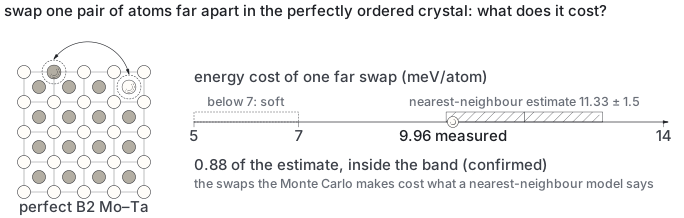
Does swapping two atoms in the ordered crystal cost what a nearest-neighbour model predicts?
Yes. One far swap costs 9.96 meV/atom, 0.88 of the nearest-neighbour estimate and inside the predicted band.
In the log: the local check, pre-registered before measuring (2026-09-21 07:2x)
confirmedDate 2026-09-21 07:2x, as written in the logrung 1 · ordering0 predictions · 1 result paragraphEXPERIMENTS.md lines 13519–13534, lines 13555–13569
What E213b did and how it came out, drawn from this record and the files it names (book/assets/diagrams/exp/E213b.svg).
Pre-registration
The pre-registration, as written
E213b — the local check, pre-registered before measuring (2026-09-21 07:2x).
A high R² on the global order parameter is not the same statement as "the local
excitation spectrum is nearest-neighbour Ising". Bragg–Williams cares about the first; the
Monte Carlo is driven entirely by the second — the energy cost of one swap. A model
whose energy is linear in mean α₁ can still have soft local swaps if the many-body part
absorbs them, and that would produce exactly the observed low T_c with no sampler defect
at all. So: take v5's Mo–Ta B2 ground state, swap one Mo with one Ta on non-adjacent
sites, and measure v5's ΔE directly.
The bar, derived not guessed. ΔE_order = 76.5 meV/atom over 4 bonds per atom, with B2
at 4 unlike bonds and random at 2, gives a per-bond like−unlike difference Δ = 38.2 meV.
One far-apart unlike swap flips 8 + 8 bonds, so a nearest-neighbour Ising with this Δ costs
612 meV total = 11.33 meV/atom. Prediction: if v5 is NN-pair-like locally, the mean
measured swap cost is 11.3 ± 1.5 meV/atom. If it comes in below 7, the local
spectrum is soft, the Bragg–Williams yardstick is being fed a global number the sampler
never sees, and the fault is the model's many-body partition, not the Monte Carlo —
which reverses the conclusion E213's decision rule would otherwise deliver.
Results
EXPERIMENTS.md · line 13555
E213b CONFIRMED. 40 far-apart Mo↔Ta swaps in B2 cost 9.96 ± 0.02 meV/atom against
the derived nearest-neighbour Ising bar of 11.33 — ratio 0.88, inside the pre-registered
11.3 ± 1.5. So the local excitation spectrum the Monte Carlo actually samples is
nearest-neighbour-like too, not just the global correlation.
A methods trap, recorded because it nearly produced a published-looking wrong answer.
The first version of this script built the cell itself from BCC.ideal_sites and an assumed
species order instead of reusing ground_state.py::to_structure. That scrambled every
decoration: energies came out −93 to −49 (straddling the random value) with α₁ never below
−0.21, and it still returned a confident R² = 0.9685. A scrambled dataset produced a
number two hundredths away from the right one. The script now asserts that the deepest saved
state reproduces the recorded ground-state energy and refuses to report otherwise. Second
trap, same session: a follow-up check reported a swap cost of exactly 0.00 and I briefly
took it for a predictor defect — the two sites I swapped held the same species.
Both were caught by controls, and neither would have been caught by the test suite.
The full record
This entry is written in 2 separate places in the log, shown here in log order.
EXPERIMENTS.md · lines 13519–13534
E213b — the local check, pre-registered before measuring (2026-09-21 07:2x).
A high R² on the global order parameter is not the same statement as "the local
excitation spectrum is nearest-neighbour Ising". Bragg–Williams cares about the first; the
Monte Carlo is driven entirely by the second — the energy cost of one swap. A model
whose energy is linear in mean α₁ can still have soft local swaps if the many-body part
absorbs them, and that would produce exactly the observed low T_c with no sampler defect
at all. So: take v5's Mo–Ta B2 ground state, swap one Mo with one Ta on non-adjacent
sites, and measure v5's ΔE directly.
The bar, derived not guessed. ΔE_order = 76.5 meV/atom over 4 bonds per atom, with B2
at 4 unlike bonds and random at 2, gives a per-bond like−unlike difference Δ = 38.2 meV.
One far-apart unlike swap flips 8 + 8 bonds, so a nearest-neighbour Ising with this Δ costs
612 meV total = 11.33 meV/atom. Prediction: if v5 is NN-pair-like locally, the mean
measured swap cost is 11.3 ± 1.5 meV/atom. If it comes in below 7, the local
spectrum is soft, the Bragg–Williams yardstick is being fed a global number the sampler
never sees, and the fault is the model's many-body partition, not the Monte Carlo —
which reverses the conclusion E213's decision rule would otherwise deliver.
EXPERIMENTS.md · lines 13555–13569
E213b CONFIRMED. 40 far-apart Mo↔Ta swaps in B2 cost 9.96 ± 0.02 meV/atom against
the derived nearest-neighbour Ising bar of 11.33 — ratio 0.88, inside the pre-registered
11.3 ± 1.5. So the local excitation spectrum the Monte Carlo actually samples is
nearest-neighbour-like too, not just the global correlation.
A methods trap, recorded because it nearly produced a published-looking wrong answer.
The first version of this script built the cell itself from BCC.ideal_sites and an assumed
species order instead of reusing ground_state.py::to_structure. That scrambled every
decoration: energies came out −93 to −49 (straddling the random value) with α₁ never below
−0.21, and it still returned a confident R² = 0.9685. A scrambled dataset produced a
number two hundredths away from the right one. The script now asserts that the deepest saved
state reproduces the recorded ground-state energy and refuses to report otherwise. Second
trap, same session: a follow-up check reported a swap cost of exactly 0.00 and I briefly
took it for a predictor defect — the two sites I swapped held the same species.
Both were caught by controls, and neither would have been caught by the test suite.
Related entries
E213 — where does v5's ordering energy live? (pre-registered 2026-09-21 07:1x, before measuring)