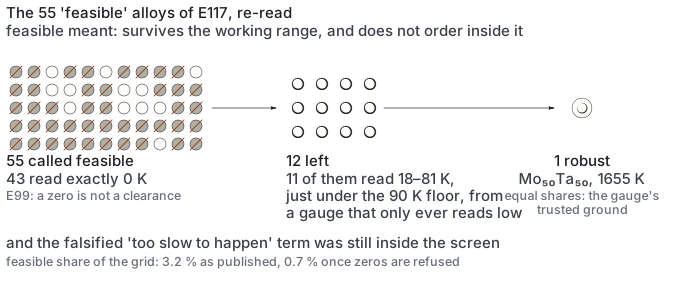
Do the 55 'feasible' alloys survive once two discredited checks stop being trusted?
No. 43 of the 55 rested on an ordering reading of exactly 0 K, which is no clearance; 12 remained, and only equal-share Mo–Ta robustly.
In the log: Do E117's 55 feasible compositions rest on two withdrawn instruments?
confirmedDate not stated in the log; it was written between the commit of 2026-09-16 10:56 and the first commit that contains it, 2026-09-16 11:53rung 1 · ordering0 predictions · 2 result paragraphsEXPERIMENTS.md lines 7912–7947, lines 7949–8005
What E131 did and how it came out, drawn from this record and the files it names (book/assets/diagrams/exp/E131.svg).
Results
EXPERIMENTS.md · line 7912
E131 — Do E117's 55 feasible compositions rest on two withdrawn instruments?
The audit of the record raises this as the highest-blast-radius open problem, and it is not in
the task queue. E117 defines feasibility as two conditions:
p_survives_window > 0.9 AND orders_in_window false
Both instruments have been withdrawn, and neither withdrawal reached screen().
E99 withdrew the ordering gate as a clearance: "A nonzero T_order is a real signal ...
A zero is not a clearance." It measured the failure curve off equiatomic - x_major
0.56 -> ratio 0.72, 0.69 -> 0.21, 0.73 -> 0.00 - and the error is one-signed: the gate
always under-reports. E118's Pareto front is almost entirely 0.75/0.25 binaries, squarely in
the regime where the gate was measured returning zero against a real transition.
E92 falsified the Q proxy, over-predicting by up to 1.58 eV and "always in the direction
that manufactures stability", with the error growing monotonically with element count. E93
then stated the remedy: "The term stays out of the screen."
If both hold, both halves of "feasible" are broken in the same direction, and E118, E122,
E123 and E125 all build on the 55.
Predicted:
The Q term is still in screen() and still feeds p_survives_window - i.e. E93's
stated remedy was never applied. Verifiable by reading the code.
A large share of the 55 carry T_order exactly 0, which E99 says is not a clearance.
I expect more than half. If it is under a tenth, the withdrawal barely touches this set
and the problem is smaller than the audit claims.
Refusing zeros as clearances shrinks the feasible set substantially - to fewer than 30
of the original 55.
The compositions lost are disproportionately the extreme ones (0.75/0.25 and beyond),
because that is where E99 measured the gate failing, while near-equiatomic ones survive.
Falsified if the zeros are rare or evenly spread across composition extremity, in which
case E99's withdrawal, though real, does not undermine E117 and the 55 stand on the ordering
side. The Q side would still need separate treatment.
EXPERIMENTS.md · line 7949
E131 result: all four predictions confirmed. E117's feasible set collapses from 55 to 12,
and only one of those twelve is cleared by an instrument operating inside its validated
regime.
Prediction 1 confirmed.Q_PER_KB_TMELT = 18.4 at verifier.py:90 feeds q_est (212),
p_happens (229-231) and p_survives_window (294). E93 wrote "The term stays out of the
screen." It is in the screen. The remedy was stated and never applied.
Predictions 2, 3 and 4 confirmed:
of the 55 "feasible" compositions
  T_order exactly 0 - which E99 says is NOT a clearance        43   (78%)
  T_order nonzero and outside the window                       12

the axis E99 measured the gate failing along
  zeros:    mean x_major 0.571,  23 of 43 at x_major >= 0.70
  nonzero:  mean x_major 0.368
The zeros sit exactly where E99 measured the gate returning 0.00 against a real 649 K
transition. Cr0.75 Ni0.25 - the top of E118's Pareto front on every axis the ladder can
compute - is one of them, at x_major 0.75.
The twelve survivors are not twelve results. Eleven of them have T_order between 18 and
81 K - that is, just below the window's 90 K floor - reported by a gate whose error E99
measured as one-signed and always downward. A reading of 25 K from an instrument that returns
0.00 for a real 649 K transition is not evidence of a transition below the window. Exactly
one composition, Mo0.50 Ta0.50 at 1655 K, is equiatomic - where E99 says the gate is
reliable - and far enough above the window that the one-signed error cannot reach it.
E117's "55 feasible compositions" and its "3.2 per cent of the grid" figure. Refusing
zeros gives 0.7 per cent.
E118's Pareto front, whose top three entries (Cr0.75Ni0.25, Co0.33Cr0.33Ni0.33,
Co0.25Cr0.25Cu0.25Ni0.25) include two zeros; the oxidation comparison that produced "28
times better" is drawn from a set that does not survive.
E122's "10 of 55 flagged" - the denominator is wrong.
E125's"E117 already established that only 3.2 per cent of the grid passes", which was
used to overturn the archive-arm framing. The corrected figure is 0.7 per cent, which
strengthens rather than weakens that particular argument.
What survives, and it is the load-bearing half of E117. The enrichment claim is
unaffected and slightly stronger: refusing zeros, the whole grid passes at 0.7 per cent and
the best 50 by reward at 10 per cent - a 14-fold enrichment against the 12-fold reported.
So E117's actual conclusion - that the search is not broken and the reward is a good filter -
stands. What collapses is the absolute size of the feasible set and everything built on the
particular compositions in it.
And the Q side is untouched by this entry.p_survives_window remains the other half of
every feasibility verdict above, and it is computed from an estimator E92 falsified as
over-predicting by up to 1.58 eV "always in the direction that manufactures stability". The
12 have not been re-tested against that; they are what survives the ordering withdrawal
only.
231 passing.
The full record
This entry is written in 2 separate places in the log, shown here in log order.
EXPERIMENTS.md · lines 7912–7947
E131 — Do E117's 55 feasible compositions rest on two withdrawn instruments?
The audit of the record raises this as the highest-blast-radius open problem, and it is not in
the task queue. E117 defines feasibility as two conditions:
p_survives_window > 0.9 AND orders_in_window false
Both instruments have been withdrawn, and neither withdrawal reached screen().
E99 withdrew the ordering gate as a clearance: "A nonzero T_order is a real signal ...
A zero is not a clearance." It measured the failure curve off equiatomic - x_major
0.56 -> ratio 0.72, 0.69 -> 0.21, 0.73 -> 0.00 - and the error is one-signed: the gate
always under-reports. E118's Pareto front is almost entirely 0.75/0.25 binaries, squarely in
the regime where the gate was measured returning zero against a real transition.
E92 falsified the Q proxy, over-predicting by up to 1.58 eV and "always in the direction
that manufactures stability", with the error growing monotonically with element count. E93
then stated the remedy: "The term stays out of the screen."
If both hold, both halves of "feasible" are broken in the same direction, and E118, E122,
E123 and E125 all build on the 55.
Predicted:
The Q term is still in screen() and still feeds p_survives_window - i.e. E93's
stated remedy was never applied. Verifiable by reading the code.
A large share of the 55 carry T_order exactly 0, which E99 says is not a clearance.
I expect more than half. If it is under a tenth, the withdrawal barely touches this set
and the problem is smaller than the audit claims.
Refusing zeros as clearances shrinks the feasible set substantially - to fewer than 30
of the original 55.
The compositions lost are disproportionately the extreme ones (0.75/0.25 and beyond),
because that is where E99 measured the gate failing, while near-equiatomic ones survive.
Falsified if the zeros are rare or evenly spread across composition extremity, in which
case E99's withdrawal, though real, does not undermine E117 and the 55 stand on the ordering
side. The Q side would still need separate treatment.
EXPERIMENTS.md · lines 7949–8005
E131 result: all four predictions confirmed. E117's feasible set collapses from 55 to 12,
and only one of those twelve is cleared by an instrument operating inside its validated
regime.
Prediction 1 confirmed.Q_PER_KB_TMELT = 18.4 at verifier.py:90 feeds q_est (212),
p_happens (229-231) and p_survives_window (294). E93 wrote "The term stays out of the
screen." It is in the screen. The remedy was stated and never applied.
Predictions 2, 3 and 4 confirmed:
of the 55 "feasible" compositions
  T_order exactly 0 - which E99 says is NOT a clearance        43   (78%)
  T_order nonzero and outside the window                       12

the axis E99 measured the gate failing along
  zeros:    mean x_major 0.571,  23 of 43 at x_major >= 0.70
  nonzero:  mean x_major 0.368
The zeros sit exactly where E99 measured the gate returning 0.00 against a real 649 K
transition. Cr0.75 Ni0.25 - the top of E118's Pareto front on every axis the ladder can
compute - is one of them, at x_major 0.75.
The twelve survivors are not twelve results. Eleven of them have T_order between 18 and
81 K - that is, just below the window's 90 K floor - reported by a gate whose error E99
measured as one-signed and always downward. A reading of 25 K from an instrument that returns
0.00 for a real 649 K transition is not evidence of a transition below the window. Exactly
one composition, Mo0.50 Ta0.50 at 1655 K, is equiatomic - where E99 says the gate is
reliable - and far enough above the window that the one-signed error cannot reach it.
E117's "55 feasible compositions" and its "3.2 per cent of the grid" figure. Refusing
zeros gives 0.7 per cent.
E118's Pareto front, whose top three entries (Cr0.75Ni0.25, Co0.33Cr0.33Ni0.33,
Co0.25Cr0.25Cu0.25Ni0.25) include two zeros; the oxidation comparison that produced "28
times better" is drawn from a set that does not survive.
E122's "10 of 55 flagged" - the denominator is wrong.
E125's"E117 already established that only 3.2 per cent of the grid passes", which was
used to overturn the archive-arm framing. The corrected figure is 0.7 per cent, which
strengthens rather than weakens that particular argument.
What survives, and it is the load-bearing half of E117. The enrichment claim is
unaffected and slightly stronger: refusing zeros, the whole grid passes at 0.7 per cent and
the best 50 by reward at 10 per cent - a 14-fold enrichment against the 12-fold reported.
So E117's actual conclusion - that the search is not broken and the reward is a good filter -
stands. What collapses is the absolute size of the feasible set and everything built on the
particular compositions in it.
And the Q side is untouched by this entry.p_survives_window remains the other half of
every feasibility verdict above, and it is computed from an estimator E92 falsified as
over-predicting by up to 1.58 eV "always in the direction that manufactures stability". The
12 have not been re-tested against that; they are what survives the ordering withdrawal
only.
231 passing.
Related entries
E117 — Is rung 0's reward anti-aligned with the actual requirement?
E99 — Checking rung 0's ordering gate against rung 1, on the fly's own finds
E118 — Multi-objective selection over the feasible set
E92 — Does the four-millisecond activation energy survive the alloys it now recommends?
E93 — What the cheap activation energy was missing, derived rather than fitted
E122 — Closing the magnetic hole, or rather admitting it