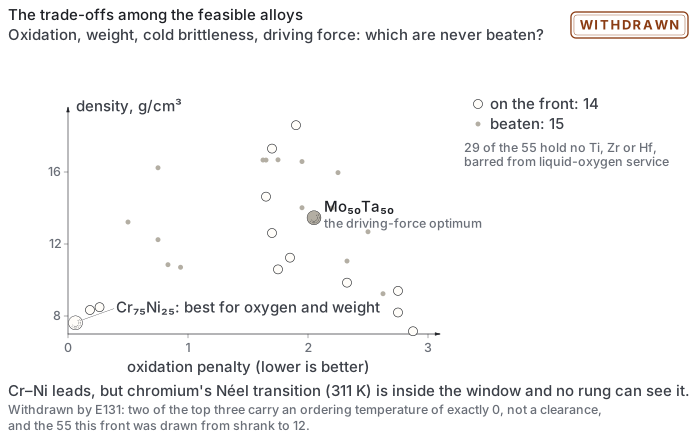
Among the stable candidates, which balance oxidation, weight and brittleness best?
Withdrawn. A 14-member trade-off front favoured chromium–nickel, but its candidate list was later cut from 55 to 12.
In the log: Multi-objective selection over the feasible set
withdrawnDate not stated in the log; it was written between the commit of 2026-09-13 08:16 and the first commit that contains it, 2026-09-16 02:04unclassified0 predictions · 0 result paragraphsEXPERIMENTS.md lines 6991–7027
What E118 did and how it came out, drawn from this record and the files it names (book/assets/diagrams/exp/E118.svg).
Results
No result paragraph for this entry was found in the log.
The full record
EXPERIMENTS.md · lines 6991–7027
E118 — Multi-objective selection over the feasible set
Oxidation, liquid-oxygen compatibility and cold brittleness are selection criteria, not
feasibility ones: they are applied to whatever survived the ladder and they trade against one
another. forager/selection.py implements them as a separate layer with the constants and
encodings sourced in its docstring, and with the brittleness figure deliberately ordinal
because the ORNL source states the transition "is not a fixed property of the material" and
moves by 204 C on fabrication variables alone.
Of the 55 feasible compositions, 29 contain no LOX-prohibited element and 14 are on the
Pareto front over (oxidation, density, cold brittleness, driving force):
The composition that wins the ladder is near the worst thing on the front for the
application. Mo0.50 Ta0.50 carries an oxidation penalty of 2.05 against Cr0.75 Ni0.25's
0.06, and is 5.8 g/cm^3 heavier. It is the right answer to "what holds a single phase" and a
poor answer to "what survives oxygen at 1000 K".
This is the concrete payoff of the twelve-element widening (E114): every composition in the
top three of this front is one the eight-element space could not represent. Fable predicted
this before the run - "expect to rediscover the Monel/Inconel neighbourhood, which is a
validation, not a failure" - and Cr-Ni and Co-Cr-Ni are that neighbourhood.
One caveat that may kill the leader, and our ladder cannot see it. Chromium has an
antiferromagnetic Neel transition at 311 K, which is inside the 90-1000 K window. The
expansion and MACE are both spin-blind, so a magnetic transition is invisible to every rung.
Cr0.75 Ni0.25 is therefore reported as feasible by a model that cannot evaluate the most
likely way it fails. Nothing Cr-rich should be promoted up the ladder until a magnetic
check exists. The same applies to Ni (Curie 627 K) and Co (hcp-fcc at 695 K), both also
inside the window.
Related entries
E114 — The search space was eight elements, and the search collapses inside it