EXPERIMENTS.md · lines 5279–5369E93 — What the cheap activation energy was missing, derived rather than fitted
E92 killed the melting-point proxy for Q: it over-predicts by up to 1.58 eV on multi-element
alloys, always in the direction that manufactures stability, and the error grows with element
count. The reason was stated there in words. Here it is derived.
A hopping rate is a sum of exponentials, so the barrier that reproduces the total rate is not
the mean barrier. Taking the barriers as normally distributed about mu with spread sigma,
SymPy gives the mean rate and hence the effective barrier:
<exp(-E/kT)> = exp( (-mu + sigma^2/(2kT)) / kT )

**Q_eff = mu - sigma^2 / (2 k T)**
The melting point estimates mu and says nothing about sigma. For a dilute or
two-element alloy the spread is small and the correction vanishes, which is why the
three-element controls came back within 0.18 eV. For a concentrated multi-element alloy the
spread is large, the correction is large, and it is always negative - the estimate is always
too high, which is what E92 measured.
At 1000 K, 2kT is 0.172 eV, so a barrier spread of 0.4 eV costs 0.93 eV of effective
barrier and a spread of 0.5 eV costs 1.45. The 1.58 eV error on the eight-element alloy needs
a spread of about 0.52 eV, which is an ordinary number for a concentrated alloy.
Predicted:
- The formula reproduces the measurement. Using the measured mean and spread of the
individual barriers,
mu - sigma^2/(2kT) matches the measured effective barrier on all
five compositions to within 0.15 eV. This is an identity check on the code's own
arithmetic and should be near exact; a failure means the barriers are not remotely normal.
- The spread grows with compositional disorder, correlating with the size misfit or the
mixing entropy across the five at better than 0.8.
- A corrected proxy - melting point for the mean, a descriptor for the spread - brings all
five within 0.5 eV, where the uncorrected one was out by 1.58.
Falsified if 2 fails: if the barrier spread cannot be predicted from composition at all,
then there is no four-millisecond activation energy for multi-element alloys, and the kinetic
rung has to stay expensive with high-entropy candidates promoted on thermodynamics alone.
Outcome. The derivation is right about the mechanism and wrong about which term carries
it, and no proxy is validated here.
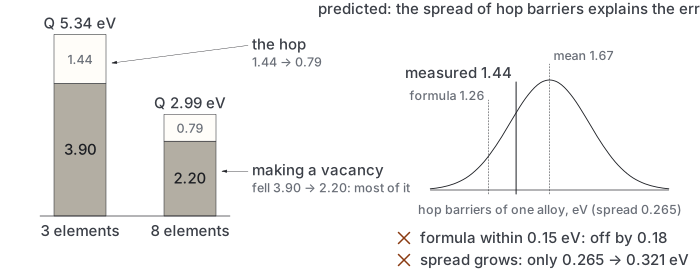
Prediction 1 fails. mu - sigma^2/(2kT) gives 1.260 against a measured effective barrier
of 1.444 on the first control, an error of 0.18 where 0.15 was predicted, and it errs the
same way throughout. The reason is visible in the data: only five barriers are sampled,
and a normal distribution has a tail reaching below anything measured, which a rate average
weights heavily. The derivation describes a continuous distribution; the measurement is five
draws. Both the proxy and the measurement are thinly sampled for these alloys.
Prediction 2 fails as stated, and the thing behind it holds. The barrier spread grows
only from 0.265 to 0.321 eV across the set - it is not what moved. The mean barrier itself
collapses, 1.67 to 0.99 eV, and so does the vacancy formation energy, 3.90 to 2.20.
Decomposed: E_f falls by 1.69 eV and E_m by 0.85, so vacancy formation carries 67 per cent
of the change. E93 was built around the migration-barrier distribution and the migration
barrier is the minor term.
The mechanism is still the one derived - an effective quantity is dominated by its easiest
instances - but it acts on both terms and hardest on formation. A multi-element alloy offers
many distinct local environments, and the vacancy goes to the cheapest of them.
Q is strongly predictable from composition, on five points:
A two-term fit on melting point and its spread brings the worst error from 1.58 to 0.35 eV.
This is not a validated proxy and must not be used as one: three parameters fitted to five
points, whose element counts are 3, 3, 7, 7 and 8, which is two clusters rather than a
range. A correlation of -0.994 with element count across two clusters is what a two-group
difference looks like.
Where this leaves the kinetic screen. The term stays out of the screen. What is
established is that the barrier to a cheap Q is not a missing constant but a missing
dependence on disorder, that the dependence is strong enough to be worth fitting, and that
fitting it needs Q measured across a proper range of element counts - twenty or thirty
compositions at six minutes each, which is an afternoon and not an hour. Until then,
multi-element candidates are promoted on thermodynamics and their kinetics are measured, not
estimated.