EXPERIMENTS.md · lines 5196–5277E92 — Does the four-millisecond activation energy survive the alloys it now recommends?
E91 put kinetics into the screen and the whole objective now rests on one cheap number:
Q estimated as 18.4 k_B T_melt. That constant was fitted to four measured activation
energies, and all four were two- to four-element Mo-Ta-W-Nb alloys. The objective's effect
was to make five- to eight-element alloys competitive, so the estimate is now being asked
about compositions well outside the set it was calibrated on.
An error of an electron volt in Q is orders of magnitude in diffusion distance at 1000 K, and
the direction matters: over-estimating Q credits an alloy with being frozen when it is
not, which would make every high-entropy find a false positive.
So Q is measured properly - per-species vacancy formation plus climbing-image migration
barriers, as the ladder does it - on five compositions chosen to span the extrapolation
rather than to flatter it: two near the calibration set as controls, three of the
multi-element alloys the new objective favours.
Predicted:
- The controls reproduce the calibration, agreeing with the rule to within the 0.31 eV
already seen, since they resemble what it was fitted on.
- The multi-element alloys disagree by more, between 0.3 and 1.0 eV, being outside it.
- The rule under-predicts on the multi-element alloys too - the one-signed error seen on
all four calibration points is the safe direction, because under-predicting Q means
under-crediting the freezing and so under-rating the alloy.
- The ranking survives: the rule orders the five the same way the measurement does.
Falsified, and E91's objective with it, if the rule OVER-predicts Q on the multi-element
alloys by more than about 0.5 eV. That is the direction that manufactures stability, and
the multi-element results would have to be withdrawn rather than merely qualified.
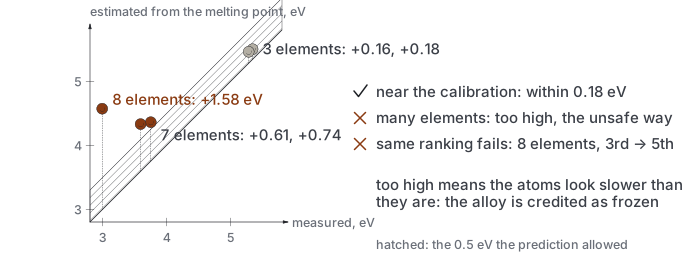
Outcome. Falsified on the condition named in advance. E91's multi-element result is
withdrawn.
Prediction 1 holds - the controls land within 0.18 eV. Prediction 3 is falsified and it was
the one that mattered: the rule OVER-predicts on every multi-element alloy, by up to 1.58
eV, where the falsification condition was set at 0.5. Prediction 4 fails too: the estimate
ranks the eight-element alloy third of five and the measurement ranks it last.
The error grows monotonically with element count - 0.17 eV at three, 0.68 at seven, 1.58
at eight - and always in the direction that manufactures stability.
The consequence, at 1000 K over the life of the part:
The eight-element alloy travels 172 nm where the estimate said 0.018, a factor of 9300,
against the 2 nm a nucleus needs. It is not frozen, and the kinetic credit that rescued it
was fictitious. The three-element controls are unaffected, so the Ta-W-Nb compositions at
the top of the effective run stand.
What is withdrawn: the claim in E91 that the objective makes high-entropy alloys
competitive on their merits. It makes them competitive on a kinetic credit that the
measurement does not support. The diversity numbers - twelve elements seen, 34 per cent
five-element or larger - were produced by an objective that over-credits exactly those
compositions, so they measure the bug and not the chemistry.
What survives. The structure of the argument is unchanged and still right: the requirement
is about a window and about reachability, and asking only about 90 K thermodynamics is asking
the wrong question. What fails is the four-millisecond proxy for Q.
Why it fails, which is the useful part. The melting point tracks mean bond strength. The
effective migration barrier in a concentrated alloy does not: the barriers form a broad
distribution and the rate-weighted average is dominated by the lowest of them, because
diffusion finds the easy paths. More elements means a broader distribution, a lower effective
barrier, and faster transport - the opposite of the mean-field estimate, and the opposite
direction to the sluggish-diffusion hypothesis often assumed for these alloys. A cheap Q for
multi-element compositions has to estimate the bottom of a barrier distribution, not its
centre, and no rule of mixtures on melting points can do that.