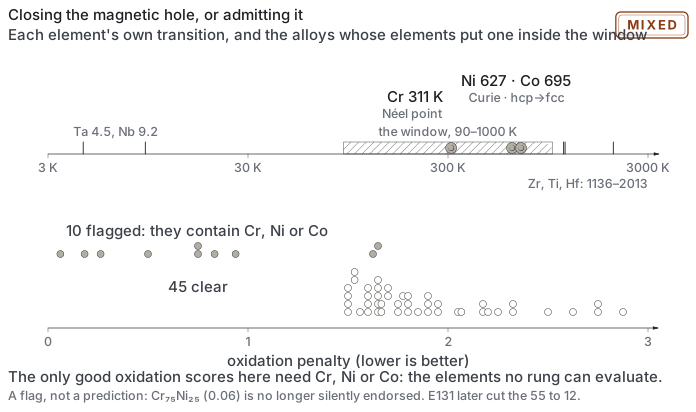
Can the ladder flag alloys holding elements with their own transition in the working range?
Yes. It flags 10 of the 55 candidates, and those hold the only elements here that resist oxygen well; the 55 later shrank to 12.
In the log: Closing the magnetic hole, or rather admitting it
mixedDate not stated in the log; it was written between the commit of 2026-09-16 03:54 and the first commit that contains it, 2026-09-16 04:53rung 4 · DFT0 predictions · 1 result paragraphEXPERIMENTS.md lines 7241–7278, lines 7280–7318
What E122 did and how it came out, drawn from this record and the files it names (book/assets/diagrams/exp/E122.svg).
Pre-registration
The pre-registration, as written
E122 — Closing the magnetic hole, or rather admitting it
Every rung of this ladder is spin-blind. The cluster expansion is fitted to MACE-MPA-0, which
carries no spin degree of freedom, and the Quantum ESPRESSO runs are not spin-polarised. Three
of the twelve elements undergo a transition inside the 90-1000 K service window in their
pure form:
Cr    311 K    antiferromagnetic Neel transition (incommensurate spin-density wave)
Ni    627 K    ferromagnetic Curie point
Co    695 K    hcp -> fcc allotropic transition
None of the other nine has a transition in the window: Ti, Zr and Hf transform hcp->bcc at
1155, 1136 and 2013 K, all above it; Nb and Ta go superconducting at 9.2 and 4.5 K, below it;
Mo, W, V and Cu have none.
What is being added is a flag, not a prediction. A fraction-weighted estimate of an
alloy's magnetic transition would be inventing physics: Cr's Neel temperature in particular
falls steeply with alloying, and the ordering is an incommensurate spin-density wave whose
existence depends on Fermi-surface nesting that dilution destroys. The honest statement the
ladder can make is: this composition contains an element whose own transition lies in the
window, and no rung here can evaluate what happens to it. That is a declaration of
ignorance, and it is worth more than a number that pretends otherwise.
Predicted, against E117's 55 feasible compositions:
Between 8 and 12 of the 55 are flagged.E118 found 11 of 55 contain Cr, Ni, Cu or Co
above 5 per cent; copper has no transition in the window, so the flagged count should be
at most 11 and at least 8.
Cr0.75 Ni0.25 is flagged, and it is the top of E118's Pareto front on oxidation. The
composition that currently looks best on every axis the ladder can compute is one whose
most likely failure mode the ladder cannot compute. If it is not flagged, the gate is
broken.
Mo0.50 Ta0.50, the driving-force optimum, is NOT flagged, and neither is any
composition drawn only from the refractory eight.
Falsified if the flag catches compositions containing none of Cr, Ni or Co, which would
mean the element table is wrong, or if it catches everything, which would mean the fraction
threshold is doing no work.
Results
EXPERIMENTS.md · line 7280
E122 result: all three predictions confirmed, and the flag exposes a structural problem
sharper than the hole it was built to record.
forager/physics/transitions.py flags a composition when a present element (above 5 per cent)
has a pure-element transition inside the window. Verifier.screen now returns
transitions_unmodelled and has_unmodelled_transition. 228 passing, one new test.
Against E117's 55 feasible compositions: 10 flagged, inside the predicted 8 to 12.
Cr0.75 Ni0.25 is flagged, as predicted, and it is the top of E118's Pareto front. No
composition drawn only from the refractory eight is flagged, also as predicted.
The structural finding is in the two lists side by side.
The best oxidation score among the 45 compositions the ladder can model is 1.70. The best
among the 10 it cannot is 0.06 - twenty-eight times better. The separation is clean: the
only way to resist oxygen at 1000 K in this element set is chromium, nickel or cobalt, and
those are exactly the three elements whose transitions this ladder cannot evaluate.
So the ladder's competence and the application's requirement are anti-correlated. This is
not a bug in the gate; the gate is what made it visible. Two consequences:
Everything the ladder currently endorses is oxidation-poor. Mo0.50 Ta0.50, the
driving-force optimum, carries a penalty of 2.05 against Cr0.75 Ni0.25's 0.06.
Every candidate that would satisfy the oxygen requirement needs physics this project does
not have - a spin-polarised model, or CALPHAD with magnetic terms assessed against
experiment. Neither is in the ladder and neither is a small addition.
The flag does not resolve that. It stops the ladder reporting a complete-looking verdict on
compositions where it has none, which was the whole point: Cr0.75 Ni0.25 is no longer
silently endorsed. Whether to extend the ladder into spin-polarised territory, or to accept
that this element set cannot meet the oxygen requirement and change the element set, is the
operator's decision and is now stated as one.
The full record
This entry is written in 2 separate places in the log, shown here in log order.
EXPERIMENTS.md · lines 7241–7278
E122 — Closing the magnetic hole, or rather admitting it
Every rung of this ladder is spin-blind. The cluster expansion is fitted to MACE-MPA-0, which
carries no spin degree of freedom, and the Quantum ESPRESSO runs are not spin-polarised. Three
of the twelve elements undergo a transition inside the 90-1000 K service window in their
pure form:
Cr    311 K    antiferromagnetic Neel transition (incommensurate spin-density wave)
Ni    627 K    ferromagnetic Curie point
Co    695 K    hcp -> fcc allotropic transition
None of the other nine has a transition in the window: Ti, Zr and Hf transform hcp->bcc at
1155, 1136 and 2013 K, all above it; Nb and Ta go superconducting at 9.2 and 4.5 K, below it;
Mo, W, V and Cu have none.
What is being added is a flag, not a prediction. A fraction-weighted estimate of an
alloy's magnetic transition would be inventing physics: Cr's Neel temperature in particular
falls steeply with alloying, and the ordering is an incommensurate spin-density wave whose
existence depends on Fermi-surface nesting that dilution destroys. The honest statement the
ladder can make is: this composition contains an element whose own transition lies in the
window, and no rung here can evaluate what happens to it. That is a declaration of
ignorance, and it is worth more than a number that pretends otherwise.
Predicted, against E117's 55 feasible compositions:
Between 8 and 12 of the 55 are flagged.E118 found 11 of 55 contain Cr, Ni, Cu or Co
above 5 per cent; copper has no transition in the window, so the flagged count should be
at most 11 and at least 8.
Cr0.75 Ni0.25 is flagged, and it is the top of E118's Pareto front on oxidation. The
composition that currently looks best on every axis the ladder can compute is one whose
most likely failure mode the ladder cannot compute. If it is not flagged, the gate is
broken.
Mo0.50 Ta0.50, the driving-force optimum, is NOT flagged, and neither is any
composition drawn only from the refractory eight.
Falsified if the flag catches compositions containing none of Cr, Ni or Co, which would
mean the element table is wrong, or if it catches everything, which would mean the fraction
threshold is doing no work.
EXPERIMENTS.md · lines 7280–7318
E122 result: all three predictions confirmed, and the flag exposes a structural problem
sharper than the hole it was built to record.
forager/physics/transitions.py flags a composition when a present element (above 5 per cent)
has a pure-element transition inside the window. Verifier.screen now returns
transitions_unmodelled and has_unmodelled_transition. 228 passing, one new test.
Against E117's 55 feasible compositions: 10 flagged, inside the predicted 8 to 12.
Cr0.75 Ni0.25 is flagged, as predicted, and it is the top of E118's Pareto front. No
composition drawn only from the refractory eight is flagged, also as predicted.
The structural finding is in the two lists side by side.
The best oxidation score among the 45 compositions the ladder can model is 1.70. The best
among the 10 it cannot is 0.06 - twenty-eight times better. The separation is clean: the
only way to resist oxygen at 1000 K in this element set is chromium, nickel or cobalt, and
those are exactly the three elements whose transitions this ladder cannot evaluate.
So the ladder's competence and the application's requirement are anti-correlated. This is
not a bug in the gate; the gate is what made it visible. Two consequences:
Everything the ladder currently endorses is oxidation-poor. Mo0.50 Ta0.50, the
driving-force optimum, carries a penalty of 2.05 against Cr0.75 Ni0.25's 0.06.
Every candidate that would satisfy the oxygen requirement needs physics this project does
not have - a spin-polarised model, or CALPHAD with magnetic terms assessed against
experiment. Neither is in the ladder and neither is a small addition.
The flag does not resolve that. It stops the ladder reporting a complete-looking verdict on
compositions where it has none, which was the whole point: Cr0.75 Ni0.25 is no longer
silently endorsed. Whether to extend the ladder into spin-polarised territory, or to accept
that this element set cannot meet the oxygen requirement and change the element set, is the
operator's decision and is now stated as one.
Related entries
E117 — Is rung 0's reward anti-aligned with the actual requirement?
E118 — Multi-objective selection over the feasible set