EXPERIMENTS.md · lines 4438–4498E81 — Before adding nickel: does the hull already know enough to judge it?
The request is to widen the search beyond the eight bcc refractory metals, nickel first.
The obstacle is not the generator, which does not care what its elements are. It is the
competitor set. The off-lattice hull holds 136 phases and every one was built for these
eight: 8 bcc, 8 hcp, 8 omega, 56 C15 Laves, 56 C14 Laves. There is no fcc phase in it at
all, because none of the eight is fcc - and nickel is. Nor is there a single L1_2, B2 or
D0_22, which are the structures nickel actually forms with these metals.
E56 established what happens when the hull is missing the phase that wins: the expansion
rates a composition highest exactly where the structure it cannot see is lowest, and a
generator rewarded on that signal learns to find them. Seven qualified compositions were
withdrawn for it.
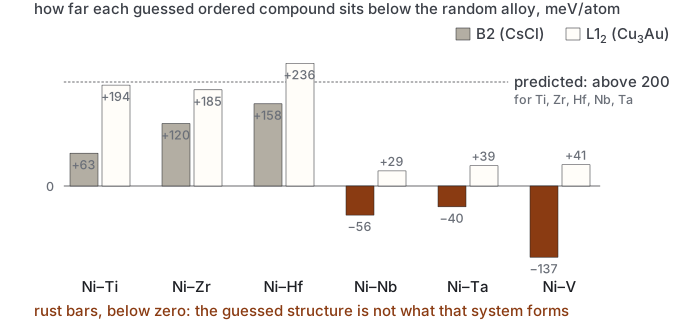
Prediction: the ordered nickel compounds sit more than 200 meV/atom below the bcc solid
solution at the same composition, for Ti, Zr, Hf, Nb and Ta at minimum. If so, running the
fly on a nickel-containing space with the present hull would manufacture winners that are
really line compounds, and the hull extension is mandatory rather than tidy.
Falsified if the ordered compounds are within about 50 meV/atom of the solid solution,
which would mean the present hull is nearly adequate and nickel could be added cheaply.
Measured with MACE, every structure relaxed, cell and ions, same potential and settings as
the existing hull so the numbers join it without a convention argument.
Outcome. The prediction is falsified as stated, and the reason is that I chose the
structures from memory instead of looking up what these systems make.
Positive is the ordered structure sitting below the solid solution. Predicted above 200
meV/atom for Ti, Zr, Hf, Nb and Ta; measured 63 to 236 for the first three and negative for
the rest, so the prediction fails.
A negative entry is not a result about the alloy, it is a result about me. It says the
ordered structure I built is higher than the disordered one, which means it is not the
structure that system forms. Ni-Nb makes delta-Ni3Nb in D0a and mu-Ni6Nb7; Ni-Ta makes
Ni3Ta; Ni-V makes sigma and D0_22 Ni3V. None of those were computed. The test is silent on
those three systems rather than reassuring about them, and the true gaps are more likely
larger than what is tabulated here, not smaller.
Where the prototypes were right, the concern is confirmed. NiTi, NiZr and NiHf really
are B2, and Ni3Ti, Ni3Zr and Ni3Hf really are close to L1_2. Those six sit 63 to 236
meV/atom below the solid solution - every one larger than the 40 meV/atom the generator
treats as qualifying, and larger than the screen's own 35 meV/atom uncertainty. A nickel
search against the present hull would score those compositions as stable solid solutions
when they are line compounds, which is E56 repeating with a different set of phases.
The lesson is the method, not the number. The hull's 136 phases were also chosen by
picking prototypes - bcc, hcp, omega, C15, C14 - and that choice was defensible for eight
bcc metals that mostly form Laves phases. It does not transfer. Extending to a new element
means taking the competitor structures from a database of what is actually observed, not
from whichever prototype comes to mind. mcp__prism-tools__query_materials_project exists
for this and was not used.