EXPERIMENTS.md · lines 4531–4632E83 — Nickel added to the system: a nine-element expansion
Nickel in a refractory high-entropy alloy is ordinary practice, and the ladder is the
mechanism for handling a cheap rung that cannot be trusted - that is what the rungs above it
are for. E81 read the missing hull phases as a reason not to run; they are a rung of work,
not a blocker, and this entry does the work.
Measured first, with MACE, so the design choices rest on numbers:
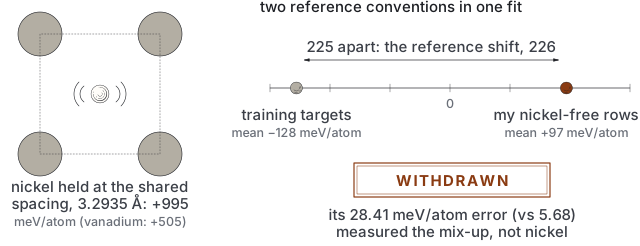
995 meV/atom is twice vanadium's 505, which was the largest in the system. That single
number is why nickel is an addition rather than a base: holding it at refractory spacing
costs an electron volt, so a nickel-rich bcc solid solution is not a thing this lattice can
represent, while nickel at ten or fifteen per cent rides a Vegard-averaged lattice that has
moved to meet it.
The shared lattice stays at 3.2935 A, the eight-element mean, rather than being
re-averaged to 3.238 with nickel in it. Re-averaging would move every reference, every
anchor and every recorded energy in this file for the sake of a minority element. Keeping it
costs nickel a large anchor, and large anchors are now measured exactly rather than modelled
(E80), so the cost is bookkeeping rather than error.
Predicted, before fitting:
- CV RMSE rises, to somewhere between 8 and 15 meV/atom, from 5.68 on eight elements.
Nickel roughly doubles the energy scale the expansion has to span and adds a chemistry
unlike the other eight.
- All nine corners pin to within the new CV error, since they are training points with
targets that are zero by definition.
- The eight existing elements keep their present pair interactions - the expansion
should not need to repay for what it already knew, so predictions on nickel-free
compositions stay within about 15 meV/atom of the eight-element fit.
A failure of 3 is the interesting one: it would mean the nine-element fit cannot serve both
systems and that nickel work needs its own expansion rather than a widened one.
Withdrawn. Every number in E83 above is an artefact of a reference-convention error of
mine, not a result about nickel.
The expansion is fitted against shared-lattice references - each element evaluated at
3.2935 A - which is why data/ce_8element.npz stores Mo at -10.6158 and not -10.8420, and
why a pure element's target is exactly zero. build_ce_nickel.py computed equilibrium
references instead, each element relaxed to its own lattice constant, by copying the
_equilibrium helper out of build_ce.py without checking which of the two numbers that
script actually fits against.
The two conventions differ by the elemental anchor, which averages 226 meV/atom over the
eight elements. That is the whole of the discrepancy:
And it was internally inconsistent, which is worse than being on the wrong footing. The
nine corners were given targets of exactly zero - true only under shared-lattice references -
while the alloy rows carried equilibrium-referenced targets. The fit was asked to satisfy
two conventions at once and split the difference, which is the entire explanation for a CV
RMSE of 28.41 meV/atom against 5.68, for nickel's corner refusing to pin at +69, and for the
209 meV/atom bias on nickel-free compositions.
So all three predictions are unfalsified rather than falsified. Nothing has yet been
learned about whether a nine-element expansion can carry nickel. The three numbers reported
against them measure my error.
The tell was there and I read past it. The nickel-free training targets came out at mean
+97 with a range of -100 to +461, while the survey compositions those same energies are
compared against run -300 to +51. Two populations of the same quantity, offset by the size
of the correction that distinguishes the conventions. I checked the distributions, saw 38
meV/atom separating nickel-free from nickel-bearing rows, concluded the scales were
comparable, and did not think to compare either of them against the training set already on
disk - which took one line and settles it.
Outcome. The controls hold exactly, the verdicts survive, and my expectation of how far
the temperatures would move was too strong.
The controls are the ones that mattered and they are exact. The driving force and the
activation energy reproduced to the digit on every composition, which is what a refit of the
expansion should do to two quantities computed entirely in MACE. Had either moved, the
conclusion would have been that I did not know which rung used what.