EXPERIMENTS.md · lines 2129–2179E42 — Ta-Ti-V-W against Sobieraj et al., with error bars from the start
Date 2026-09-12 · Question (operator) A professor on this project published on
exactly this. Does our chain reproduce it? · Provenance …/sobieraj.py
The target. Sobieraj, Wrobel, Rygier, Kurzydlowski, El Atwani, Devaraj, Martinez Saez
and Nguyen-Manh, Phys. Chem. Chem. Phys. 22, 23929 (2020), built a cluster expansion
for bcc Cr-Ta-Ti-V-W and report the equiatomic quaternary Ta-Ti-V-W at an order-disorder
transition of 500 K - the lowest of the compositions they examined. All four elements
are in our expansion, so this is the same alloy rather than a proxy, unlike E39's
comparison.
Their protocol is ours. Start disordered at 3000 K and cool in 100 K steps, via ATAT.
Followed here from 2000 K, at 128 sites, with six independent runs so the answer carries
an error bar - the lesson of E41, applied before claiming anything rather than after.
Result.
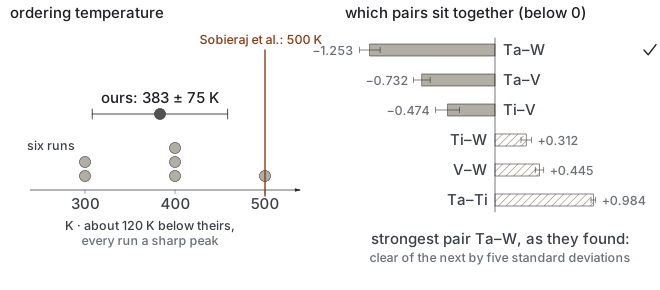
Individual runs: 500, 400, 400, 300, 300, 400 K, every one a genuine peak with prominence
7.6 to 15.5 - sharp, against 1.66 for the MoNbTaVW case of E39. This transition is well
defined rather than a broad crossover.
The pair identification is robust this time. Ta-W at -1.253 +/- 0.104, with the next
strongest Ta-V at -0.732 +/- 0.083: separated by about five standard deviations across six
runs. E39 claimed a pair ranking from one run and E41 had to withdraw it; this one survives
repetition.
The transition sits about 120 K below theirs. Our standard error on the mean is 31 K and
their value is quoted at 100 K resolution, so the disagreement is roughly two standard
errors - the same order, with our value low. Expected sources, none of them adjustable after
the fact: our expansion is fitted to a potential 6.61 meV/atom from DFT (E18) while theirs
is fitted to DFT; ours is an eight-element expansion restricted to these four, theirs a
five-element one built for its system; and the k-point mesh is not converged - 55.8 meV/atom
separates a 2x2x2 from a 3x3x3 at 16 atoms.
A caveat on that last one, entered against my own first phrasing. 55.8 meV/atom is a
shift in total energy per atom. A transition temperature depends on energy differences
between arrangements at fixed composition, and a k-point error is largely a property of the
elements and the composition, so most of it cancels in precisely those differences. Whether
any of it survives into the ordering energies is untested - it needs two arrangements of
one composition computed at both meshes and their difference compared, which has not been
done. The number is real; its relevance to the 120 K gap is speculation until then.
Full first-shell parameters at 100 K, mean +/- sd over six runs:
Ta-W -1.253 +/- 0.104, Ta-V -0.732 +/- 0.083, Ti-V -0.474 +/- 0.121,
Ti-W +0.312 +/- 0.052, V-W +0.445 +/- 0.043, Ta-Ti +0.984 +/- 0.024.