Can the quantum calculations be run in parallel in the cloud, cheaply?
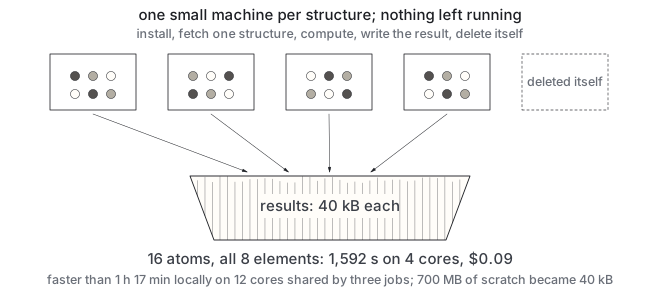
Yes. A 16-atom calculation took 1,592 s on four cores for $0.09, and each machine deleted itself when done.
In the log: Density functional theory, in parallel, for nine cents a structure
recordedDate 2026-09-13, as written in the logunclassified0 predictions · 0 result paragraphsEXPERIMENTS.md lines 2184–2229
What E43 did and how it came out, drawn from this record and the files it names (book/assets/diagrams/exp/E43.svg).
Results
No result paragraph for this entry was found in the log.
The full record
EXPERIMENTS.md · lines 2184–2229
E43 — Density functional theory, in parallel, for nine cents a structure
Date 2026-09-13 · Question DFT is the rung that decides whether anything else here
is true, and we had seventeen structures from one laptop. Can it be run in parallel
affordably? · Provenancecloud/qe_startup.sh, cloud/submit_batch.py
Shape. The calculation is embarrassingly parallel across compositions - each is
independent - and Quantum ESPRESSO scales sub-linearly with cores, so many small instances
beat a few large ones. Each instance installs what it needs, fetches one structure,
computes it, writes the result to a bucket and deletes itself. Nothing is kept on the
instance and nothing idles: a crash costs one structure, and a finished job stops billing
the moment it ends rather than when somebody notices.
Verified end to end, 16 atoms, all eight species, 36 k-points, Marzari-Vanderbilt
smearing:
total energy
-8535.01649 Ry, JOB DONE
time
1,592 s on 4 cores (n2-standard-4)
cost
$0.09 per structure
instance afterwards
deleted itself; nothing left billing
It is faster than the same job here. Locally that size took 1h17m on twelve cores
against 26.5 minutes on four in the cloud - because the local machine was running three
Quantum ESPRESSO processes against each other. Isolation is worth more than cores.
Two faults the cloud smoke run caught, each in under two minutes and for about a cent:
nproc reports hyperthreads while OpenMPI counts physical cores, so asking for eight
ranks on a four-core instance fails instantly with no calculation attempted. Physical
cores are the right choice regardless - the pair sharing a core also share the memory
bandwidth this code is bound by.
A sixteen-atom eight-species job is hours, not minutes. That was an assumption, not a
measurement, and it is what makes many-small-instances the right shape rather than a
preference.
Cost guard.submit_batch.py refuses to launch when the estimate exceeds a stated cap,
priced from on-demand rates because this project has no preemptible quota - the cheap
path is unavailable and assuming otherwise would understate every estimate fourfold.
Storage is no longer a constraint, and not because of the cloud. Setting disk_io = 'none' takes a job from about 700 MB of wavefunctions to 40 kB of result. Seventeen
earlier jobs had left 12 GB of scratch behind for 772 kB of answers; a thousand jobs now
cost 40 MB. The archive machinery built for cloud storage works but is solving a problem
that a one-line setting removed.