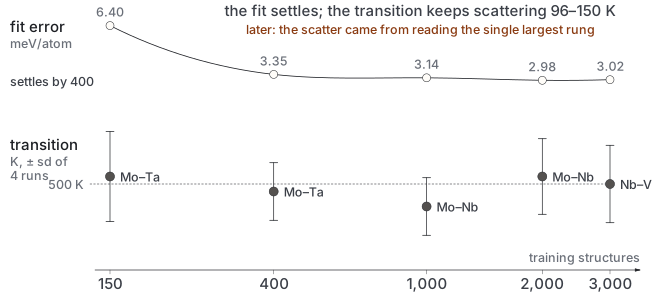
Does more training data pin down the ordering temperature?
Withdrawn. It scattered 96–150 K however much data was used; that scatter was later traced to how the peak was read, not to the data.
In the log: The transition temperature does not converge with data, and E39 over-read one run
supersededDate 2026-09-12, as written in the logrung 1 · ordering0 predictions · 0 result paragraphsEXPERIMENTS.md lines 2074–2101
What E41 did and how it came out, drawn from this record and the files it names (book/assets/diagrams/exp/E41.svg).
Results
No result paragraph for this entry was found in the log.
The full record
EXPERIMENTS.md · lines 2074–2101
E41 — The transition temperature does not converge with data, and E39 over-read one run
Date 2026-09-12 · Question How much data does a local expansion need before the
short-range order and the transition temperature settle? · Provenance…/{local_ce,odt_converge,wl_test}.py
The literature said what to expect, and half of it applied. Xie, Zhou, Luan and Jiang
(J. Chem. Theory Comput.18, 3795, 2022) found that a training set large enough for
the cross-validation score to converge still leaves the transition temperature badly
uncertain, needing a few thousand configurations - which is why they generated theirs with
a machine-learning force field rather than DFT. Our first pass reproduced their symptom
exactly: fit error fell from 16.8 to 3.5 meV/atom while the transition wandered 450-900 K.
Their fix did not work here, which is the finding. Carried to 3,000 structures, with
four independent Monte Carlo runs per fit so the transition comes with an error bar:
structures
CV RMSE
transition
sd across runs
strongest pair
alpha
150
6.40
525
150
Mo-Ta
-1.160
400
3.35
475
96
Mo-Ta
-1.136
1000
3.14
425
96
Mo-Nb
-0.769
2000
2.98
525
126
Mo-Nb
-0.888
3000
3.02
500
129
Nb-V
-0.815
The scatter is 96-150 K at every training size, while the fit converges by 400
structures. The uncertainty is Monte Carlo run-to-run, not the fit - so more training data
cannot reduce it, and the bottleneck here is not the one the literature identified. Our
transition is 500 +/- 130 K.
Related entries
E39 — Short-range order and the transition temperature, against an independent result