Is the new screening model accurate on independent quantum data for these alloys?
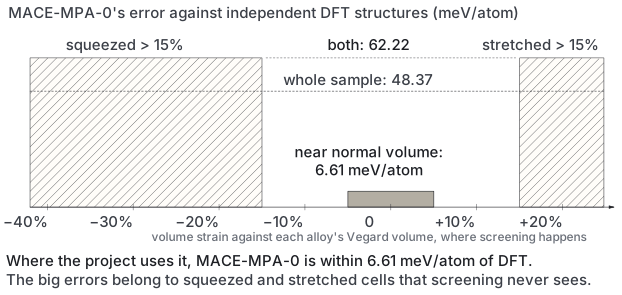
Yes. Near normal volume its error is 6.61 meV/atom on 300 independent structures; squeezed or stretched cells are about ten times worse.
In the log: MACE-MPA-0 validated on 300 independent DFT structures
recordedDate 2026-09-12, as written in the logrung 4 · DFT0 predictions · 1 result paragraphEXPERIMENTS.md lines 768–821
What E18 did and how it came out, drawn from this record and the files it names (book/assets/diagrams/exp/E18.svg).
Results
EXPERIMENTS.md · line 787
Result — the error is almost entirely off-equilibrium.
The full record
EXPERIMENTS.md · lines 768–821
E18 — MACE-MPA-0 validated on 300 independent DFT structures
Date 2026-09-12 · QuestionE13's verdict rested on ten points. Does it hold on a
large independent DFT set? · Provenance…/rhea_validate.py,
rhea_equil.py; RHEA database, Zenodo 10.5281/zenodo.18863415
Independence. MACE-MPA-0 trains on MPtrj + sAlex. MPtrj was counted exhaustively
(E14) and contains zero materials with four or more of these elements, so RHEA's
3-to-9-component random solid solutions cannot be in it; sAlex is Alexandria prototype
substitution, a different kind of object; and RHEA is dated March 2026, after the
model. RHEA's own materials_project group (147 of 22,477 frames, 0.65%) is the only
possible overlap and is excluded.
Method. RHEA bcc_alloys: 2,150 structures of 54 atoms, randomly ordered, randomly
displaced, several volumes per composition. VASP-PBE. Absolute energies are not
comparable across codes, so one constant per element is fitted by least squares - the
standard element referencing - and the residuals judged. Restricted to the eight
elements used here (1,454 of 2,150 structures).
Result — the error is almost entirely off-equilibrium.
regime
n
MAE
RMSE
whole bcc_alloys sample
400
48.37
72.85
near equilibrium, |strain| <= 5%
300
6.61
8.30
far from equilibrium, |strain| > 15%
300
62.22
87.17
meV/atom, strain measured against the Vegard volume for each structure's own
composition. RHEA spans -42% to +24.8% volume strain by design, because it exists
to train a potential; screening operates at the Vegard volume.
Interpretation.MACE-MPA-0 is accurate to 6.61 meV/atom where this project uses
it, on 300 independent VASP structures at 54 atoms in the right chemistry. That is
better than the optimistic ten-point estimate of 23 (E13) and about ten times better
than the MACE-MP-0 the project started with. The RHEA-wide figure of 48 is a
statement about compressed and expanded cells, not about screening.
6.61 meV/atom is below the DFT occupancy scatter of 4.03 measured in E17 to within
a factor of two - that is, the potential is now approaching the intrinsic
configurational noise of the quantity itself.
Consequences.
Fine-tuning is not needed for near-equilibrium screening. It would chase an error
comparable to the physics' own scatter.
Fine-tuning on RHEA is the right move for relaxation, molecular dynamics or
defects, which live in the 62 meV/atom regime. Freeze the foundation head and add a
second head, per the documented recipe.
A distortion proxy (spread of first-shell distances) did not separate the error
cleanly, Spearman +0.09 with a non-monotonic pattern across quartiles. Volume strain
did. The mechanism is recorded as volume, not as displacement disorder.
Caveat. The Spearman values reported by these scripts are near 1.000 in every
regime because they correlate total energies dominated by composition; they carry no
information here and MAE is the operative metric.
Related entries
E13 — A drop-in model replacement fixes the screening potential
E14 — Why the old model failed: a census, not a hypothesis
E17 — The finite-size claim does not survive DFT; a different pattern does