Does switching on magnetism for Ni3Al keep the DFT reference frame consistent?
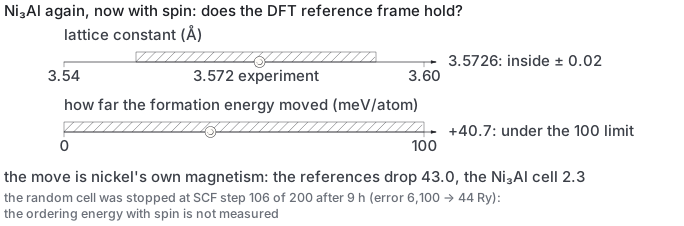
Yes. The lattice constant held at 3.5726 A and the formation energy moved 40.7 meV/atom, inside the 100 limit.
In the log: Ni₃Al with spin, references in the same frame and at the same cutoff
confirmedDate not stated in the log; it was written between the commit of 2026-09-22 10:18 and the first commit that contains it, 2026-09-22 10:46rung 4 · DFT0 predictions · 2 result paragraphsEXPERIMENTS.md lines 15582–15591, lines 16038–16063
What E226 did and how it came out, drawn from this record and the files it names (book/assets/diagrams/exp/E226.svg).
Results
EXPERIMENTS.md · line 15582
E226 — Ni₃Al with spin, references in the same frame and at the same cutoff.E218's
E_form(L1₂) = −559.4 meV/atom is unscored because the cell ran at 80 Ry against 60-Ry
references. E226 re-runs the L1₂ scan and the random Ni₂₄Al₈ cell with nspin = 2 (Ni 0.5, Al
0) and scores against fcc Ni nspin = 2 at 80 Ry (E216's, reused only if its pw.in confirms
80 Ry) and an fcc Al 80-Ry reference computed here. Expectation: a₀ within ±0.02 Å of 3.572,
E_form moving by roughly the composition-linear −45.8 meV/atom minus the cell's own magnetic
energy; a move > 100 meV/atom means the frames are still mismatched — stop and check. E226
runs first so a frame error surfaces on three 4-atom cells, not after sixteen alloy cells.
Wall time: E226 ~1 h plus the 32-atom tail (10–20 h under the retry policy); E225 36–56 h.
runs/e225_e226_chain.sh, gated behind E221, E222 and the E218 retry.
EXPERIMENTS.md · line 16038
E226 RESULT (14:3x, A100) — the frame check passes; the 32-atom tail was stopped. Spin-polarised
L1₂ Ni₃Al at 80 Ry against fcc Ni nspin 2 (E216, 80 Ry) and fcc Al (computed here, 80 Ry):
a₀ 3.5726 Å (bar 3.572 ± 0.02: PASS); E_form −423.3 meV/atom, a move of +40.7 from
E218's non-spin −464.0 (bar: < 100, PASS). Decomposed: the references drop by 43.0 (the
composition-linear spin energy of Ni, predicted 45.8) and the L1₂ cell itself by only 2.3 — its
moment is 0.82 μB per formula unit at a₀, a weak itinerant ferromagnet as the design assumed, so
nearly all of the spin correction to this formation energy is in the Ni reference. The random
Ni₂₄Al₈ cell (nspin 2, E218's plain/β 0.02 mixing) was stopped at SCF step 106 of 200 after 9 h:
estimated accuracy fell from 6,100 to 44 Ry while the magnetisation relaxed 39.7 → 22.1 μB/cell, then
flattened (49.6 → 44.3 Ry over the last 15 steps); reaching 1e-6 Ry was not plausible in the
remaining steps, and the retry ladder only cuts β further. Output kept as
runs/e226_ni3al_spin/random_2x2x2/pw.out.attempt1_killed. ΔE_order with spin is therefore
not measured; it is queued behind the ladder's own DFT with a changed start (initial moment near
the relaxed 0.9 μB/Ni rather than 1.65, and a two-stage smearing restart), to be pre-registered
when launched. E225 no longer waits on it (runs/e225_colab_chain.sh, started 14:3x).
Review of the exact evaluator (Sonnet, adversarial, 14:5x): holds. Production-cell parity on
seven models (embeddings 3/4/5/9, 10 Å pairs): per-cell ≤ 6.3e-7 eV, per-swap ≤ 0.023 meV; cache
drift over >1,300 accepted swaps at machine epsilon, for single members and the ensemble mean;
composition projection by element name confirmed with a scrambled 11-element order. Three findings,
all closed: ECEVerifier silently dropped an ensemble member without a model directory (now
refused); the evaluator's constant-site-basis assumption was unasserted (now asserted); and the 10 Å
pair cutoff exceeds half the production cell edge (9.88 Å), which parity cannot see. Known answer
for the last: a decoration periodic in a 3×3×3 cell — whose whole edge is shorter than the cutoff —
has the same energy per site in the 6×6×6 tiling to 1.5e-5 meV/atom (and 6→12 to 3.7e-6), so
pyeCE enumerates every lattice vector once rather than folding to a minimum image, and a 10 Å model
is evaluated correctly on the production cell (tests/test_ece_distill.py, tiling test).
The full record
This entry is written in 2 separate places in the log, shown here in log order.
EXPERIMENTS.md · lines 15582–15591
E226 — Ni₃Al with spin, references in the same frame and at the same cutoff.E218's
E_form(L1₂) = −559.4 meV/atom is unscored because the cell ran at 80 Ry against 60-Ry
references. E226 re-runs the L1₂ scan and the random Ni₂₄Al₈ cell with nspin = 2 (Ni 0.5, Al
0) and scores against fcc Ni nspin = 2 at 80 Ry (E216's, reused only if its pw.in confirms
80 Ry) and an fcc Al 80-Ry reference computed here. Expectation: a₀ within ±0.02 Å of 3.572,
E_form moving by roughly the composition-linear −45.8 meV/atom minus the cell's own magnetic
energy; a move > 100 meV/atom means the frames are still mismatched — stop and check. E226
runs first so a frame error surfaces on three 4-atom cells, not after sixteen alloy cells.
Wall time: E226 ~1 h plus the 32-atom tail (10–20 h under the retry policy); E225 36–56 h.
runs/e225_e226_chain.sh, gated behind E221, E222 and the E218 retry.
EXPERIMENTS.md · lines 16038–16063
E226 RESULT (14:3x, A100) — the frame check passes; the 32-atom tail was stopped. Spin-polarised
L1₂ Ni₃Al at 80 Ry against fcc Ni nspin 2 (E216, 80 Ry) and fcc Al (computed here, 80 Ry):
a₀ 3.5726 Å (bar 3.572 ± 0.02: PASS); E_form −423.3 meV/atom, a move of +40.7 from
E218's non-spin −464.0 (bar: < 100, PASS). Decomposed: the references drop by 43.0 (the
composition-linear spin energy of Ni, predicted 45.8) and the L1₂ cell itself by only 2.3 — its
moment is 0.82 μB per formula unit at a₀, a weak itinerant ferromagnet as the design assumed, so
nearly all of the spin correction to this formation energy is in the Ni reference. The random
Ni₂₄Al₈ cell (nspin 2, E218's plain/β 0.02 mixing) was stopped at SCF step 106 of 200 after 9 h:
estimated accuracy fell from 6,100 to 44 Ry while the magnetisation relaxed 39.7 → 22.1 μB/cell, then
flattened (49.6 → 44.3 Ry over the last 15 steps); reaching 1e-6 Ry was not plausible in the
remaining steps, and the retry ladder only cuts β further. Output kept as
runs/e226_ni3al_spin/random_2x2x2/pw.out.attempt1_killed. ΔE_order with spin is therefore
not measured; it is queued behind the ladder's own DFT with a changed start (initial moment near
the relaxed 0.9 μB/Ni rather than 1.65, and a two-stage smearing restart), to be pre-registered
when launched. E225 no longer waits on it (runs/e225_colab_chain.sh, started 14:3x).
Review of the exact evaluator (Sonnet, adversarial, 14:5x): holds. Production-cell parity on
seven models (embeddings 3/4/5/9, 10 Å pairs): per-cell ≤ 6.3e-7 eV, per-swap ≤ 0.023 meV; cache
drift over >1,300 accepted swaps at machine epsilon, for single members and the ensemble mean;
composition projection by element name confirmed with a scrambled 11-element order. Three findings,
all closed: ECEVerifier silently dropped an ensemble member without a model directory (now
refused); the evaluator's constant-site-basis assumption was unasserted (now asserted); and the 10 Å
pair cutoff exceeds half the production cell edge (9.88 Å), which parity cannot see. Known answer
for the last: a decoration periodic in a 3×3×3 cell — whose whole edge is shorter than the cutoff —
has the same energy per site in the 6×6×6 tiling to 1.5e-5 meV/atom (and 6→12 to 3.7e-6), so
pyeCE enumerates every lattice vector once rather than folding to a minimum image, and a 10 Å model
is evaluated correctly on the production cell (tests/test_ece_distill.py, tiling test).
Related entries
E218 — E216–E219 — pre-registered before any of them runs (2026-09-21 16:2x)
E216 — E219 — pre-registered before any of them runs (2026-09-21 16:2x)
E225 — does ΔE_mag depend on the decoration at fixed composition?
E221 — the alloy vacancy anchor, pre-registered (2026-09-21 21:1x; queued after E217 and the…