Does magnetism's energy depend on how the atoms are arranged, not just on the mix?
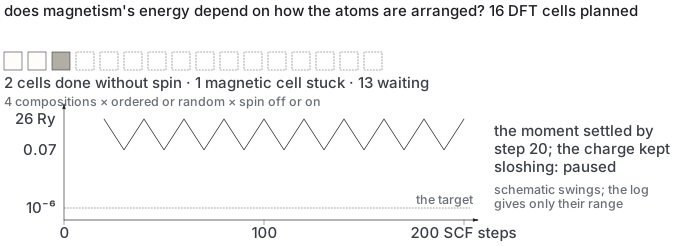
Not yet. Paused: the first magnetic DFT cell never converged, oscillating for 180 steps.
In the log: does ΔE_mag depend on the decoration at fixed composition?
stoppedDate 2026-09-24 00:06, as written in the logrung 4 · DFT0 predictions · 1 result paragraphEXPERIMENTS.md lines 15570–15580, lines 16198–16218
What E225 did and how it came out, drawn from this record and the files it names (book/assets/diagrams/exp/E225.svg).
Pre-registration
The pre-registration, as written
E225 — does ΔE_mag depend on the decoration at fixed composition? Four fcc compositions
(Ni₁₂Fe₄, Ni₈Fe₄Cr₄, Ni₄Fe₄Cr₄Al₄, Fe₈Cr₈) × two decorations (ordered = one element per fcc
sublattice; a seed-fixed random) × nspin 1 and 2 (FM start) = 16 cells on 16-site 2×2×1
conventional fcc cells at Vegard a (the design's "16-atom 2×2×2" is 32 atoms; 16 is 2×2×1,
and the 3.5 Å z-period means these measure a spread, not an absolute ordering energy),
80/720 Ry, MV 0.02, k 6 6 11, conv 1e-6, each through run_with_policy. Pre-registered
(written to prediction.json before any pw.x): sd(ΔE_mag) across decorations ≥ 25 meV/atom
for Fe-bearing fcc, and |ordered − random| > 20 meV/atom in ≥ 2 of 4 compositions.
Falsifier: sd < 10 meV/atom in every composition withdraws the magnetic-frame design and
adopts the composition-linear correction as the whole magnetic rung. E216's linear model is
reported beside each measurement (−162.7, −150.5, −135.2, −239.9 meV/atom).
Results
EXPERIMENTS.md · line 16198
E225 PAUSED (19:1x) — spin-polarised SCF does not converge under the retry ladder. The first
nspin 2 cell (ordered Ni₁₂Fe₄, 16 atoms) ran 200 steps at plain β 0.05 / ndim 16: the total moment
settled at 19.4 μB by step 20, but the estimated accuracy then oscillated between 0.07 and 26 Ry for
180 steps (charge sloshing, not a magnetic search). (Note 2026-09-24 00:06: that range was read off the paused run's output, which is not kept; the kept first attempt on the same cell and settings, runs/scf_spin_test/Ni12Fe4_ordered_nspin2/pw.out.attempt1, swings 0.031–33.6 Ry over steps 21–200, 5th–95th percentile 0.09–22 Ry.) The ladder's answer — cut β to 0.04 — cannot cure
that; the second attempt sat near 25 Ry and was stopped (output kept as
pw.out.attempt2_stopped). E226's random Ni₂₄Al₈ failed the same way. E225 is paused, not dropped
(resume-safe; the two finished nspin 1 cells are kept), so the shared A100 serves E239 and E221 and is
free for the survivor DFT. A spin-aware convergence strategy (mixing mode and a staged restart, never
a change to cutoffs, smearing or k) is being written and tested on this exact cell before E225 and
E226's random cell resume. Also found in E240's first finds: the reported "strongest ordering pair"
can be a pair of trace species with one or two atoms in the 432-site cell (α₁ = −9, −53), which is
statistics, not order; T_od is unaffected. Fix queued.
Rung 1's reported ordering pair fixed (19:4x).alpha1_pair / alpha1_floor now name only pairs
whose α is readable on the cell: the exact random-decoration standard error of α (derived for a
uniform permutation of fixed counts on a symmetric z-regular shell; checked against exhaustive
enumeration on 18 small lattices and against empirical sd within 10 %) must be ≤ 0.1, and the
pair's own floor max(1 − 1/x_a, 1 − 1/x_b) must lie more than 3 SE below the random mean. E240's
"Cr–Hf −53.0" was one bond between two lone atoms. Stated limit (review): on the 432-site cell a
minority below ~7 % (30 atoms) cannot show detectable order even when perfectly ordered (5 %:
α_perfect = −0.054 inside the noise), so such pairs report None; T_od is unaffected. E240's
running shards still carry the old selection in their alpha1_* fields.
The full record
This entry is written in 2 separate places in the log, shown here in log order.
EXPERIMENTS.md · lines 15570–15580
E225 — does ΔE_mag depend on the decoration at fixed composition? Four fcc compositions
(Ni₁₂Fe₄, Ni₈Fe₄Cr₄, Ni₄Fe₄Cr₄Al₄, Fe₈Cr₈) × two decorations (ordered = one element per fcc
sublattice; a seed-fixed random) × nspin 1 and 2 (FM start) = 16 cells on 16-site 2×2×1
conventional fcc cells at Vegard a (the design's "16-atom 2×2×2" is 32 atoms; 16 is 2×2×1,
and the 3.5 Å z-period means these measure a spread, not an absolute ordering energy),
80/720 Ry, MV 0.02, k 6 6 11, conv 1e-6, each through run_with_policy. Pre-registered
(written to prediction.json before any pw.x): sd(ΔE_mag) across decorations ≥ 25 meV/atom
for Fe-bearing fcc, and |ordered − random| > 20 meV/atom in ≥ 2 of 4 compositions.
Falsifier: sd < 10 meV/atom in every composition withdraws the magnetic-frame design and
adopts the composition-linear correction as the whole magnetic rung. E216's linear model is
reported beside each measurement (−162.7, −150.5, −135.2, −239.9 meV/atom).
EXPERIMENTS.md · lines 16198–16218
E225 PAUSED (19:1x) — spin-polarised SCF does not converge under the retry ladder. The first
nspin 2 cell (ordered Ni₁₂Fe₄, 16 atoms) ran 200 steps at plain β 0.05 / ndim 16: the total moment
settled at 19.4 μB by step 20, but the estimated accuracy then oscillated between 0.07 and 26 Ry for
180 steps (charge sloshing, not a magnetic search). (Note 2026-09-24 00:06: that range was read off the paused run's output, which is not kept; the kept first attempt on the same cell and settings, runs/scf_spin_test/Ni12Fe4_ordered_nspin2/pw.out.attempt1, swings 0.031–33.6 Ry over steps 21–200, 5th–95th percentile 0.09–22 Ry.) The ladder's answer — cut β to 0.04 — cannot cure
that; the second attempt sat near 25 Ry and was stopped (output kept as
pw.out.attempt2_stopped). E226's random Ni₂₄Al₈ failed the same way. E225 is paused, not dropped
(resume-safe; the two finished nspin 1 cells are kept), so the shared A100 serves E239 and E221 and is
free for the survivor DFT. A spin-aware convergence strategy (mixing mode and a staged restart, never
a change to cutoffs, smearing or k) is being written and tested on this exact cell before E225 and
E226's random cell resume. Also found in E240's first finds: the reported "strongest ordering pair"
can be a pair of trace species with one or two atoms in the 432-site cell (α₁ = −9, −53), which is
statistics, not order; T_od is unaffected. Fix queued.
Rung 1's reported ordering pair fixed (19:4x).alpha1_pair / alpha1_floor now name only pairs
whose α is readable on the cell: the exact random-decoration standard error of α (derived for a
uniform permutation of fixed counts on a symmetric z-regular shell; checked against exhaustive
enumeration on 18 small lattices and against empirical sd within 10 %) must be ≤ 0.1, and the
pair's own floor max(1 − 1/x_a, 1 − 1/x_b) must lie more than 3 SE below the random mean. E240's
"Cr–Hf −53.0" was one bond between two lone atoms. Stated limit (review): on the 432-site cell a
minority below ~7 % (30 atoms) cannot show detectable order even when perfectly ordered (5 %:
α_perfect = −0.054 inside the noise), so such pairs report None; T_od is unaffected. E240's
running shards still carry the old selection in their alpha1_* fields.
Related entries
E216 — E219 — pre-registered before any of them runs (2026-09-21 16:2x)
E226 — Ni₃Al with spin, references in the same frame and at the same cutoff
E239 — pin the label frame's pure-element references with QE anchor cells (pre-registered…
E221 — the alloy vacancy anchor, pre-registered (2026-09-21 21:1x; queued after E217 and the…
E240 — E223's finds re-walked on the corrected ladder (E236 redone; pre-registered 2026-09-23…