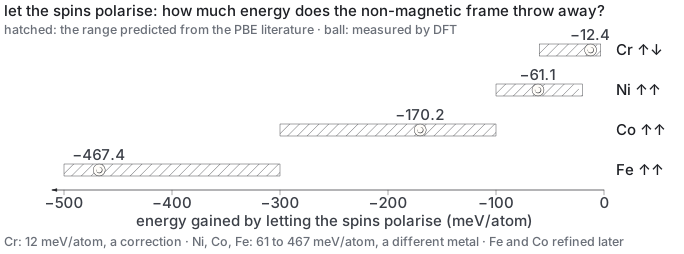
Is ignoring magnetism a small error for chromium but large for iron, nickel, cobalt?
Yes. Magnetism is worth 12 meV/atom in chromium but 61 to 467 meV/atom in nickel, cobalt and iron.
In the log: E219 — pre-registered before any of them runs (2026-09-21 16:2x)
confirmedDate 2026-09-21 16:2x, as written in the logrung 4 · DFT0 predictions · 1 result paragraphEXPERIMENTS.md lines 14103–14106, lines 14108–14117, lines 14709–14726
What E216 did and how it came out, drawn from this record and the files it names (book/assets/diagrams/exp/E216.svg).
Pre-registration
The pre-registration, as written
E216–E219 — pre-registered before any of them runs (2026-09-21 16:2x)
Queued as one pw.x-at-a-time chain behind the fcc references (runs/e216_e219_chain.sh),
cheapest first. Each is the first number of its kind in this project.
E216 — the magnetic energy the frame throws away, per element. Cr (bcc, antiferro-
magnetic: two sublattices with opposite starting moments), Fe (bcc, ferromagnetic), Ni and Co
(fcc, ferromagnetic): nspin = 1 and nspin = 2, three volumes each, parabola minima,
ΔE_mag = E_min(spin) − E_min(non-spin), 60/720 Ry, MV 0.02, same pseudopotentials. This
turns "the ladder is spin-blind" from a sentence into four numbers. Predictions (PBE
literature): Fe −400 to −600 meV/atom (the non-magnetic bcc Fe frame is grossly
wrong); Co (fcc) −150 to −250; Ni −30 to −80; Cr (AFM) −5 to −40 (PBE
overstabilises AFM Cr, moment ≈ 1 μB). Bars: Fe < −300; Co −100 to −300; Ni −20 to −100;
Cr −3 to −60. Any element outside its bar is a finding about the pseudopotential or the
cell, not about magnetism.
Results
EXPERIMENTS.md · line 14709
E216 RESULT — the magnetic blind spot is four numbers now (2026-09-21 18:0x real time)
element
lattice
a₀ non-spin
a₀ spin
ΔE_mag = E(spin) − E(non-spin)
moment
bar
Cr
bcc, AFM
2.8575
2.8791 (exp 2.884)
−12.4 meV/atom
1.1 μB/atom, net 0
−3 to −60
✓
Fe
bcc, FM
2.7269 (outside bracket)
2.8382 (exp 2.866)
−460.2
2.2 μB/atom
< −300
✓
Ni
fcc, FM
3.5240
3.5322 (exp 3.524)
−61.1
0.66 μB/atom
−20 to −100
✓
Co
fcc, FM
3.4274 (outside bracket)
3.5219 (exp 3.545)
−172.6
1.7 μB/atom
−100 to −300
✓
All four predictions confirmed. The spin-polarised lattice constants land on experiment to
0.3–1 %; the non-spin ones for Fe and Co collapse so far (3.9 % and 2.7 %) that their minima
fell below the 0.97–1.03 brackets and are extrapolated — a lower-bracket rerun is queued so
those two E_min are bracketed too (the spin minima, which carry the physics, are inside).
What it means for the ladder: the non-spin frame is off by 12 meV/atom on chromium, which
SOB20 also judged small and neglected; it is off by 60–460 meV/atom on Ni, Co and Fe, which
is not a correction but a different metal. Any fcc port containing those three needs a
spin-polarised reference set from the first cell, and spec.py now carries these numbers
where it used to say "spin-blind".
The full record
This entry is written in 3 separate places in the log, shown here in log order.
EXPERIMENTS.md · lines 14103–14106
E216–E219 — pre-registered before any of them runs (2026-09-21 16:2x)
Queued as one pw.x-at-a-time chain behind the fcc references (runs/e216_e219_chain.sh),
cheapest first. Each is the first number of its kind in this project.
EXPERIMENTS.md · lines 14108–14117
E216 — the magnetic energy the frame throws away, per element. Cr (bcc, antiferro-
magnetic: two sublattices with opposite starting moments), Fe (bcc, ferromagnetic), Ni and Co
(fcc, ferromagnetic): nspin = 1 and nspin = 2, three volumes each, parabola minima,
ΔE_mag = E_min(spin) − E_min(non-spin), 60/720 Ry, MV 0.02, same pseudopotentials. This
turns "the ladder is spin-blind" from a sentence into four numbers. Predictions (PBE
literature): Fe −400 to −600 meV/atom (the non-magnetic bcc Fe frame is grossly
wrong); Co (fcc) −150 to −250; Ni −30 to −80; Cr (AFM) −5 to −40 (PBE
overstabilises AFM Cr, moment ≈ 1 μB). Bars: Fe < −300; Co −100 to −300; Ni −20 to −100;
Cr −3 to −60. Any element outside its bar is a finding about the pseudopotential or the
cell, not about magnetism.
EXPERIMENTS.md · lines 14709–14726
E216 RESULT — the magnetic blind spot is four numbers now (2026-09-21 18:0x real time)
element
lattice
a₀ non-spin
a₀ spin
ΔE_mag = E(spin) − E(non-spin)
moment
bar
Cr
bcc, AFM
2.8575
2.8791 (exp 2.884)
−12.4 meV/atom
1.1 μB/atom, net 0
−3 to −60
✓
Fe
bcc, FM
2.7269 (outside bracket)
2.8382 (exp 2.866)
−460.2
2.2 μB/atom
< −300
✓
Ni
fcc, FM
3.5240
3.5322 (exp 3.524)
−61.1
0.66 μB/atom
−20 to −100
✓
Co
fcc, FM
3.4274 (outside bracket)
3.5219 (exp 3.545)
−172.6
1.7 μB/atom
−100 to −300
✓
All four predictions confirmed. The spin-polarised lattice constants land on experiment to
0.3–1 %; the non-spin ones for Fe and Co collapse so far (3.9 % and 2.7 %) that their minima
fell below the 0.97–1.03 brackets and are extrapolated — a lower-bracket rerun is queued so
those two E_min are bracketed too (the spin minima, which carry the physics, are inside).
What it means for the ladder: the non-spin frame is off by 12 meV/atom on chromium, which
SOB20 also judged small and neglected; it is off by 60–460 meV/atom on Ni, Co and Fe, which
is not a correction but a different metal. Any fcc port containing those three needs a
spin-polarised reference set from the first cell, and spec.py now carries these numbers
where it used to say "spin-blind".
Related entries
E219 — E216–E219 — pre-registered before any of them runs (2026-09-21 16:2x)