Does the DFT set-up reproduce known facts about Ni3Al, its first fcc alloy?
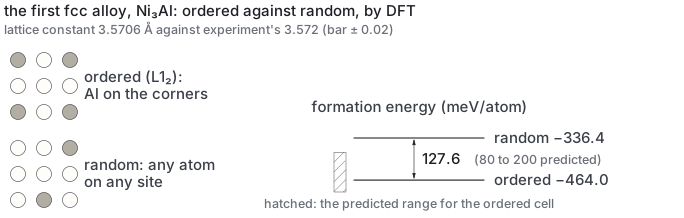
Yes. Lattice constant 3.5706 A against experiment's 3.572, and ordering lowers the energy by 127.6 meV/atom.
In the log: E216–E219 — pre-registered before any of them runs (2026-09-21 16:2x)
confirmedDate 2026-09-21 16:2x, as written in the logrung 4 · DFT0 predictions · 2 result paragraphsEXPERIMENTS.md lines 14103–14106, lines 14130–14138, lines 14728–14748, lines 15393–15397, lines 15936–15943
What E218 did and how it came out, drawn from this record and the files it names (book/assets/diagrams/exp/E218.svg).
Pre-registration
The pre-registration, as written
E216–E219 — pre-registered before any of them runs (2026-09-21 16:2x)
Queued as one pw.x-at-a-time chain behind the fcc references (runs/e216_e219_chain.sh),
cheapest first. Each is the first number of its kind in this project.
E218 — the first fcc alloy through rung 4: Ni₃Al. (a) The L1₂ 4-atom cell, volume scan
0.98/1.00/1.02 × 3.572 Å, parabola minimum; (b) a random Ni₂₄Al₈ 2×2×2 fcc cell at that a₀.
Formation energies against the fcc Ni and Al references from refs_fcc_fit.json. Non-spin,
stated: Ni₃Al is a weak itinerant ferromagnet and the spin correction is expected at the
few-meV level, unlike E216's elements. Predictions (PBE literature): a₀ 3.56–3.58 Å
(experiment 3.572); E_form(L1₂) −440 ± 50 meV/atom; ΔE_order = E_random − E_L1₂
+80 to +200 meV/atom — an order of magnitude larger than Mo–Ta's 81, which is why
Ni₃Al orders at its melting point and Mo–Ta does not order at all in practice. Bars:
a₀ ±0.02 Å; E_form −380 to −500; ΔE_order > +50.
E218, provisional. L1₂ Ni₃Al: a₀ = 3.5706 Å (experiment 3.572; bar ±0.02 ✓);
E_form(L1₂) = −559.4 meV/atom against a bar of −380 to −500 — not scored: the L1₂ cell
ran at the corrected 80 Ry while its fcc Ni reference is still the 60 Ry one, so the
difference carries the cutoff mismatch the standard change was made to remove. It is re-read
when the 80 Ry Ni reference lands (queued). The random Ni₂₄Al₈ cell was at SCF iteration 13
of a slow convergence (β = 0.1, 6 min per iteration) when I restarted the chain and killed it;
it is re-queued to finish, and the ordering energy waits on it.
The second sampler on v5 — independent confirmation. The agent's from-scratch Metropolis
on a fast in-process evaluator of v5 (71× faster than ECEPredictor, validated to 10⁻⁶
eV/atom against it) on the same 6³ cell, 3000 → 100 → 3000 K, 85 K grid: v5's transition
at 953 K (cooling, both estimators) and 1038 K (heating, dE/dT), reaching the exact B2 floor
by 441 K; its control on the exact NN Ising: 1294 K on both legs and both estimators
(numpy control 1300–1320, thermodynamic 1410). pyeCE's nominal 441–526 K is therefore low by
2.0× on v5 itself, and the agent found the same mechanism in the source independently.
Three independent routes now give the same factor: E215 (2.1–2.3 at 170 K physical
resolution), the sampler object's own swap delta (0.500 exactly), and a second sampler
(1.9–2.0). T_c(Mo–Ta, v5, physical) ≈ 950–1050 K. The agent's further point stands too:
v5's Hamiltonian orders ~22 % below a nearest-neighbour Ising of the same ordering energy
under the same sampler, so the referee's "not nearest-neighbour" finding is real and was
never the whole gap.
Results
EXPERIMENTS.md · line 15393
E218's random Ni₃Al cell stopped again: plain mixing at β 0.05 plateaued at 4.3–4.5 × 10⁻⁴
Ry for ten iterations after 70 (six hours) against a 10⁻⁷ target. Third setting β 0.02 with a
16-step Broyden history and conv 10⁻⁶ Ry (0.4 meV per cell, ten times finer than any formation
energy read from it); re-queued behindE221 and E222 so the kinetics anchor and the Cr–Ta
test are no longer held by one hard cell.
EXPERIMENTS.md · line 15936
E218 RESULT (A100). Ni₃Al L1₂ −464.0, random 2×2×2 −336.4 → ΔE_order 127.6 meV/atom.
The rung-1 floor.E223's walk left 24 of 32 finds — including the search's top three — at
"no transition found above 100 K" and therefore p = None: the sweep stopped at 100 K and the window
starts at 90 K, so an alloy that never orders could not pass by construction. Fixed (c9250be):
the cooling leg continues to 80 and 60 K, and "no transition down to a floor below the window" is
bounded at the floor with the step above it as σ and scored by the same passes_requirement
(p_no_ordering 0.78 at 60 ± 20 K with the ladder's conservative T-scale).
The full record
This entry is written in 5 separate places in the log, shown here in log order.
EXPERIMENTS.md · lines 14103–14106
E216–E219 — pre-registered before any of them runs (2026-09-21 16:2x)
Queued as one pw.x-at-a-time chain behind the fcc references (runs/e216_e219_chain.sh),
cheapest first. Each is the first number of its kind in this project.
EXPERIMENTS.md · lines 14130–14138
E218 — the first fcc alloy through rung 4: Ni₃Al. (a) The L1₂ 4-atom cell, volume scan
0.98/1.00/1.02 × 3.572 Å, parabola minimum; (b) a random Ni₂₄Al₈ 2×2×2 fcc cell at that a₀.
Formation energies against the fcc Ni and Al references from refs_fcc_fit.json. Non-spin,
stated: Ni₃Al is a weak itinerant ferromagnet and the spin correction is expected at the
few-meV level, unlike E216's elements. Predictions (PBE literature): a₀ 3.56–3.58 Å
(experiment 3.572); E_form(L1₂) −440 ± 50 meV/atom; ΔE_order = E_random − E_L1₂
+80 to +200 meV/atom — an order of magnitude larger than Mo–Ta's 81, which is why
Ni₃Al orders at its melting point and Mo–Ta does not order at all in practice. Bars:
a₀ ±0.02 Å; E_form −380 to −500; ΔE_order > +50.
EXPERIMENTS.md · lines 14728–14748
E218, provisional. L1₂ Ni₃Al: a₀ = 3.5706 Å (experiment 3.572; bar ±0.02 ✓);
E_form(L1₂) = −559.4 meV/atom against a bar of −380 to −500 — not scored: the L1₂ cell
ran at the corrected 80 Ry while its fcc Ni reference is still the 60 Ry one, so the
difference carries the cutoff mismatch the standard change was made to remove. It is re-read
when the 80 Ry Ni reference lands (queued). The random Ni₂₄Al₈ cell was at SCF iteration 13
of a slow convergence (β = 0.1, 6 min per iteration) when I restarted the chain and killed it;
it is re-queued to finish, and the ordering energy waits on it.
The second sampler on v5 — independent confirmation. The agent's from-scratch Metropolis
on a fast in-process evaluator of v5 (71× faster than ECEPredictor, validated to 10⁻⁶
eV/atom against it) on the same 6³ cell, 3000 → 100 → 3000 K, 85 K grid: v5's transition
at 953 K (cooling, both estimators) and 1038 K (heating, dE/dT), reaching the exact B2 floor
by 441 K; its control on the exact NN Ising: 1294 K on both legs and both estimators
(numpy control 1300–1320, thermodynamic 1410). pyeCE's nominal 441–526 K is therefore low by
2.0× on v5 itself, and the agent found the same mechanism in the source independently.
Three independent routes now give the same factor: E215 (2.1–2.3 at 170 K physical
resolution), the sampler object's own swap delta (0.500 exactly), and a second sampler
(1.9–2.0). T_c(Mo–Ta, v5, physical) ≈ 950–1050 K. The agent's further point stands too:
v5's Hamiltonian orders ~22 % below a nearest-neighbour Ising of the same ordering energy
under the same sampler, so the referee's "not nearest-neighbour" finding is real and was
never the whole gap.
EXPERIMENTS.md · lines 15393–15397
E218's random Ni₃Al cell stopped again: plain mixing at β 0.05 plateaued at 4.3–4.5 × 10⁻⁴
Ry for ten iterations after 70 (six hours) against a 10⁻⁷ target. Third setting β 0.02 with a
16-step Broyden history and conv 10⁻⁶ Ry (0.4 meV per cell, ten times finer than any formation
energy read from it); re-queued behindE221 and E222 so the kinetics anchor and the Cr–Ta
test are no longer held by one hard cell.
EXPERIMENTS.md · lines 15936–15943
E218 RESULT (A100). Ni₃Al L1₂ −464.0, random 2×2×2 −336.4 → ΔE_order 127.6 meV/atom.
The rung-1 floor.E223's walk left 24 of 32 finds — including the search's top three — at
"no transition found above 100 K" and therefore p = None: the sweep stopped at 100 K and the window
starts at 90 K, so an alloy that never orders could not pass by construction. Fixed (c9250be):
the cooling leg continues to 80 and 60 K, and "no transition down to a floor below the window" is
bounded at the floor with the step above it as σ and scored by the same passes_requirement
(p_no_ordering 0.78 at 60 ± 20 K with the ladder's conservative T-scale).
Related entries
E216 — E219 — pre-registered before any of them runs (2026-09-21 16:2x)
E219 — E216–E219 — pre-registered before any of them runs (2026-09-21 16:2x)
E215 — second attempt: the gate failed, and the failure is the finding (2026-09-21 17:4x)
E221 — the alloy vacancy anchor, pre-registered (2026-09-21 21:1x; queued after E217 and the…