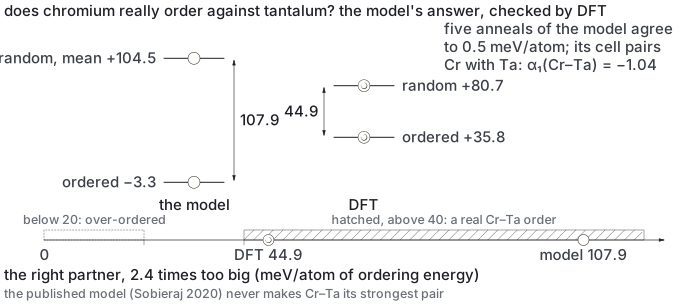
Does chromium order against tantalum, as the energy model says, though a published model disagrees?
Yes. DFT gives an ordering energy of 44.9 meV/atom, though the model's 107.9 is 2.4 times too big.
In the log: the Cr–Ta disagreement, pre-registered (2026-09-22 02:0x; queued behind E215c)
confirmedDate 2026-09-22 02:0x, as written in the logrung 4 · DFT4 predictions · 2 result paragraphsEXPERIMENTS.md lines 15274–15297, lines 15363–15374, lines 15630–15649
What E222 did and how it came out, drawn from this record and the files it names (book/assets/diagrams/exp/E222.svg).
Pre-registration
(1)
v5's annealed ground state is Cr–Ta B2-like: α₁(Cr–Ta) < −0.8 in the
54-atom cell, with Ti and W taking the remaining sites; the five starts agree within 10
meV/atom.
confirmedearlier …
(2)
ΔE_order(v5) = E_random − E_ground is > 60 meV/atom (the 1461 K ODTT
implies ~50 meV by the Bragg–Williams bound, and v5 orders 22–27 % below an NN Ising of its
own ΔE).
confirmed(107 …
(3)
The decisive one: ΔE_order(DFT) > 40 meV/atom — DFT confirms a deep Cr–Ta
ordering and v5 is right where SOB20's CE is not, the first time this project's model would
beat a published CE on its own ground.
confirmed44 …
(4)
If ΔE_order(DFT) < 20 meV/atom, v5 over-orders
Cr–Ta and every Cr-bearing number on this scorecard — including E210b's 1076 K on the Cr
quinary, which agreed with SOB20 to 8 % — is suspect for the right answer by the wrong
mechanism; the correction goes into v7. Between 20 and 40 the test is inconclusive and the
next step is the same pair in the quinary, where SOB20's Cr–V ordering competes.
Both rows enter data/dft and the v7 refit either way.
v5 and SOB20's CE disagree about one pair, not a temperature scale: on Cr₂₅Ta₂₅Ti₂₅W₂₅ v5
gives an ODTT of 1461 K with α₁(Cr–Ta) = −1.03 where SOB20 give 500 K and report
their strongest ordering between Cr and V, which this alloy does not contain. E217 has
validated v5's Cr energetics at the random-solution level (DFT +78.2 vs v5 +63.1 meV/atom on
the Cr quinary) and says nothing about the ordered state. runs/e222_chain.sh: anneal v5
from five independent starts to a 54-atom ground state (ground_state.py, 10 K floor), write
it and a random decoration of the same composition (random_cell.py, new) as DFT cells at
the store's convention — ideal bcc sites at the Vegard constant, never pyeCE's 3.2935 Å
mapping lattice — and run both through rung 4 at 60/720 Ry, k 4³.
Predictions. (1) v5's annealed ground state is Cr–Ta B2-like: α₁(Cr–Ta) < −0.8 in the
54-atom cell, with Ti and W taking the remaining sites; the five starts agree within 10
meV/atom. (2) ΔE_order(v5) = E_random − E_ground is > 60 meV/atom (the 1461 K ODTT
implies ~50 meV by the Bragg–Williams bound, and v5 orders 22–27 % below an NN Ising of its
own ΔE). (3) The decisive one: ΔE_order(DFT) > 40 meV/atom — DFT confirms a deep Cr–Ta
ordering and v5 is right where SOB20's CE is not, the first time this project's model would
beat a published CE on its own ground. (4) If ΔE_order(DFT) < 20 meV/atom, v5 over-orders
Cr–Ta and every Cr-bearing number on this scorecard — including E210b's 1076 K on the Cr
quinary, which agreed with SOB20 to 8 % — is suspect for the right answer by the wrong
mechanism; the correction goes into v7. Between 20 and 40 the test is inconclusive and the
next step is the same pair in the quinary, where SOB20's Cr–V ordering competes.
Both rows enter data/dft and the v7 refit either way.
Results
EXPERIMENTS.md · line 15363
E222 anneal complete; prediction (1) confirmed, (2) confirmed. Five independent starts
agree to 0.5 meV/atom (ground −3.3, random +104.5 ± 10.8): ΔE_order(v5) = +107.9
meV/atom, against the pre-registered > 60. The annealed 54-atom cell has shell-1
α(Cr–Ta) = −1.040 (bar < −0.8), with Ta–W −0.48 as a second ordering and Ta–Ti +0.56
avoiding — Cr–Ta B2-like exactly as predicted. Two caveats travel with the DFT pair now
queued: the 54-site cell cannot host the periodicity the 432-site sweep found (its floor was
−17.3 meV/atom against this cell's −3.3, so ΔE_order here is a lower bound on the model's
own), and the random counterpart is one 54-site draw whose shell-1 α(Cr–Ta) is −0.343 —
energetically a typical draw (v5 +112.7 against a random mean +104.5 ± 10.8) but not a
correlation-free reference, so ΔE_order(DFT) from this pair is likewise a lower bound. Both
push the measurement toward the "v5 over-orders" verdict, so a DFT ΔE_order above 40 meV/atom
is the stronger reading of prediction (3), not the weaker one.
EXPERIMENTS.md · line 15630
E222 RESULT — Cr does order against Ta; v5 has the pair right and the size 2.4× too big (2026-09-22 19:0x)
Both cells through rung 4 at 60/720 Ry, k 4³, 54 atoms at Vegard a = 3.168 Å.
DFT: v5's annealed ground state +35.8 meV/atom, the random twin +80.7 → ΔE_order(DFT) =
+44.9 meV/atom. v5 said −3.3 / +112.7 (mean +104.5) → 107.9. Scored: (1) confirmed earlier
(α(Cr–Ta) −1.04); (2) confirmed (107.9 > 60); (3) confirmed — 44.9 > 40, and both stated
caveats (a 54-site cell that cannot hold the 432-site ordering; a random twin with residual
α(Cr–Ta) −0.34) push this number down, so it is a lower bound on the true ordering energy;
(4) not triggered. The reading: DFT agrees with v5 that chromium orders against tantalum in
Cr–Ta–Ti–W — the pair Sobieraj's CE never has as its strongest — and disagrees with v5 on the
size, 45 against 108, the same ~2.5× overstatement E211 measured on MoNbTaVW (74 vs 28).
Scaling v5's 1461 K by the ordering-energy ratio (Bragg–Williams proportionality, an estimate
not a measurement) puts the DFT-implied transition near 600 K — within one 100 K grid step
of Sobieraj's 500 K. So the 2.92× outlier on the scorecard was not a wrong pair but a
magnitude error on one pair, and the two published-vs-v5 disagreements collapse to one
statement: v5 orders the right partners and over-orders Cr–Ta (and the quinary) by ~2.5×.
Both cells are in the store and enter the next refit; the v7-series refit that fixes the
Cr–Ta magnitude without breaking the RHEA frame is now the concrete flywheel target. On the
random-solution side v5 sits +32 meV/atom above DFT here and −15 below on E217's Cr quinary —
a ±30 meV scatter on Cr-bearing random cells, not a bias.
The full record
This entry is written in 3 separate places in the log, shown here in log order.
v5 and SOB20's CE disagree about one pair, not a temperature scale: on Cr₂₅Ta₂₅Ti₂₅W₂₅ v5
gives an ODTT of 1461 K with α₁(Cr–Ta) = −1.03 where SOB20 give 500 K and report
their strongest ordering between Cr and V, which this alloy does not contain. E217 has
validated v5's Cr energetics at the random-solution level (DFT +78.2 vs v5 +63.1 meV/atom on
the Cr quinary) and says nothing about the ordered state. runs/e222_chain.sh: anneal v5
from five independent starts to a 54-atom ground state (ground_state.py, 10 K floor), write
it and a random decoration of the same composition (random_cell.py, new) as DFT cells at
the store's convention — ideal bcc sites at the Vegard constant, never pyeCE's 3.2935 Å
mapping lattice — and run both through rung 4 at 60/720 Ry, k 4³.
Predictions. (1) v5's annealed ground state is Cr–Ta B2-like: α₁(Cr–Ta) < −0.8 in the
54-atom cell, with Ti and W taking the remaining sites; the five starts agree within 10
meV/atom. (2) ΔE_order(v5) = E_random − E_ground is > 60 meV/atom (the 1461 K ODTT
implies ~50 meV by the Bragg–Williams bound, and v5 orders 22–27 % below an NN Ising of its
own ΔE). (3) The decisive one: ΔE_order(DFT) > 40 meV/atom — DFT confirms a deep Cr–Ta
ordering and v5 is right where SOB20's CE is not, the first time this project's model would
beat a published CE on its own ground. (4) If ΔE_order(DFT) < 20 meV/atom, v5 over-orders
Cr–Ta and every Cr-bearing number on this scorecard — including E210b's 1076 K on the Cr
quinary, which agreed with SOB20 to 8 % — is suspect for the right answer by the wrong
mechanism; the correction goes into v7. Between 20 and 40 the test is inconclusive and the
next step is the same pair in the quinary, where SOB20's Cr–V ordering competes.
Both rows enter data/dft and the v7 refit either way.
EXPERIMENTS.md · lines 15363–15374
E222 anneal complete; prediction (1) confirmed, (2) confirmed. Five independent starts
agree to 0.5 meV/atom (ground −3.3, random +104.5 ± 10.8): ΔE_order(v5) = +107.9
meV/atom, against the pre-registered > 60. The annealed 54-atom cell has shell-1
α(Cr–Ta) = −1.040 (bar < −0.8), with Ta–W −0.48 as a second ordering and Ta–Ti +0.56
avoiding — Cr–Ta B2-like exactly as predicted. Two caveats travel with the DFT pair now
queued: the 54-site cell cannot host the periodicity the 432-site sweep found (its floor was
−17.3 meV/atom against this cell's −3.3, so ΔE_order here is a lower bound on the model's
own), and the random counterpart is one 54-site draw whose shell-1 α(Cr–Ta) is −0.343 —
energetically a typical draw (v5 +112.7 against a random mean +104.5 ± 10.8) but not a
correlation-free reference, so ΔE_order(DFT) from this pair is likewise a lower bound. Both
push the measurement toward the "v5 over-orders" verdict, so a DFT ΔE_order above 40 meV/atom
is the stronger reading of prediction (3), not the weaker one.
EXPERIMENTS.md · lines 15630–15649
E222 RESULT — Cr does order against Ta; v5 has the pair right and the size 2.4× too big (2026-09-22 19:0x)
Both cells through rung 4 at 60/720 Ry, k 4³, 54 atoms at Vegard a = 3.168 Å.
DFT: v5's annealed ground state +35.8 meV/atom, the random twin +80.7 → ΔE_order(DFT) =
+44.9 meV/atom. v5 said −3.3 / +112.7 (mean +104.5) → 107.9. Scored: (1) confirmed earlier
(α(Cr–Ta) −1.04); (2) confirmed (107.9 > 60); (3) confirmed — 44.9 > 40, and both stated
caveats (a 54-site cell that cannot hold the 432-site ordering; a random twin with residual
α(Cr–Ta) −0.34) push this number down, so it is a lower bound on the true ordering energy;
(4) not triggered. The reading: DFT agrees with v5 that chromium orders against tantalum in
Cr–Ta–Ti–W — the pair Sobieraj's CE never has as its strongest — and disagrees with v5 on the
size, 45 against 108, the same ~2.5× overstatement E211 measured on MoNbTaVW (74 vs 28).
Scaling v5's 1461 K by the ordering-energy ratio (Bragg–Williams proportionality, an estimate
not a measurement) puts the DFT-implied transition near 600 K — within one 100 K grid step
of Sobieraj's 500 K. So the 2.92× outlier on the scorecard was not a wrong pair but a
magnitude error on one pair, and the two published-vs-v5 disagreements collapse to one
statement: v5 orders the right partners and over-orders Cr–Ta (and the quinary) by ~2.5×.
Both cells are in the store and enter the next refit; the v7-series refit that fixes the
Cr–Ta magnitude without breaking the RHEA frame is now the concrete flywheel target. On the
random-solution side v5 sits +32 meV/atom above DFT here and −15 below on E217's Cr quinary —
a ±30 meV scatter on Cr-bearing random cells, not a bias.
Related entries
E215c — RESULT — the factor of two is 2.000 ± 0.03 (2026-09-22 03:2x)
E217 — E216–E219 — pre-registered before any of them runs (2026-09-21 16:2x)
E210b — the nine-system scorecard by the second sampler, pre-registered (2026-09-21 19:1x)
E211 — ground states by search, then DFT on each (2026-09-20 23:42; queued after E207, ahead of…