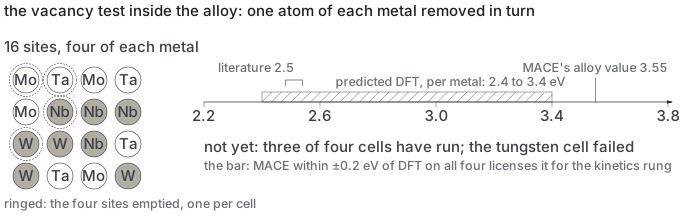
Does the machine-learned potential get vacancy energies right inside the MoNbTaW alloy?
Not yet. Three of four DFT cells have finished; the tungsten cell failed and no result is written.
In the log: the alloy vacancy anchor, pre-registered (2026-09-21 21:1x; queued after E217 and the E218 finish)
runningDate 2026-09-21 21:1x, as written in the logrung 4 · DFT5 predictions · 0 result paragraphsEXPERIMENTS.md lines 15022–15073, lines 16362–16374
What E221 did and how it came out, drawn from this record and the files it names (book/assets/diagrams/exp/E221.svg).
Pre-registration
(0)
, Cr +72 (prior +394 ✗) — and the residual after the
offsets is RMS 37 meV/atom, max 208, far beyond a settings difference (ACWF-scale
disagreement between PBE codes is 1–3 meV). Cr's implied fcc-minus-ground-state energy of
72 meV is a third of the physical 0.39 eV, and Fe/Cr-rich fcc cells are exactly where
spin-polarised relaxations land in different magnetic minima (NM / FM / AFM fcc Cr and Fe
differ by 0.1–0.4 eV/atom); the two sets' "same decoration" is not the same state. Decision:
the sets are NOT merged. fcc v1 stays Waters-only; a Li-only fcc model (ece_fcc_li_v1,
seven species incl. Co and Cu, Li's own convention) is queued behind it; the two are then
compared on ORDERING energies — differences between decorations at fixed composition, which
no reference enters — on shared compositions, the reference-free cross-check. Open: which
magnetic states each set's Cr/Fe cells sit in (Waters carries per-atom moments in
relaxed_structures.full.json; Li carries magmom); to be read before either model is
believed on Cr- or Fe-rich fcc.
no verdict written against it
(1)
DFT E_f per species
2.4–3.4 eV, Nb/Ta sites below Mo/W (the easy species dominate SNAP's effective 2.5);
no verdict written against it
(2)
DFT E_f_eff(1000 K) 2.5–3.0 eV;
no verdict written against it
(3)
MACE − DFT within ±0.2 eV on all four species
licenses MACE on this basis — trust_kinetics may then be switched on with the measured
residual as the correction, and SNAP's 2.5 is the number that is off; > +0.3 eV on any
species keeps trust off and the residual becomes the correction the rung needs. About 3 h
of pw.x; runs/e221_chain.sh, runs/e221_alloy_vacancy_anchor/results.json.
Li et al. 2024, fcc half imported (2026-09-21 21:3x). scripts/expansion/import_li2024.py --lattice fcc --drop Mn: 9,633 rows of 2–64 atoms (ordered 2–8 and SQS 27/64) in Co, Fe,
Cr, Ni, Si, Al, Cu after dropping every Mn-bearing row (25,746; Mn is outside the element
universe), 2,228 above 0.5 eV of the hull, 2,537 whose internal relaxation exceeded 0.10 Å
(measured by mapping the relaxed cell back onto the initial one and removing the affine
strain) and 281 whose volume moved more than 20 %. Their Ef_per_atom is against the most
stable unary of each element, and the set holds no pure fcc Fe/Cr/Co/Si to re-reference
with; the rows keep that convention (reference: most_stable_unaries) — a cluster expansion
absorbs a linear-in-composition offset exactly in its point terms, so a fit on Li alone is
unaffected, and joining Li to Waters needs the per-element offsets c_i in E_Li − E_Waters =
Σ x_i c_i. scripts/expansion/reference_offsets.py fits them on decorations the two sets
share (StructureMatcher on the primitive cells, elements Ni Fe Cr Al Si) and reports the
residual — the two codes' settings disagreement — beside the OQMD prior (Fe +161, Cr +394,
Si +537, Ni 0, Al 0 meV/atom). Running. Plan: fcc v1 = Waters alone (fitting); v2 = Waters +
Li fcc on nine species (Ni Fe Cr Al Ti Si Co Cu — Ti from Waters, Co/Cu from Li), Li rows
shifted by the fitted offsets, scored on the same held-out systems plus Co- and Cu-bearing
ones; nothing enters the ladder before the pre-registered bars hold.
Reference offsets between the two fcc sets (2026-09-21 21:5x): the sets do not merge on a
linear offset. 965 identical decorations (StructureMatcher, Ni Fe Cr Al Si). Fitted
E_Li − E_Waters = Σ x_i c_i: Fe +155 meV/atom (OQMD fcc−bcc prior +161 ✓), Si +466 (prior
+537), Al +10 (0 ✓), Ni −30
no verdict written against it
(16)
+ μ_X with μ_X the standard pure bcc reference
(refs_v3_fit.json); MACE-MPA-0 on the identical cells with its own relaxed pure references;
the 1000 K Boltzmann-effective value on both sides (boltzmann_effective, the rung's own
estimator). Smoke-tested on the fake pw.x. Predictions:
no verdict written against it
The pre-registration, as written
E221 — the alloy vacancy anchor, pre-registered (2026-09-21 21:1x; queued after E217 and the E218 finish)
E219's falsified branch: MACE is within 0.06 eV of DFT on pure Mo, so the rung's MoNbTaW value
(MACE E_f_eff 3.55 eV against SNAP's 2.48–2.54) is alloy-specific and needs an alloy anchor.
scripts/dft/e221_alloy_vacancy_anchor.py: MoNbTaW on the 16 sites of a 2×2×2 bcc cell at
Vegard a = 3.2555 Å (four of each species, seed 0), k 7³, 60/720 Ry; the perfect cell and four
15-atom cells — the first site of each species removed — relaxed at fixed cell; E_f(X) =
E(15, X removed) − E(16) + μ_X with μ_X the standard pure bcc reference
(refs_v3_fit.json); MACE-MPA-0 on the identical cells with its own relaxed pure references;
the 1000 K Boltzmann-effective value on both sides (boltzmann_effective, the rung's own
estimator). Smoke-tested on the fake pw.x. Predictions: (1) DFT E_f per species
2.4–3.4 eV, Nb/Ta sites below Mo/W (the easy species dominate SNAP's effective 2.5);
(2) DFT E_f_eff(1000 K) 2.5–3.0 eV; (3) MACE − DFT within ±0.2 eV on all four species
licenses MACE on this basis — trust_kinetics may then be switched on with the measured
residual as the correction, and SNAP's 2.5 is the number that is off; > +0.3 eV on any
species keeps trust off and the residual becomes the correction the rung needs. About 3 h
of pw.x; runs/e221_chain.sh, runs/e221_alloy_vacancy_anchor/results.json.
Li et al. 2024, fcc half imported (2026-09-21 21:3x).scripts/expansion/import_li2024.py --lattice fcc --drop Mn: 9,633 rows of 2–64 atoms (ordered 2–8 and SQS 27/64) in Co, Fe,
Cr, Ni, Si, Al, Cu after dropping every Mn-bearing row (25,746; Mn is outside the element
universe), 2,228 above 0.5 eV of the hull, 2,537 whose internal relaxation exceeded 0.10 Å
(measured by mapping the relaxed cell back onto the initial one and removing the affine
strain) and 281 whose volume moved more than 20 %. Their Ef_per_atom is against the most
stable unary of each element, and the set holds no pure fcc Fe/Cr/Co/Si to re-reference
with; the rows keep that convention (reference: most_stable_unaries) — a cluster expansion
absorbs a linear-in-composition offset exactly in its point terms, so a fit on Li alone is
unaffected, and joining Li to Waters needs the per-element offsets c_i in E_Li − E_Waters =
Σ x_i c_i. scripts/expansion/reference_offsets.py fits them on decorations the two sets
share (StructureMatcher on the primitive cells, elements Ni Fe Cr Al Si) and reports the
residual — the two codes' settings disagreement — beside the OQMD prior (Fe +161, Cr +394,
Si +537, Ni 0, Al 0 meV/atom). Running. Plan: fcc v1 = Waters alone (fitting); v2 = Waters +
Li fcc on nine species (Ni Fe Cr Al Ti Si Co Cu — Ti from Waters, Co/Cu from Li), Li rows
shifted by the fitted offsets, scored on the same held-out systems plus Co- and Cu-bearing
ones; nothing enters the ladder before the pre-registered bars hold.
Reference offsets between the two fcc sets (2026-09-21 21:5x): the sets do not merge on a
linear offset. 965 identical decorations (StructureMatcher, Ni Fe Cr Al Si). Fitted
E_Li − E_Waters = Σ x_i c_i: Fe +155 meV/atom (OQMD fcc−bcc prior +161 ✓), Si +466 (prior
+537), Al +10 (0 ✓), Ni −30 (0), Cr +72 (prior +394 ✗) — and the residual after the
offsets is RMS 37 meV/atom, max 208, far beyond a settings difference (ACWF-scale
disagreement between PBE codes is 1–3 meV). Cr's implied fcc-minus-ground-state energy of
72 meV is a third of the physical 0.39 eV, and Fe/Cr-rich fcc cells are exactly where
spin-polarised relaxations land in different magnetic minima (NM / FM / AFM fcc Cr and Fe
differ by 0.1–0.4 eV/atom); the two sets' "same decoration" is not the same state. Decision:
the sets are NOT merged. fcc v1 stays Waters-only; a Li-only fcc model (ece_fcc_li_v1,
seven species incl. Co and Cu, Li's own convention) is queued behind it; the two are then
compared on ORDERING energies — differences between decorations at fixed composition, which
no reference enters — on shared compositions, the reference-free cross-check. Open: which
magnetic states each set's Cr/Fe cells sit in (Waters carries per-atom moments in
relaxed_structures.full.json; Li carries magmom); to be read before either model is
believed on Cr- or Fe-rich fcc.
E221 partial — three of four vacancy cells; two predictions already decided.runs/e221_alloy_vacancy_anchor/results.json: DFT E_f (μ = pure bcc) Mo 3.36, Nb 4.31, Ta
4.16 eV; MACE 3.18 / 3.95 / 3.85; W's 15-atom relax never ran: the Colab session
dropped at 22:34 ("Session 'forager-qe' not found"), the first job's folder went with the old
VM, and the two retries produced empty output (failed 2026-09-23 22:38; attempts parked in
vac15_W_relax/colab_outage_2026-09-23/). (1) Falsified without W: Nb
and Ta lie above the 2.4–3.4 eV band and above Mo, the reverse of the predicted order. (3) The
licence is not granted: MACE − DFT is −0.17 / −0.36 / −0.31 eV, outside ±0.2 on two species,
so trust_kinetics stays off. MACE sits below DFT: it overstates vacancy supply, which makes
rung 3 err toward reaching a phase change. That is the conservative side for this goal. (2)
(E_f_eff at 1000 K) needs W and is not scored. DFT is above SNAP's 2.48–2.54 on every species
measured. Whether SNAP's figure uses the same chemical-potential convention has not been
checked, so that comparison is not scored. The W cell is re-queued behind E242 on the A100 (runs/e221w_chain.sh).
Results
No result paragraph for this entry was found in the log — it is pre-registered and has not reported.
The full record
This entry is written in 2 separate places in the log, shown here in log order.
EXPERIMENTS.md · lines 15022–15073
E221 — the alloy vacancy anchor, pre-registered (2026-09-21 21:1x; queued after E217 and the E218 finish)
E219's falsified branch: MACE is within 0.06 eV of DFT on pure Mo, so the rung's MoNbTaW value
(MACE E_f_eff 3.55 eV against SNAP's 2.48–2.54) is alloy-specific and needs an alloy anchor.
scripts/dft/e221_alloy_vacancy_anchor.py: MoNbTaW on the 16 sites of a 2×2×2 bcc cell at
Vegard a = 3.2555 Å (four of each species, seed 0), k 7³, 60/720 Ry; the perfect cell and four
15-atom cells — the first site of each species removed — relaxed at fixed cell; E_f(X) =
E(15, X removed) − E(16) + μ_X with μ_X the standard pure bcc reference
(refs_v3_fit.json); MACE-MPA-0 on the identical cells with its own relaxed pure references;
the 1000 K Boltzmann-effective value on both sides (boltzmann_effective, the rung's own
estimator). Smoke-tested on the fake pw.x. Predictions: (1) DFT E_f per species
2.4–3.4 eV, Nb/Ta sites below Mo/W (the easy species dominate SNAP's effective 2.5);
(2) DFT E_f_eff(1000 K) 2.5–3.0 eV; (3) MACE − DFT within ±0.2 eV on all four species
licenses MACE on this basis — trust_kinetics may then be switched on with the measured
residual as the correction, and SNAP's 2.5 is the number that is off; > +0.3 eV on any
species keeps trust off and the residual becomes the correction the rung needs. About 3 h
of pw.x; runs/e221_chain.sh, runs/e221_alloy_vacancy_anchor/results.json.
Li et al. 2024, fcc half imported (2026-09-21 21:3x).scripts/expansion/import_li2024.py --lattice fcc --drop Mn: 9,633 rows of 2–64 atoms (ordered 2–8 and SQS 27/64) in Co, Fe,
Cr, Ni, Si, Al, Cu after dropping every Mn-bearing row (25,746; Mn is outside the element
universe), 2,228 above 0.5 eV of the hull, 2,537 whose internal relaxation exceeded 0.10 Å
(measured by mapping the relaxed cell back onto the initial one and removing the affine
strain) and 281 whose volume moved more than 20 %. Their Ef_per_atom is against the most
stable unary of each element, and the set holds no pure fcc Fe/Cr/Co/Si to re-reference
with; the rows keep that convention (reference: most_stable_unaries) — a cluster expansion
absorbs a linear-in-composition offset exactly in its point terms, so a fit on Li alone is
unaffected, and joining Li to Waters needs the per-element offsets c_i in E_Li − E_Waters =
Σ x_i c_i. scripts/expansion/reference_offsets.py fits them on decorations the two sets
share (StructureMatcher on the primitive cells, elements Ni Fe Cr Al Si) and reports the
residual — the two codes' settings disagreement — beside the OQMD prior (Fe +161, Cr +394,
Si +537, Ni 0, Al 0 meV/atom). Running. Plan: fcc v1 = Waters alone (fitting); v2 = Waters +
Li fcc on nine species (Ni Fe Cr Al Ti Si Co Cu — Ti from Waters, Co/Cu from Li), Li rows
shifted by the fitted offsets, scored on the same held-out systems plus Co- and Cu-bearing
ones; nothing enters the ladder before the pre-registered bars hold.
Reference offsets between the two fcc sets (2026-09-21 21:5x): the sets do not merge on a
linear offset. 965 identical decorations (StructureMatcher, Ni Fe Cr Al Si). Fitted
E_Li − E_Waters = Σ x_i c_i: Fe +155 meV/atom (OQMD fcc−bcc prior +161 ✓), Si +466 (prior
+537), Al +10 (0 ✓), Ni −30 (0), Cr +72 (prior +394 ✗) — and the residual after the
offsets is RMS 37 meV/atom, max 208, far beyond a settings difference (ACWF-scale
disagreement between PBE codes is 1–3 meV). Cr's implied fcc-minus-ground-state energy of
72 meV is a third of the physical 0.39 eV, and Fe/Cr-rich fcc cells are exactly where
spin-polarised relaxations land in different magnetic minima (NM / FM / AFM fcc Cr and Fe
differ by 0.1–0.4 eV/atom); the two sets' "same decoration" is not the same state. Decision:
the sets are NOT merged. fcc v1 stays Waters-only; a Li-only fcc model (ece_fcc_li_v1,
seven species incl. Co and Cu, Li's own convention) is queued behind it; the two are then
compared on ORDERING energies — differences between decorations at fixed composition, which
no reference enters — on shared compositions, the reference-free cross-check. Open: which
magnetic states each set's Cr/Fe cells sit in (Waters carries per-atom moments in
relaxed_structures.full.json; Li carries magmom); to be read before either model is
believed on Cr- or Fe-rich fcc.
EXPERIMENTS.md · lines 16362–16374
E221 partial — three of four vacancy cells; two predictions already decided.runs/e221_alloy_vacancy_anchor/results.json: DFT E_f (μ = pure bcc) Mo 3.36, Nb 4.31, Ta
4.16 eV; MACE 3.18 / 3.95 / 3.85; W's 15-atom relax never ran: the Colab session
dropped at 22:34 ("Session 'forager-qe' not found"), the first job's folder went with the old
VM, and the two retries produced empty output (failed 2026-09-23 22:38; attempts parked in
vac15_W_relax/colab_outage_2026-09-23/). (1) Falsified without W: Nb
and Ta lie above the 2.4–3.4 eV band and above Mo, the reverse of the predicted order. (3) The
licence is not granted: MACE − DFT is −0.17 / −0.36 / −0.31 eV, outside ±0.2 on two species,
so trust_kinetics stays off. MACE sits below DFT: it overstates vacancy supply, which makes
rung 3 err toward reaching a phase change. That is the conservative side for this goal. (2)
(E_f_eff at 1000 K) needs W and is not scored. DFT is above SNAP's 2.48–2.54 on every species
measured. Whether SNAP's figure uses the same chemical-potential convention has not been
checked, so that comparison is not scored. The W cell is re-queued behind E242 on the A100 (runs/e221w_chain.sh).
Related entries
E217 — E216–E219 — pre-registered before any of them runs (2026-09-21 16:2x)
E218 — E216–E219 — pre-registered before any of them runs (2026-09-21 16:2x)
E219 — E216–E219 — pre-registered before any of them runs (2026-09-21 16:2x)
E242 — the survivor at DFT: does Mo₅₁Ti₃₈W₃Ta₃ order? (pre-registered 2026-09-23 22:0x)